Loading…
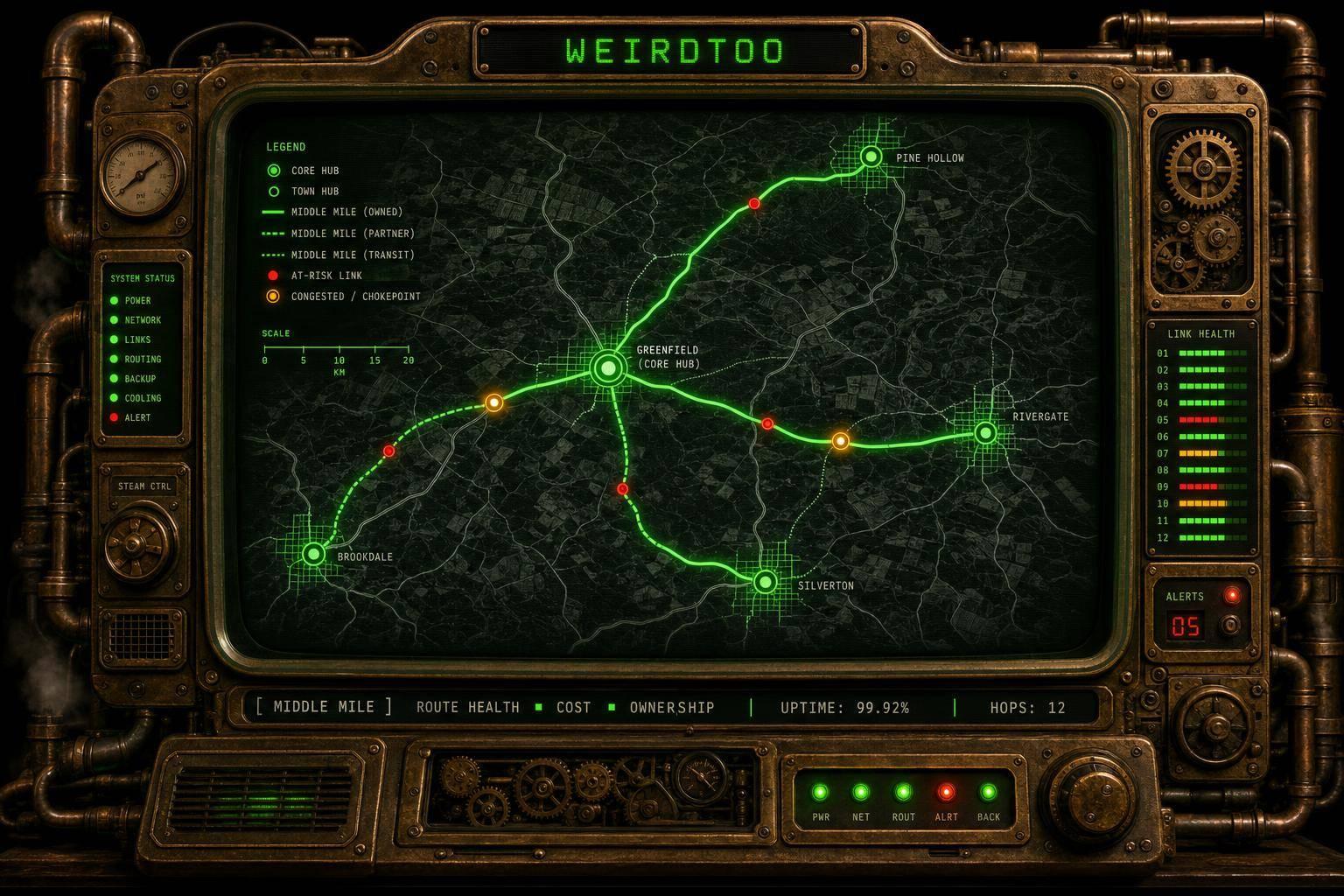
Why Middle Mile Matters for Rural ISPs
By weirdtoo·July 30, 2026·10 min read
How middle-mile costs, route design, and ownership determine rural ISP reliability, outages, and funding outcomes.
Why Middle Mile Matters for Rural ISPs
If the middle mile is weak, a rural ISP pays more, breaks more often, and struggles to grow.
I’d boil the whole issue down to this: middle mile is the link between local service and the internet, and in rural areas that link is often the most expensive and fragile part of the network. Costs can run as high as $5 per Mbps in remote markets, while many healthy networks try to get near $0.01 per Mbps. One fiber cut on a single-path route can also take an entire town offline.
Here’s the short version:
- High transport costs eat into thin rural margins
- Single-path backhaul turns one cut or failure into a broad outage
- Last-mile upgrades alone do not fix congestion behind the network
- Fiber, microwave, and satellite each fit different route needs
- Build, lease, IRU, and shared models each change cost, control, and risk
- Ring design, route diversity, multi-homing, and backup power lower outage risk
- Anchor institutions, handoff points, and grant rules should shape the plan before money is spent
A simple way to think about it: you can build a fast local network, but if the path feeding it is overpriced or narrow, users still feel slowdowns and outages.
#FiberConnect25: Why America Must Invest in Middle Mile Networks
sbb-itb-342b8b2
Quick comparison
| Issue | What it does to a rural ISP | What usually helps |
|---|---|---|
| High middle-mile cost | Pushes up monthly network expense | Ownership, IRUs, shared fiber, better interconnection |
| Single physical route | Makes outages hit whole communities | Rings, separate physical paths, multi-homing |
| Weak backhaul capacity | Causes buffering and peak-hour slowdown | More transport capacity, better route design |
| Poor route control | Limits pricing and outage response | Owned fiber, dark fiber IRUs, co-op networks |
| Weak project planning | Hurts funding and long-term payback | Map demand, anchors, handoffs, and grant fit early |
So when I look at rural broadband, I don’t see middle mile as a side issue. I see it as the part that decides whether the rest of the network works well enough to last.
The core problem: expensive or weak middle mile raises prices and causes outages
High transport costs squeeze already thin rural margins
For many rural ISPs, the middle mile is where the math starts to break.
Wholesale competition is often thin or nonexistent. In a lot of rural markets, there’s basically one incumbent transport provider, which means there may be no practical backup option at all.
In Arkansas, providers were paying between $10,000 and $20,000 for a single 10G connection, and $30,000 to $40,000 for a 100G connection [3]. When transport costs hit that level, money that could have gone to network expansion, maintenance, or customer support gets eaten up fast. And price isn’t the only issue. When routes are weak, cost pressure can turn into outage risk almost overnight.
Single-path routes can turn one failure into a community-wide outage
The bigger problem isn’t only what middle mile costs. It’s how fragile it can be when something goes wrong.
Many rural middle-mile networks were built as single-path branches instead of loops. That means one cut, one equipment failure, or one damaged segment can knock out service for an entire area.
Older fiber adds another layer of trouble. Much of the rural middle mile was laid in the 1980s and 1990s, and those older builds can develop failures that are hard to trace, along with poor repair records [3]. On paper, two providers may sound like a safety net. In practice, that falls apart if both routes run through the same conduit, cross the same bridge, or hang on the same pole line. Separate contracts do not equal separate routes [6].
That’s the catch: you can spend money upgrading service closer to the customer, then watch that investment lose punch because the transport path behind it is still brittle.
Last-mile upgrades fall short when backhaul stays constrained
A better last mile doesn’t fix a clogged backhaul link.
A subscriber can see full signal bars and still deal with buffering or high latency, because coverage and capacity are not the same thing [5]. It’s a bit like having a smooth on-ramp to a highway that’s jammed solid. The local connection looks fine, but traffic still crawls.
This tends to show up most clearly around 8:00 PM, when streaming demand climbs and backhaul congestion peaks [5]. If the transport layer is undersized, last-mile upgrades can’t deliver what they promise.
The solution: better middle-mile design lowers costs and improves service
Choose the right backhaul mix for the terrain and budget
The right backhaul mix can cut transport costs without giving up uptime. And in rural areas, that's the whole game. No single option works for every route. Fiber gives you the most capacity over the long run, microwave gets to remote sites much faster, and satellite is best kept for extreme off-grid spots [5].
| Technology | Best Use Case | Key Advantage | Key Trade-off |
|---|---|---|---|
| Fiber | High-density rural hubs | Highest capacity, lowest latency | Expensive and slow to build [5] |
| Microwave | Remote towers, rough terrain | Fast deployment | Line-of-sight required; capacity limits [5] |
| Satellite | Extreme, off-grid locations | Reaches anywhere | High latency; poor for real-time use [5] |
A hybrid setup often makes the most sense: fiber on the main routes, then microwave for the hard-to-reach stretches. That gives rural ISPs a better mix of performance and build speed.
Once you've picked the transport mix, the next call is just as important: who owns the route?
Use ownership, leasing, and shared infrastructure to manage costs
In middle mile, ownership can matter just as much as the gear you choose. Owning your middle mile or locking in long-term Indefeasible Rights of Use, or IRUs, can cut transport costs over time and give you more control. Leasing is faster to start with, but route control and long-term pricing stay in someone else's hands [1][3].
A common middle path is joining open-access or cooperative middle-mile networks. IdeaTek's Freestate Middle-Mile Network in Kansas is a good example of how open-access fiber can lower barriers to interconnection [1].
Diamond State Networks in Arkansas took a cooperative ownership approach and tied into major hubs to lower wholesale transport costs [3].
Electric cooperatives also deserve a close look. For a rural ISP, they bring a lot to the table: nonprofit status, existing utility infrastructure, rights-of-way, and access to low-cost capital. That's a hard combo to match if you're building alone [3].
Low cost only helps if traffic can still move when something breaks.
Build redundancy into the network before it becomes urgent
The best time to plan for outages is before one hits. Ring topologies let traffic reroute around a fiber cut, which makes them a strong starting point for rural middle mile [4][6].
Physical route diversity matters just as much as logical diversity. Two upstream providers may sound safe on paper. But if both paths use the same conduit, cross the same bridge, or ride the same pole line, you don't have much protection at all [6].
"A 10 Gbps port at an exchange is different from 10 Gbps of usable protected capacity from every rural sector." - Mara Voss, BTW Media [6]
Multi-homing adds another layer at the edge. By connecting to multiple upstream providers and using BGP to shift traffic when one session fails, operators can avoid turning one upstream outage into a full service outage [6].
Power is part of redundancy too. Remote towers on weak rural grids are exposed to utility failures, so battery backup, UPS systems, generators, and remote monitoring should be built into the plan [5][6].
With the route mapped out, the next step is to check demand, access points, and funding fit.
What rural ISPs should evaluate before investing in middle mile
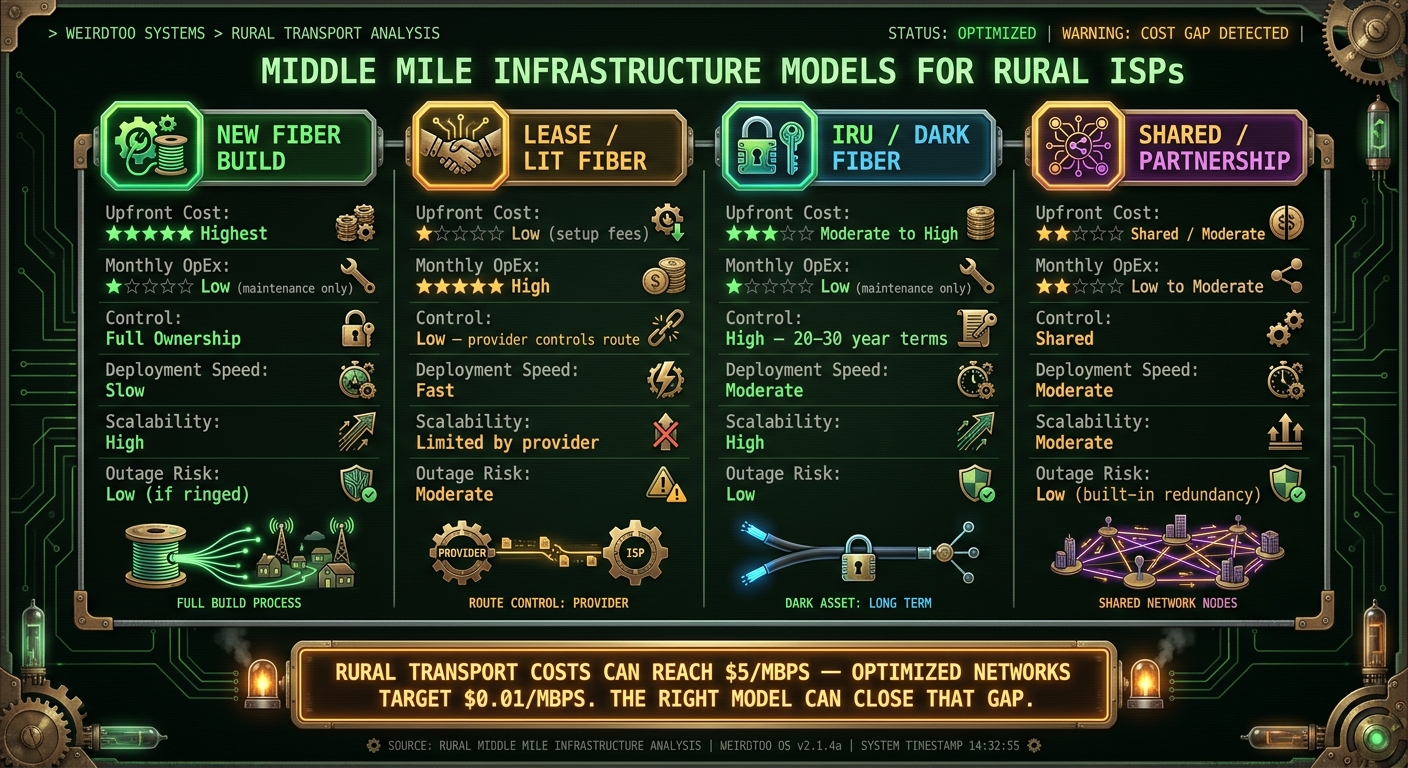
Rural ISP Middle Mile: Build vs. Lease vs. IRU vs. Shared Infrastructure
Once the route map is clear, the next step is simple to say and hard to answer: can this project be paid for, and can it keep working financially over time?
Map demand, anchor institutions, and handoff points first
Before you commit to any route, you need to know what that route has to carry. Start by mapping anchor institutions - schools, libraries, hospitals, government agencies, and utilities. These are high-capacity customers, and their demand can help make a project pencil out while also strengthening a grant application [2].
A route only makes sense if it can cut transport costs and support steady service. So don’t stop with anchor tenants. You also need to identify your handoff points: fiber handoff points, provider handoff sites, and nearby Internet Exchange Points (IXPs). Where you can hand off traffic - and what that handoff costs - affects every route choice that comes after [1][3].
And don’t size the route only for what you need today. If usage grows, a line that looked fine on paper can turn into a bottleneck fast.
Those demand points and handoff locations shape which build model fits best.
Compare build, lease, and partnership options with a comparison table
Once you know the route, the next issue is control. Do you build it, lease it, or share it? Each option comes with its own mix of cost, speed, and risk, and the right pick depends on your budget, your technical team, and where you want to be in a few years.
| Model | Upfront Cost | Monthly Operating Cost | Control | Deployment Speed | Scalability | Outage Risk |
|---|---|---|---|---|---|---|
| New Fiber Build | Highest | Low (maintenance only) | Full | Slow | High | Low (if ringed) |
| Lease (Lit Fiber) | Low (setup fees) | High | Low | Fast | Limited by provider | Moderate |
| IRU (Dark Fiber) | Moderate to High | Low (maintenance only) | High | Moderate | High | Low |
| Shared / Partnership | Shared / Moderate | Low to Moderate | Shared | Moderate | Moderate | Low (built-in redundancy) |
Owning the route, or locking in a long-term IRU that often runs 20–30 years, can give you better cost control over time [1][4]. On the other hand, shared and partnership models - such as joining a cooperative middle-mile network - can split the upfront bill while still giving you ring-topology redundancy built in [4].
That’s the tradeoff in plain terms: pay more now for control later, or lower the entry cost and give up some control along the way.
After the route and cost model are clear, the project needs one more hard look: does it match funding rules?
Align the project with federal and state funding requirements
Federal and state funding programs come with specific rules, and projects that miss those rules early often get disqualified or pushed into delays. Middle-mile grant competition is tough, so document your coverage gaps clearly and use FCC-recognized data when you can [3].
Funders want to see community impact in concrete terms. Which anchor institutions will benefit? What coverage gaps does the project close? What does the timeline look like? State programs often sit on top of federal rules, so you need to check both before you lock your budget or route design.
Getting that paperwork right before you apply is a lot easier than trying to redo it after a funding denial.
Conclusion: middle mile is the hidden backbone that determines rural ISP viability
Put the pieces together, and the picture gets pretty clear: middle mile is the layer that makes or breaks a rural ISP.
It shapes cost, uptime, and how far a network can grow. Rural transport can run as high as $5 per megabit, while tuned networks aim for about $0.01 per megabit [3]. That's not a small pricing gap. It's the kind of gap that can wipe out already thin rural margins in a hurry.
The same pattern shows up in reliability. Redundancy, route diversity, and long-term access models help cut outage risk [3][6]. And it shows up in funding too. Most funding still goes to the last mile. NTIA set aside $1 billion for middle-mile infrastructure, which is only a small slice next to the tens of billions aimed at last-mile projects [3]. That means planning, cost modeling, and grant fit can't be treated as separate calls. They need to be handled together.
When middle mile is done well, rural broadband has room to grow. When it's weak, even major last-mile spending won't close the gap.
FAQs
What is middle mile in broadband?
Middle-mile infrastructure is the high-capacity connection between a local internet service provider and the global internet. It’s the regional network that moves data from major exchange points into a community.
When that middle-mile connection is weak, local providers often pay more and get less capacity. The result is simple: slower speeds and less reliable internet service, especially in rural areas.
Why can’t last-mile upgrades fix slow service?
Slow service isn’t just a last-mile problem. Middle-mile infrastructure links local providers to the broader internet, and if that part of the network doesn’t have enough capacity, last-mile upgrades by themselves won’t fix the issue.
Better middle-mile networks can help rural ISPs cut operating costs, improve reliability, and support more competition. That can put pressure on prices and help bring costs down for end users.
Should a rural ISP build or lease middle mile?
It depends, but middle mile plays a big role. It links local ISPs to the broader internet, which can help cut costs, improve reliability, and give rural areas more competition.
For rural ISPs, building or getting access to open-access middle-mile infrastructure can make growth easier and help meet future bandwidth needs, especially when the other option is a limited or congested route.
Current contact path
Need Weird Network WiFi, custom apparel, or scoped help?
Use the contact form; removed product, checkout, research, and newsletter funnels stay offline.