Loading…
What a $26 T-Shirt Really Earns You
By weirdtoo·November 2, 2026·7 min read
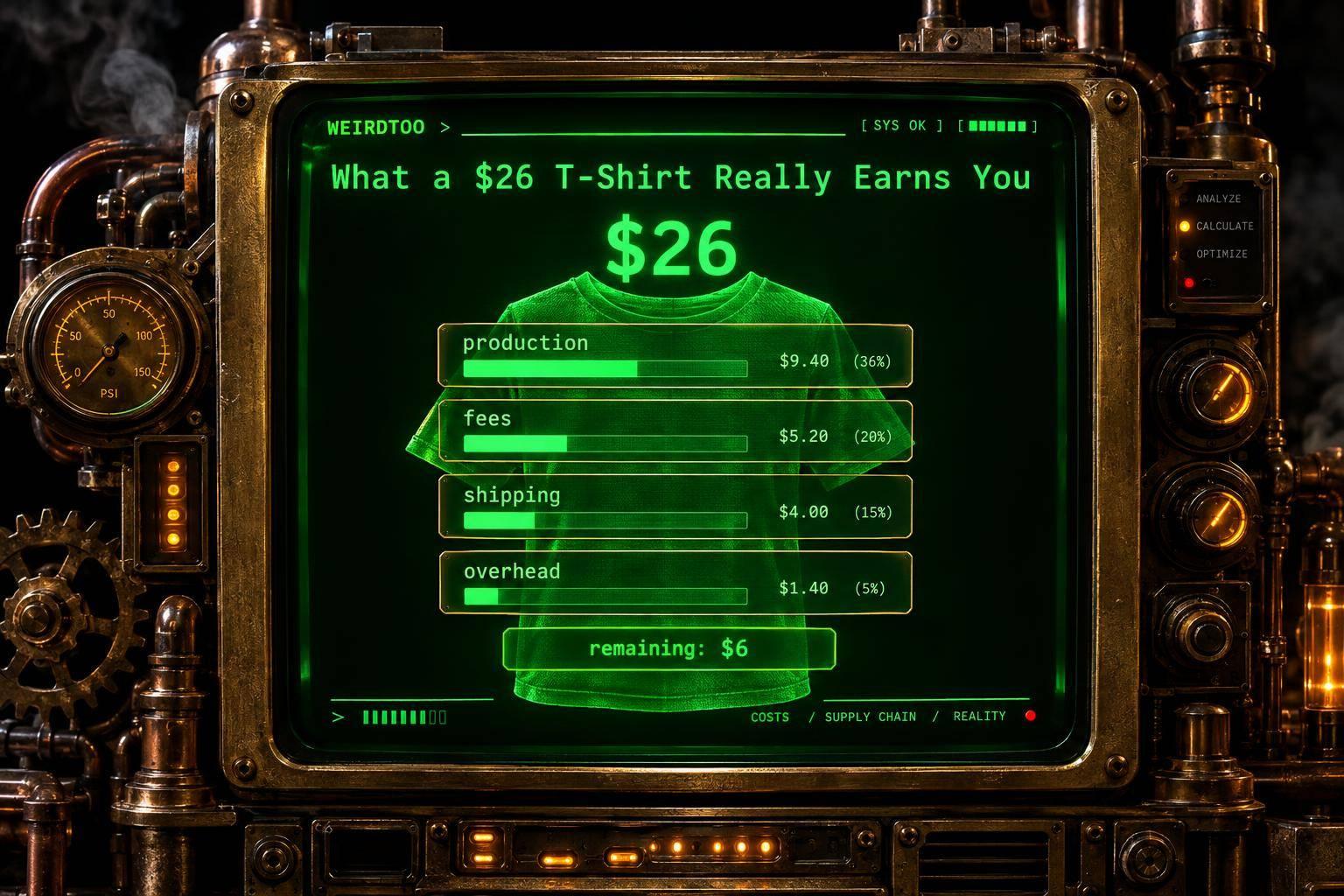
A $26 T-shirt often leaves only about $6 after production, fees, shipping, and overhead — too little for labor, ads, and returns.
What a $26 T-Shirt Really Earns You
In this hypothetical U.S. order, I’m left with $8.12 from a $26 shirt sale - a 31.2% margin before ads, refunds, reprints, and overhead. After allocating $2.00 for overhead, I have $6.12 left before those other costs and my labor. That is not take-home pay.
Before I set a price, I check:
- Order costs: the shirt, printing, fees, packaging, and shipping, using current quotes.
- Sales costs: discounts, ads, and a reserve for refunds or reprints.
- Business costs: overhead, my time, and cash needed while payouts are pending.
Then I calculate the price that covers those costs and my profit target. <u>I count each cost once</u> - including packaging or return losses already covered elsewhere. The shirt should pay for the work, not just its replacement.
How to Price Custom T-Shirts: Full Cost Breakdown! l Expert Tips for Success
sbb-itb-342b8b2
A Sample $26 Shirt Cost Breakdown
Hypothetical planning assumptions only, not a provider quote.
Line item Illustrative cost Calculation note Balance after each line item Revenue $26.00 Starting shirt price $26.00 Blank and printing −$10.00 Assumed production cost $16.00 Platform fee −$1.30 $26.00 × 5% $14.70 Payment processing −$1.08 ($26.00 × 3%) + $0.30 $13.62 Packaging −$0.50 Assumed materials and handling $13.12 Seller-paid shipping −$5.00 Assumed domestic delivery $8.12 Gross profit $8.12 $8.12 ÷ $26.00 = 31.2% $8.12
Direct costs total $17.88, leaving $8.12 in gross profit before ads, returns, and reprints. That’s not your take-home pay.[3][4][6]
Use these figures to plan, then replace them with current quotes. Your margin will change with the actual costs.
Use Current Fulfillment Quotes
For planning, allow $6.00–$15.00 for a basic printed shirt and $4.00–$12.00 for domestic shipping. These are ranges, not quotes. Garment weight, front versus back printing, destination, and fulfillment method can change the bill. Sizes 2XL and up may add $0.75–$2.50 per shirt.[1][3][4]
Get a current quote for the exact garment, size, print placements, and destination. Check whether packaging is included. If it is, don’t subtract another $0.50 - you’d be counting that cost twice.[3][4]
Budget for Charges Before Payout
A profitable order can still leave you short on cash. Print-on-demand (POD) providers may charge for production and shipping immediately, while storefront payouts can take days or weeks. Confirm when charges are due, any net payment terms, and when payouts arrive. Keep enough working cash to cover orders and replacements while you wait.[4][6]
How Discounts, Ads, and Returns Cut Profit

T-Shirt Profit: How a $26 Sale Can Become a Loss
The $8.12 baseline contribution can shrink fast. These hypothetical scenarios show how discounts, shipping, ads, refunds, and reprints change what remains before overhead.[4][1][2]
Illustrative scenarios using the same $26 baseline costs
Order scenario Shirt revenue Shipping collected Direct costs Ad cost Contribution Margin Organic baseline $26.00 $0.00 $17.88 $0.00 $8.12 31.2% Customer-paid shipping $26.00 $5.00 $18.28 $0.00 $12.72 41.0% 20% discount $20.80 $0.00 $17.46 $0.00 $3.34 16.1% Paid ad $26.00 $0.00 $17.88 $10.00 −$1.88 −7.2% Refunded order $0.00 $0.00 $17.88 $0.00 −$17.88 N/A Reprinted order $26.00 $0.00 $33.38 $0.00 −$7.38 −28.4% Table note: Direct costs include the blank, printing, platform fees, payment fees, packaging, and seller-paid shipping. The seller pays $5.00 for delivery in every scenario; customer-paid shipping adds $5.00 in revenue. Use total customer payment, including shipping but excluding sales tax, as the margin base. The refund assumes no costs or fees are recovered; the reprint adds $15.50 for production, packaging, and shipping, with no new selling fees.[4][1][2]
Recalculate Fees on Discounts and Shipping
Recalculate percentage-based fees when you change the price. A discount lowers those fees along with revenue. Shipping collected from the customer is still subject to fees, while “free shipping” means you cover delivery.[4][1]
Account for Ads, Refunds, and Reprints
A $10.00 customer acquisition cost turns the $8.12 baseline into a $1.88 loss before overhead.[1][4]
A refund removes the sale revenue. A reprint adds another round of production and shipping costs.[1][4]
A returns reserve of about 3% to 5% of revenue can help cover expected refunds and reprints. When recording those losses, check that you haven't also counted the same costs through the reserve.[1][3]
Subtract Overhead and Count Owner Labor
In this hypothetical overhead calculation:
$100.00 in monthly overhead ÷ 50 shirts = $2.00 per shirt, leaving $6.12 from the baseline before owner labor.[5]
Assign fixed overhead to each shirt, then account for your labor separately. The remaining $6.12 is not take-home pay.[4][6] Carry that amount into the break-even price check.
Calculate the Price That Covers Your Costs
Turn your per-shirt cost into a selling price that covers fees and leaves room for profit.
Calculate Break-Even and Target-Profit Prices
Use C for your total per-shirt cost from the previous section. Get actual quotes for each size, not just the cheapest option. Extended sizes can cost more.[3]
Use f for your combined percentage fees, written as a decimal. Include flat royalties and fixed return reserves in C. Put percentage-based return reserves in f. Keep charges in one place so you don’t count them twice.
- Break-even price = C ÷ (1 − f)
- Price for target dollar profit P = (C + P) ÷ (1 − f)
- Price for target profit margin m = C ÷ (1 − f − m)
Choose a dollar profit goal or a margin goal - not both. Margin = profit ÷ selling price.[7]
If you charge shipping separately, the formula gives the total before tax. Subtract the shipping collected to find the item price. To allow for a discount, divide that item price by 1 − discount rate.
Use the hypothetical $26 selling price below to test the calculation.
Check Whether $26 Pays Enough
At $26, your contribution is $26 × (1 − f) − C. Keep that price only if the amount left covers your work at your expected sales volume. If expected volume drops, recalculate overhead per shirt.
If $26 falls short, test a higher price or charge shipping separately. For bundles, use the actual shipping cost of adding another item. Don’t assume delivery costs double. Include artist payments or licensing costs according to the actual agreement.
Conclusion: Cover Costs and Pay the Creator
$26.00 is revenue, not take-home pay. After direct costs and the $2.00 overhead allocation, $6.12 remains before ads and losses.[5]
Before setting your price, check current fulfillment and shipping quotes, recalculate fees after discounts, set aside money for ads and returns, and define your minimum profit target.
That fits WEIRDTOO’s stated direction for OddDrip, which is being built: cover product costs and pay artists fairly.
A $26 shirt works only if its margin covers labor, overhead, and risk - not just the cost of replacing the shirt.
FAQs
How should I price my time per shirt?
Add up your cost per shirt: the blank shirt, printing, packaging, platform and payment fees, a reserve for returns, and any shipping you cover. Subtract that total from your selling price. What’s left must cover your time and profit.
Time cost = desired hourly rate × hours spent per shirt.
Subtract your time cost and advertising costs, too. If the result is negative, charge more or cut the time spent per shirt.
How much cash should I keep for pending orders?
For pending print-on-demand (POD) orders, set aside production costs, selling fees, and a returns reserve before treating any cash as yours to keep. Refunds and chargebacks can reverse payments later.
Hypothetical example: A $26.99 tee with a $12.00 base cost, $4.75 postage, Etsy and payment-processing fees, and a 3% returns reserve leaves about $6.42 before marketing or bills. That estimate depends on the fees applied. Any seller-paid shipping beyond the $4.75 postage cuts profit further.
Should I set aside taxes from each sale?
Yes. Your profit margin calculations include production, platform, and marketing costs, but not your personal income taxes.
Industry guidance suggests setting aside 20%–40% of your net profit for income taxes. The amount depends on your total earnings, including other income. Treat this range as a planning estimate, not your exact tax rate.
Personal income taxes are separate from business expenses. Setting aside part of the profit from each sale can help you avoid a shortfall at tax time.
Current contact path
Need custom apparel or scoped help?
Use the contact form; removed product, checkout, research, and newsletter funnels stay offline.