Loading…
Top Spectrum Challenges for Community ISPs
By weirdtoo·February 16, 2026·12 min read
How rural ISPs face spectrum shortages, costly licenses, interference, and policy barriers — and practical fixes like CBRS, 6 GHz and managed Wi‑Fi.
Top Spectrum Challenges for Community ISPs
Community ISPs in rural areas face major hurdles in accessing spectrum, the key resource for wireless internet. These challenges stem from high costs, complex licensing processes, and limitations of unlicensed spectrum. Here's a quick breakdown:
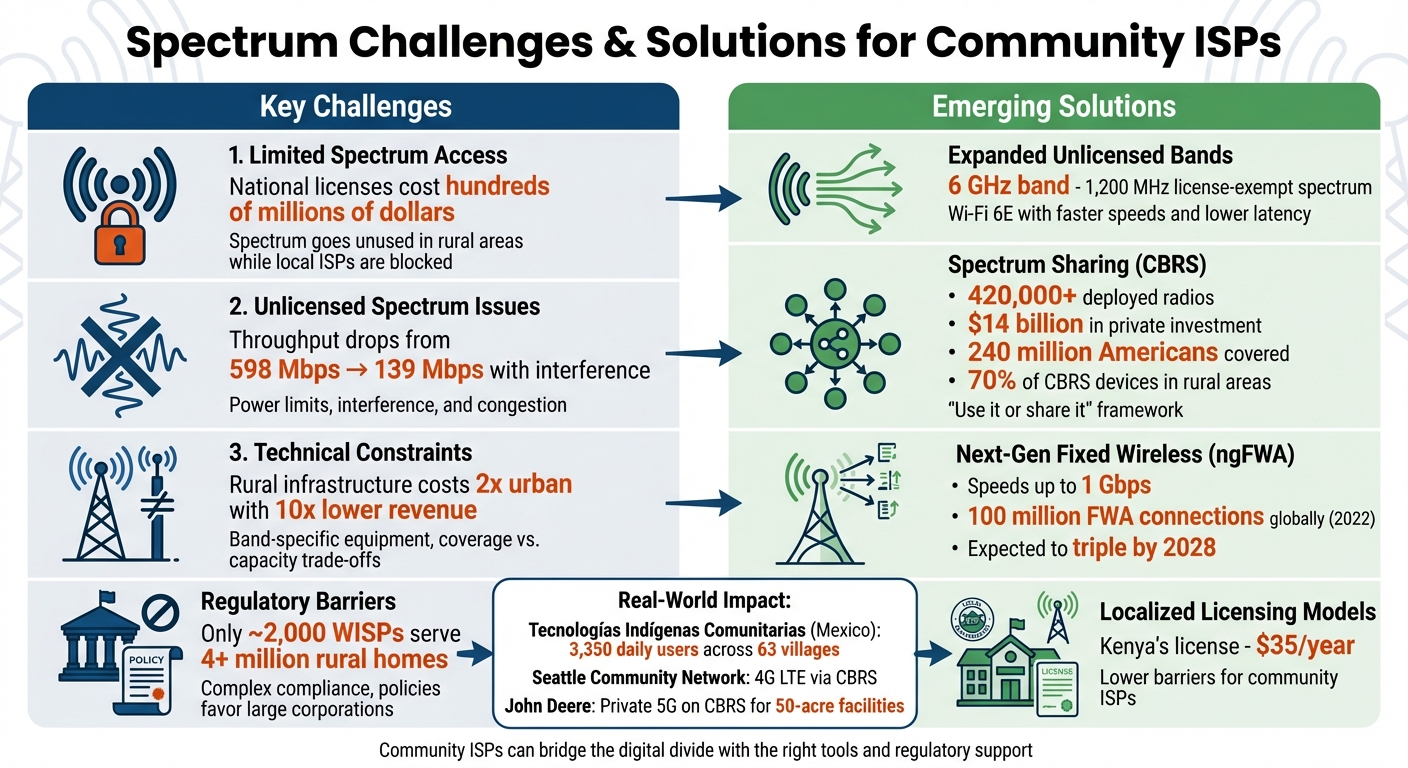
- Spectrum Access Issues: National licenses are expensive (hundreds of millions of dollars) and often leave rural areas underserved.
- Unlicensed Spectrum Problems: Interference, congestion, and power limits hinder reliable service.
- Technical Constraints: Equipment costs and regulatory limits on frequencies reduce network efficiency.
- Regulatory Barriers: Policies favor large corporations, making it hard for smaller ISPs to compete.
To address these issues, solutions like spectrum sharing (e.g., CBRS), expanded unlicensed bands (e.g., 6 GHz), and localized licensing models are helping ISPs improve rural connectivity without relying on costly auctions. Managed Wi-Fi services, such as those offered by WEIRDTOO LLC, are also providing affordable options for underserved areas. These approaches show that smaller ISPs can bridge the digital divide with the right tools and support.
Spectrum Access Challenges and Solutions for Community ISPs
Leveraging Spectrum Innovation to Bridge the Digital Divide in South Bend @infraday
sbb-itb-342b8b2
Limited Spectrum Access and Distribution
Radio spectrum is a finite resource, and its distribution heavily favors large corporate providers over community ISPs. Most spectrum is allocated through national licenses, granting exclusive rights to use specific frequencies across the entire country. These licenses are auctioned off for hundreds of millions of dollars [1], leaving smaller providers unable to compete. Once a corporation secures a license, they control those frequencies nationwide - even in rural areas where they may not have any infrastructure.
This creates a frustrating paradox: valuable spectrum often goes unused in rural areas, while local ISPs are legally blocked from accessing it. The Internet Society highlights this issue:
"Nationally licensed spectrum is rarely used nationwide, leading to areas with limited or no coverage. The high prices paid for spectrum motivate operators to focus on the wealthiest, most densely populated regions" [1].
The outcome is clear: rural areas are left with no service from the national license holders and no chance for local ISPs to step in and fill the gap.
High Costs and Complex Licensing for Spectrum Access
Licensed spectrum is prohibitively expensive. Spectrum auctions frequently see bids climbing into the hundreds of millions of dollars [1]. This places licensed bands far out of reach for smaller operators like community ISPs. But it's not just the cost that's a barrier - the licensing process itself is designed for large corporations. Securing a license often requires long-term commitments, substantial collateral, and navigating a complex application process that can take months or even years [3].
For smaller ISPs and non-profits, this is a nearly impossible hurdle. They lack the legal teams, engineering expertise, and financial resources needed to meet these demands. As the Internet Society explains:
"Licensing restrictions, burdensome compliance requirements, and elevated spectrum and license fees act as entry barriers for smaller operators" [3].
Without access to licensed spectrum, community ISPs are forced to rely on unlicensed alternatives, which come with their own set of challenges.
Unlicensed Spectrum and Interference Problems
Community ISPs often turn to unlicensed Wi-Fi bands, as licensed spectrum is simply out of reach. However, unlicensed spectrum comes with strict power limits imposed by regulators to prevent interference with licensed users. These restrictions mean community ISPs have to install many more access points to cover the same area that a single licensed base station could handle [1].
Susan Higgins, Senior Marketing Manager at Calix, sheds light on this issue:
"Acquiring expensive licenses is far beyond the reach of most WISPs; therefore, they're reliant on unlicensed spectrum... Interference and congestion are commonplace" [4].
Unlicensed spectrum is a shared resource, meaning any device can operate on these frequencies - from routers and IoT devices to neighboring networks. This creates a chaotic environment where interference is unavoidable. In one test, throughput on a shared frequency dropped from 598 Mbps to just 139 Mbps when multiple users competed for the same band [6]. For rural ISPs, this lack of reliability makes it incredibly difficult to deliver consistent, high-quality service.
Technical Problems in Spectrum Use
Community ISPs, especially those in rural areas, face a host of technical challenges tied to the physics of radio waves and the limitations of affordable equipment. These issues go hand in hand with the licensing and interference hurdles they already encounter, making it even harder to deliver reliable service.
Balancing Coverage Area and Network Capacity
The nature of radio frequencies presents a constant trade-off: lower frequencies can cover larger areas but offer lower data speeds, while higher frequencies provide faster speeds but only over shorter distances. For rural ISPs, this means deciding between broad coverage with slower internet or faster speeds for a smaller audience.
Regulatory restrictions on transmission power further complicate this balancing act. A case in point is the ARA Wireless Living Lab in Central Iowa, which spans 155 square kilometers. Researchers observed that TV White Space (TVWS) operations were limited to 16 dBm EIRP under database-driven policies. However, when operating under an experimental license allowing 42 dBm, the coverage area expanded dramatically across rural farmland [6]. That 26 dBm boost turned a barely usable network into one that could genuinely serve its purpose.
Interestingly, ground truth measurements within the ARA footprint revealed that nearly half of the TVWS spectrum was actually available, despite databases only listing three usable channels [6]. These technical constraints directly influence the kind of equipment community ISPs can afford and deploy.
Equipment Costs for Specific Spectrum Bands
The spectrum trade-offs also shape equipment investments. Each spectrum band requires its own specialized hardware, forcing ISPs to make tough decisions about which bands to prioritize. For example, a radio designed for the 2.5 GHz band won't work on the 3.5 GHz CBRS band, and equipment for TVWS isn't compatible with the 6 GHz band. This fragmentation often leaves certain communities without service simply because the necessary equipment is too costly.
Small ISPs frequently rely on Software Defined Radios (SDRs) or lower-end devices that struggle with carrier aggregation. These devices often fail to efficiently combine fragmented spectrum and may produce out-of-band emissions, leading to interference. In contrast, larger providers use advanced base stations with sophisticated filtering and signal processing capabilities, but these units can cost tens of thousands of dollars each - far beyond the reach of many community ISPs.
Despite these challenges, rural areas have seen widespread deployment of CBRS devices. As of January 2023, over 70% of the 287,033 active CBRS devices in the U.S. were in rural regions [8]. Still, deployment is only part of the equation. The cost of building broadband infrastructure in remote areas is roughly double that of urban locations, while the revenue potential is often ten times lower [6]. For small ISPs trying to serve a few hundred households scattered across vast areas, the steep investment required for band-specific equipment can be a dealbreaker.
Regulatory and Policy Barriers
Community ISPs, much like their challenges with technical and financial hurdles, face a regulatory system that seems built for massive, national operators. The FCC's spectrum management policies tend to favor large telecommunications companies, leaving smaller, local providers struggling to navigate the system.
Difficult Compliance Requirements
For small operators, the complexities of spectrum policy create significant obstacles. The Internet Society highlights this challenge:
"Spectrum policy and regulation are complex, requiring elements of expertise in radio physics, network engineering, economics, competition, and law. For small operators, this makes engagement particularly challenging" [1].
In other words, these small providers must deal with intricate regulatory frameworks that demand expertise across multiple disciplines - expertise they often lack. Yet, they’re held to the same standards as massive corporations with far greater resources.
The challenges don’t end with regulatory knowledge. Administrative tasks, like licensing and compliance, drain the limited resources of these smaller ISPs. According to the Internet Society:
"Most traditional licensing frameworks were created for large national telecommunications operators, involving long-term exclusive rights, significant compliance demands, and high fees" [3].
On top of this, compliance often requires extensive reporting and comes with hefty financial obligations. Spectrum auctions, for example, can impose financial requirements that small ISPs simply can’t meet. Delays in the approval process - sometimes stretching months or years - only worsen the situation. These delays can exhaust the startup capital of smaller providers, leaving rural communities disconnected. Without tailored licensing frameworks or access to Universal Service Fund grants, these providers face an uphill battle in bringing connectivity to underserved areas [3].
Insufficient Support for Rural Providers
The current policies also fail to account for the unique needs of rural ISPs. The FCC’s auction system for popular spectrum frequencies, for instance, often sees bids climbing into the hundreds of millions of dollars [1]. This works for large carriers serving millions in urban areas but is entirely unrealistic for a small ISP trying to connect a few hundred households in rural Wyoming.
This creates a stark divide. While around 2,000 WISPs across the U.S. serve over 4 million homes in remote areas [4], they often rely on unlicensed spectrum. This spectrum, however, is plagued by interference and regulatory uncertainty. As Susan Higgins, Senior Marketing Manager at Calix, explains:
"Usage [of unlicensed spectrum] is at the mercy of regulatory rules that can change at any time. These factors place significant restraints on growth for WISPs at a time of heightening competition" [4].
Some countries are taking a different approach. In May 2021, Kenya’s Communications Authority introduced a Community Networks Service License, which costs just $35 annually and exempts providers from Universal Service Fund contributions. By late 2025, 13 community providers had already obtained licenses under this framework [3].
The contrast with U.S. policy is striking. While Kenya actively supports community connectivity, American regulations continue to favor large incumbents, leaving many rural areas without adequate service. To address these gaps, U.S. policymakers must consider reforms that enable community ISPs to thrive and help bridge the connectivity divide in rural regions.
Solutions for Overcoming Spectrum Challenges
Community ISPs face a variety of hurdles, but there are practical ways to improve spectrum access and service quality. These include technical advancements, partnerships, and affordable service platforms.
Making the Most of Unlicensed Spectrum
The 6 GHz band offers a major opportunity for community ISPs dealing with congestion. The FCC has opened up 1,200 MHz of this spectrum for license-exempt use, offering relief from the crowded 2.4 GHz and 5 GHz bands [1]. This additional spectrum supports Wi-Fi 6E, which delivers faster speeds, lower latency, and improved overall performance [1][7].
To fully benefit from this, ISPs can use dynamic spectrum assignment, which relies on geo-location databases to allocate spectrum based on real-time availability. Verifying site and tower locations in the Universal Licensing System (ULS) database is also key to minimizing interference [1][5][7]. Additionally, conducting technical studies of existing microwave links can help ISPs determine baseline noise levels and identify links at risk of interference from unlicensed devices [7].
Another promising technology, next-generation Fixed Wireless Access (ngFWA), allows ISPs to deliver speeds up to 1 Gbps - comparable to fiber. This solution is particularly effective for bridging the broadband gap in rural areas. By the end of 2022, there were approximately 100 million FWA connections worldwide, a number expected to triple by 2028 [4].
Expanding Access Through Spectrum Sharing
While technical improvements boost unlicensed spectrum performance, spectrum sharing through partnerships expands access even further. Under a "use it or share it" framework, unused spectrum held by a primary license holder can be made available to others, such as community ISPs [9][10][2].
The Citizens Broadband Radio Service (CBRS) offers a successful example of this model. By August 2025, CBRS had grown to include over 420,000 deployed radios and attracted $14 billion in private investment, making it a cornerstone of U.S. wireless infrastructure [10]. Recent updates, dubbed "CBRS 2.0", expanded unencumbered coverage to reach 240 million Americans - 72 million more than before [10]. Alan Ewing, Executive Director of the OnGo Alliance, highlights this progress:
"CBRS is a success story that's only getting better. In just a few years, more than 420,000 radios and $14 billion in private capital have transformed a 'pilot' into indispensable infrastructure" [10].
Real-world applications show the model's potential. For instance, John Deere standardized its factory connectivity on CBRS, using private 5G to cover 50-acre facilities. This shared spectrum allows the company to quickly adapt operations during factory replanning. As Jason Wallin, Senior Principal Architect at John Deere, explains:
"Private 5G on CBRS is just how we move data now - it's the default" [10].
Community ISPs can also form partnerships with rural utilities, agricultural cooperatives, and local governments to share infrastructure and costs [11]. Cooperatives, which already provide 72.7% of rural fiber-optic internet access, offer a proven model for community-based connectivity [12].
Affordable Wi-Fi for Underserved Areas: WEIRDTOO LLC
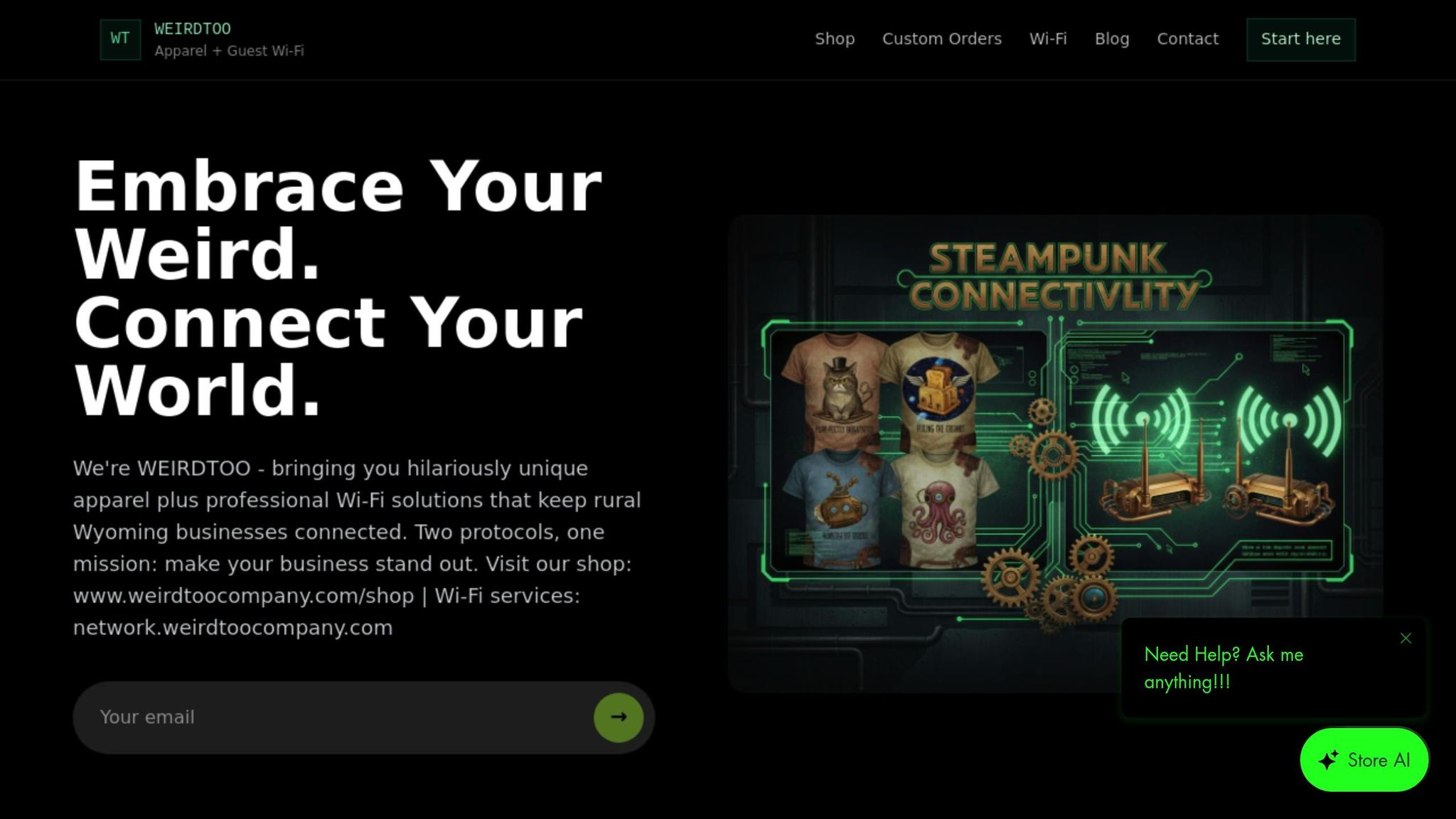
In addition to technical and collaborative strategies, localized solutions can address connectivity issues in underserved areas. WEIRDTOO LLC specializes in managed Wi-Fi services for trailer parks, RV parks, marinas, and other rural locations where traditional ISPs are less likely to invest.
WEIRDTOO takes a revenue-sharing approach instead of relying on equipment markups. Their plans include a free Basic tier with guest Wi-Fi and splash page customization (100 logins per month) and a Basic Plus+ plan for $7 per month, which adds features like password protection, video ads, and data capture (3,000 logins per month) [13][14]. Bulk-rate managed Wi-Fi for community sites is also available at approximately $25–$35 per site per month [14].
Unlike traditional solutions that require long-term contracts and high upfront costs, WEIRDTOO’s model allows small operators to launch internet services with minimal investment. Features like customizable splash pages, remote control hubs, and API integration give ISPs control over pricing, bandwidth, and user data while keeping operations local.
This approach aligns with localized licensing frameworks adopted by countries like Canada, the UK, and Germany, which help small operators access spectrum at lower costs [1]. By combining unlicensed spectrum with managed services and local support, companies like WEIRDTOO prove that community ISPs don’t need to compete in expensive spectrum auctions to provide reliable connectivity.
With nearly 400,000 broadband access points already deployed by 1,000 CBRS operators nationwide [8], the infrastructure for shared spectrum is well-established. Community ISPs can use these frameworks and partner with local providers to overcome spectrum challenges and close the connectivity gap.
Conclusion: Improving Rural Internet Access
Community ISPs face tough spectrum challenges, ranging from high licensing costs and interference issues to regulatory hurdles and limited technical know-how. Even with these obstacles, solutions like the 6 GHz band expansion, CBRS spectrum sharing, and dynamic spectrum access are making a difference across the United States. For instance, Tecnologías Indígenas Comunitarias in Mexico uses spectrum set-aside to serve 3,350 daily users across 63 villages, while Seattle's Community Network leverages CBRS to deliver 4G LTE service [1].
However, the economic realities of rural broadband deployment remain a major hurdle. Building infrastructure in remote areas costs twice as much as in urban ones, yet generates significantly less revenue [6]. This economic imbalance highlights why the rural broadband gap persists. Bridging this divide will require more than traditional infrastructure - it demands a mix of regulatory strategies, such as localized licensing, spectrum sharing models, and the expansion of license-exempt bands [1].
Community ISPs like WEIRDTOO LLC show how localized, revenue-sharing approaches can work in underserved areas like Wyoming. By targeting trailer parks, RV parks, and other rural locations overlooked by larger ISPs, these models help lower costs and make internet access more practical in low-density areas.
Small ISPs can provide reliable service without needing to compete in expensive spectrum auctions. As the Internet Society emphasizes:
"Spectrum regulation should reflect the needs of all actors... from large national operators to small, community‑centered and not‑for‑profit providers" [1].
FAQs
Why can’t community ISPs use unused rural spectrum?
Spectrum management policies prevent community ISPs from freely using unused rural spectrum, such as CBRS. These regulations are in place to avoid interference and ensure fair access. By restricting unlicensed or unrestricted use, the system aims to maintain an equitable balance for all users sharing the spectrum.
When should an ISP choose CBRS vs unlicensed Wi-Fi?
When an Internet Service Provider (ISP) requires a network that delivers reliability, security, and strong performance, CBRS is the go-to choice. It's particularly effective in areas where interference is common or coverage is tricky. Operating on shared spectrum (3.55-3.70 GHz), CBRS provides consistent performance, making it a solid option for private networks or community-based setups.
On the other hand, unlicensed Wi-Fi works well for more budget-friendly applications, especially for general indoor use or public hotspots. However, in crowded environments, interference can become an issue, potentially affecting its performance.
What’s the cheapest way to improve rural wireless reliability?
The most budget-friendly way to improve wireless reliability in rural areas is by leveraging fixed wireless technologies such as CBRS spectrum sharing or TV White Spaces. These solutions provide high-speed internet at a lower cost since they eliminate the need for costly trenching or extensive infrastructure projects. This makes them a perfect fit for the tough and remote landscapes often found in rural regions.
Current contact path
Need Weird Network WiFi, custom apparel, or scoped help?
Use the contact form; removed product, checkout, research, and newsletter funnels stay offline.