Loading…

Solving Rural Connectivity Issues with Low-Cost Access Points
By weirdtoo·January 18, 2026·11 min read
Affordable, durable Wi-Fi access points let rural communities bypass costly fiber, expand coverage with simple installs, and manage networks locally.
Solving Rural Connectivity Issues with Low-Cost Access Points
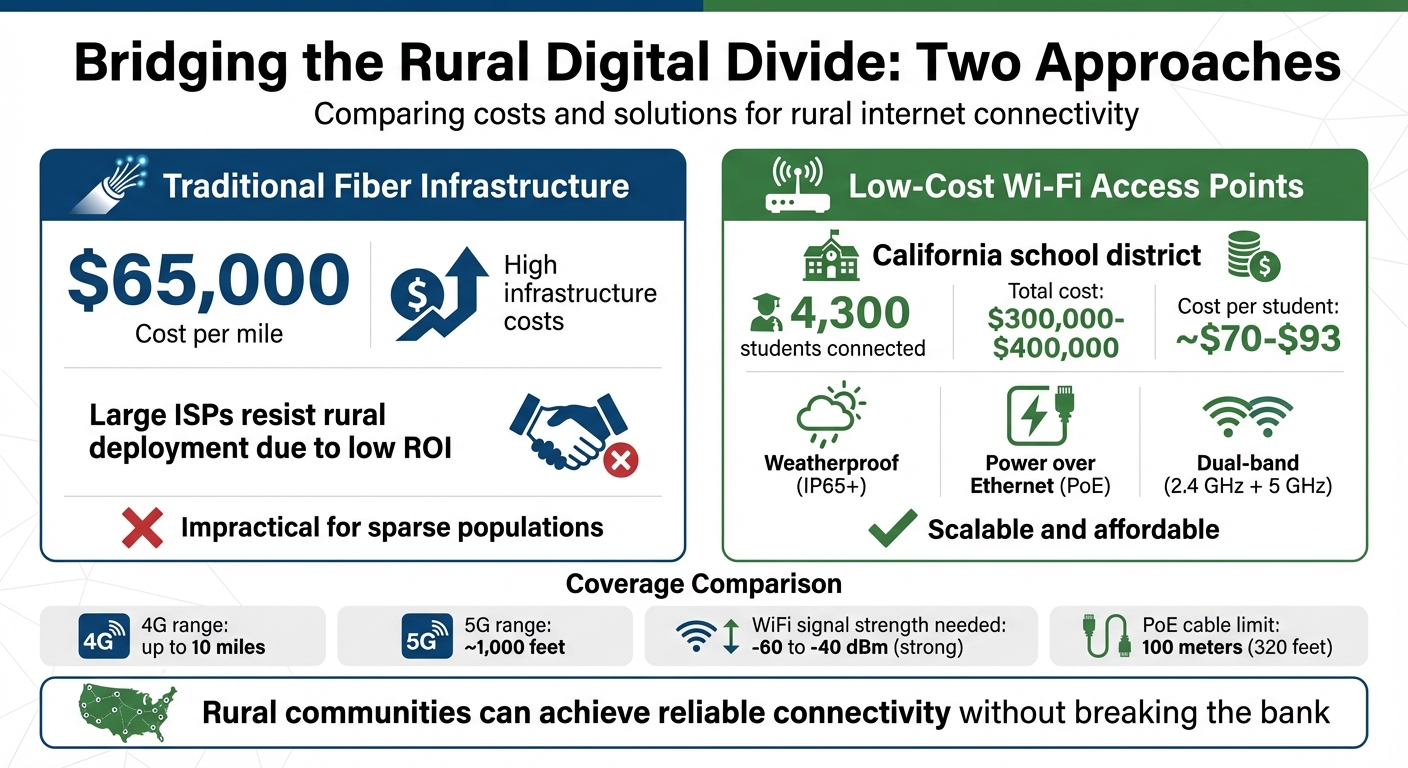
Millions in rural America still lack reliable internet. The main obstacles? High costs of traditional infrastructure, challenging geography, and low population density. Fiber networks can cost up to $65,000 per mile, making them impractical for sparsely populated areas. But there's a solution: low-cost Wi-Fi access points.
These devices extend internet coverage using existing setups, bypassing expensive cable installations. For example, a California school district connected 4,300 students for $300,000–$400,000 - far cheaper than fiber. Features like weatherproof outdoor units, Power over Ethernet, and dual-band operation make these systems ideal for rural use.
Local providers, like WEIRDTOO LLC in Wyoming, offer affordable, flexible plans tailored to underserved areas. Their revenue-sharing models and remote monitoring reduce costs and improve reliability. By focusing on scalable and durable solutions, rural communities can bridge the digital divide without breaking the bank.
Traditional Fiber vs Low-Cost Wi-Fi Access Points for Rural Internet
5 ACRES of WiFi Coverage - Here's How We Did It
What Rural Communities Need for Internet Access
For rural communities, internet access must check three key boxes: reliable, affordable, and low-maintenance. Unlike urban areas, where large providers focus on maximizing profits, rural regions face unique challenges like vast distances between homes, unpredictable weather, and tighter budgets. These factors push rural areas to address geographic and financial hurdles directly.
Infrastructure and Geographic Barriers
The challenges of bringing internet to rural areas go far beyond just covering long distances. Sparse populations make traditional network builds financially unfeasible. Add in rugged landscapes - mountains, dense forests, and scattered homes - and the costs escalate quickly.
Take technologies like 5 GHz Wi-Fi, for example. They rely on a clear line-of-sight between transmitters and receivers. In areas with heavy tree cover or uneven terrain, towers need to be built taller, which drives up expenses. Remote locations also require additional spending on transportation, energy, and skilled labor, often making the price of building a single transmission tower skyrocket [3].
Then there’s the infamous "last mile" problem - the final stretch of infrastructure needed to connect homes. As the Rural Tech Project explains:
"Large internet service providers resisted committing to the last mile of service because of the high infrastructure costs and lack of revenue to recover those costs" [1].
In short, traditional infrastructure is just too expensive to justify in areas with only a handful of homes per mile.
Budget Limitations in Rural Areas
Cost is another enormous hurdle for rural internet access. Tight budgets shape every decision, from installation to ongoing maintenance. And while the upfront expense of bringing internet to rural areas is already high, maintaining and supporting the network adds another layer of financial strain.
Studies have shown that traditional fiber installations often exceed what rural budgets can handle, forcing communities to think outside the box. On top of that, equipment in these areas needs to withstand severe weather - storms, high winds, and other harsh conditions can knock out satellite and fixed wireless connections, leading to costly repairs [1]. For rural areas, the ideal solution is hardware that’s not only durable but also affordable enough to allow for gradual network expansion without requiring huge upfront investments.
This is where cost-conscious Wi-Fi hardware becomes a game-changer, offering a practical way forward for rural connectivity.
Low-Cost Access Points for Rural Areas
Affordable Wi-Fi hardware has made it possible to bring reliable internet access to rural areas without the steep costs of traditional infrastructure. By leveraging existing setups instead of laying down expensive new cables, many communities have successfully expanded connectivity using modern Wi-Fi solutions.
Indoor and Outdoor Models
Indoor access points are ideal for spaces like small businesses, community centers, and libraries where devices stay within a building. These units typically support both 2.4 GHz and 5 GHz bands, allowing them to handle multiple users at once. They’re easy to install - mount them on walls or ceilings - and can connect to existing internet services like DSL or 4G LTE home internet [2].
Outdoor access points, on the other hand, are built to endure harsher conditions. They’re perfect for places like trailer parks, RV communities, and public areas, where weather resistance is key. These models are designed to handle wind, rain, and temperature extremes. To deliver connectivity, they often work alongside backhaul solutions like satellite, fixed wireless, or 4G/5G mobile broadband. Choosing the right backhaul is crucial to ensuring reliable service in these environments [2].
Next, we’ll look at specific models suited for different rural scenarios.
Important Features to Look For
When selecting access points, dual-band operation is a must. The 2.4 GHz band provides extended range, making it great for large outdoor spaces, while the 5 GHz band delivers faster speeds and less interference in areas with many devices [2]. Features like Power over Ethernet (PoE) simplify installation by removing the need for separate power cables, which is especially useful for mounting equipment on poles or building exteriors. For outdoor setups, look for weatherproofing with a rating of IP65 or higher to protect against dust and water.
Coverage range is also a key factor in rural deployments. For instance, 4G networks can reach up to 10 miles, whereas 5G is limited to about 1,000 feet [2]. The geography of the area plays a role too - open fields might require different solutions than forested regions. In some cases, directional antennas like LPDA or Yagi models can help extend signals to distant towers more effectively than omnidirectional ones [4].
sbb-itb-342b8b2
How to Install and Maintain Access Points in Rural Settings
Simple Installation Methods
Start by using a WiFi analyzer app to check signal strength across the property. Look for readings between -60 to -40 dBm for a strong, reliable connection. Signals weaker than -85 dBm are essentially unusable, so this step helps you avoid mounting equipment in dead zones [6].
Using Power over Ethernet (PoE) simplifies the setup by combining data and power into a single Cat6 cable, removing the need for electrical outlets at every mounting point. Just ensure your cable runs are within 100 meters (about 320 feet) to maintain signal integrity [5][6]. For rural areas with lower user density, 2x2 MIMO access points provide adequate coverage and are more budget-friendly compared to pricier 4x4 models [6].
When installing, place access points in open spaces, away from metal structures, ducts, or concrete walls that can block the signal [6][7]. Use existing tall structures like buildings or even trees instead of building new towers, saving time and resources [3]. If you’re deploying several access points, manually assign channels 1, 6, and 11 on the 2.4 GHz band to avoid interference and ensure smooth operation [6].
These straightforward steps help you set up a functional and efficient network while minimizing unnecessary complications.
Maintenance and Support Options
Once the network is up and running, keeping it in good shape is critical, especially in rural areas where reliability matters most. Cloud-based management platforms are a game-changer here, allowing you to troubleshoot issues remotely without needing to send technicians to remote locations [7]. Regularly update firmware to address security vulnerabilities and improve performance, and schedule periodic reboots to clear device memory [5][8]. For outdoor setups, make sure the equipment is rated IP67 for waterproofing and has built-in surge protection to handle harsh weather conditions [9].
"Reliability quickly becomes an important concern once an affordable service has proven itself and as the community becomes more dependent on it, especially for economic activities, such as remote work." - Mike Jensen, Association for Progressive Communications [3]
Empowering local residents can also make a big difference. Train volunteers with basic technical skills to handle minor troubleshooting and user management [3]. Keep spare equipment on-site so broken parts can be swapped out quickly, avoiding long delays for replacements [3]. Additionally, consider providers that offer 24/7 customer support - downtime in rural areas can disrupt remote work or online education, leading to significant setbacks for the community.
WEIRDTOO LLC: Affordable Internet Solutions in Wyoming

Internet Services for Underserved Communities
WEIRDTOO LLC, based in Alpine, Wyoming, is tackling the rural "last mile" connectivity challenge with solutions designed for areas where traditional providers fall short. Focused on rural venues often ignored by large corporations, WEIRDTOO offers Wi-Fi hotspot management without the hefty price tags, bundles, or long-term commitments typical of major providers. Their plans are flexible, starting with a free Basic Plan that includes guest Wi-Fi with customizable splash pages and bandwidth controls for up to 100 monthly logins.
A standout feature of WEIRDTOO's approach is its revenue-sharing partnership model, which offers three tiers to suit different business needs:
- Full-Service: A 70/30 revenue split with a minimum monthly revenue of $300.
- Equipment+Support: A 70/30 split paired with a $100 monthly support fee.
- DIY+Support: An 85/15 revenue split with a $125 monthly retainer.
This model eliminates equipment markups and prioritizes reliable, sustainable connectivity. Each plan includes 24/7 remote monitoring and troubleshooting, a critical feature for rural areas where on-site technician visits can take hours. By focusing on affordability and flexibility, WEIRDTOO provides a practical solution for rural businesses.
Local Wyoming Provider with Community Focus
WEIRDTOO's local roots give it a unique edge in addressing Wyoming's connectivity needs. Operating out of Alpine, the company serves businesses within a four-hour travel radius, ensuring personalized support from a team that understands the area's terrain and infrastructure challenges. This neighborly, community-focused approach sets it apart from impersonal corporate providers [10][11].
The company’s solutions are designed to scale with community needs. Businesses can start with basic guest Wi-Fi and later upgrade to advanced features like video ads, data capture, and API integration as their usage grows. For those just beginning, the Social Free plan provides social login-enabled Wi-Fi at no cost. For $15.47 per month, the Social Plus+ plan adds premium features and supports up to 3,000 logins monthly. This flexibility allows small businesses and trailer parks to test and expand their connectivity options without breaking the bank, offering a practical way to overcome the financial hurdles of rural internet access.
Conclusion
Rural connectivity can thrive without the burden of expensive, long-term contracts, especially when communities embrace affordable access points and straightforward installation methods. These practical solutions offer a lifeline in areas where traditional providers hesitate to invest.
The approach? Start small and grow steadily. For instance, neighbors can share a single upstream connection, sidestepping the hefty costs tied to traditional fiber installations. These grassroots strategies have already proven their value in making connectivity achievable in underserved areas.
Local providers play a pivotal role in this effort by offering customized solutions. Take WEIRDTOO LLC, for example. Their revenue-sharing model removes equipment markups, while 24/7 remote monitoring ensures reliable service - addressing challenges unique to rural areas. Their flexible, budget-friendly plans allow trailer parks and small businesses to experiment with connectivity options without taking on unnecessary financial risks.
Access to broadband is no longer a luxury; it's a necessity for economic growth and community well-being. Rural businesses that invest in affordable connectivity solutions today are better positioned to serve their customers, attract new residents, and secure their community's future. The tools are here, the costs are manageable, and local providers bring the on-the-ground expertise that big corporations simply can't match. By tapping into their resourcefulness and determination, communities can take charge and close the digital divide on their own terms.
FAQs
How do low-cost Wi-Fi access points compare to traditional fiber networks in terms of affordability and functionality?
Low-cost Wi-Fi access points offer a much more budget-friendly option compared to traditional fiber networks, particularly in rural regions. Installing fiber requires expensive trenching and cable-laying, which can run up to $27,000 per mile. In contrast, Wi-Fi access points can be mounted on existing infrastructure like poles or rooftops for a fraction of that expense. This makes them an ideal choice for areas with sparse populations, where the high cost of fiber installation simply doesn’t make financial sense.
Functionally, Wi-Fi solutions can handle essential activities such as online learning, telehealth services, and supporting small businesses - provided they’re backed by a solid connection, like fiber or microwave links. While fiber does deliver faster speeds, lower latency, and better scalability for future needs, its steep costs often outweigh the immediate priorities of rural communities. Low-cost Wi-Fi access points, on the other hand, offer a practical and economical way to bring connectivity to underserved areas, helping to bridge the digital divide.
What should I look for in Wi-Fi access points for rural areas?
When selecting Wi-Fi access points for rural areas, it’s essential to prioritize strong long-range performance and rugged durability. Look for devices equipped with high-gain or directional antennas, as these are great for extending coverage in wide, open spaces. Support for the 2.4 GHz band is also a must since it offers better range and can cut through obstacles like trees more effectively than the 5 GHz band.
In rural settings, access points should be weather-resistant to handle challenging conditions like rain, dust, and extreme temperatures. Power options are another important factor - features like PoE (Power over Ethernet) or solar power are crucial for areas with limited or unreliable access to traditional AC power. Remote management tools, whether cloud-based or simple web interfaces, are invaluable for reducing maintenance costs, especially for community-run networks operating on tight budgets.
To simplify deployment, consider access points with built-in captive portal or splash page capabilities. These features enable providers to offer free or tiered internet access without requiring extra equipment. This makes them an excellent choice for underserved regions where keeping things affordable and straightforward is a top priority.
What are the best ways for rural communities to maintain reliable and affordable internet access?
Rural communities can secure dependable and affordable internet by embracing a community-driven approach to managing their networks. With a DIY model, local volunteers can take charge of the equipment, handle updates, and monitor performance using budget-friendly tools. This keeps the network as a shared resource that serves everyone in the community.
For better efficiency, rural areas can rely on fixed-wireless or satellite links for upstream connections while using unlicensed Wi-Fi spectrum for last-mile coverage. Durable, cost-effective access points paired with backup power solutions like solar panels or batteries can keep the network operational during power outages. Routine inspections and automated alerts for issues like signal drops or outdated firmware help maintain smooth operations and minimize disruptions.
Teaming up with providers that focus on underserved areas, such as WEIRDTOO, can further enhance connectivity. These providers often offer affordable plans, 24/7 customer support, and solutions tailored specifically to rural needs, reducing dependence on big-name corporate options. By blending community involvement, reliable hardware, and partnerships with the right providers, rural communities can build sustainable and efficient internet access systems.
Current contact path
Need custom apparel or scoped help?
Use the contact form; removed product, checkout, research, and newsletter funnels stay offline.