Loading…
Sell themed costumes for local events or parades
By weirdtoo·May 22, 2026·11 min read
Build a home costume business serving local parades and events with themed, durable, budget-friendly outfits.
Sell themed costumes for local events or parades
Selling themed costumes for local events and parades is a great way to meet community needs while running a small business from home. From rodeos to holiday parades, these events create recurring demand for costumes tailored to specific themes. Here's how you can get started:
- Understand Local Needs: Research community events like school history days, county fairs, and theater productions to identify costume demands.
- Focus on Key Themes: Offer costumes for popular local traditions, such as Western wear for rodeos or period outfits for historical reenactments.
- Build Relationships: Connect directly with schools, event organizers, and theater groups to establish yourself as a trusted local vendor.
- Start Small: Begin with a focused range of costumes that can serve multiple purposes, like cowboy gear or colonial outfits.
- Keep Costs Low: Use thrifted materials, a home workspace, and a made-to-order system to manage expenses.
- Set Fair Pricing: Offer transparent pricing for full costumes, partial outfits, and accessories, while ensuring your costs are covered.
- Promote Locally: Use flyers, social media, and community connections to reach potential customers.
Research Local Demand and Event Opportunities
Before diving into costume design or sourcing, take a moment to understand what your community actually needs. A little research into local events can go a long way, and it doesn’t take much effort - just some direct inquiries and a bit of planning.
Build Your Local Event Calendar
Start by checking the calendars of local schools, churches, and your Chamber of Commerce for recurring events. Keep track of what you find in a spreadsheet, noting key details like the event name, date, estimated attendance, costume themes, and contact information. This method helps you quickly identify patterns. For instance, if multiple schools host a "wax museum" presentation every February, you’ll know to prepare a selection of historical costumes ahead of time. These calendars are your roadmap for spotting opportunities and understanding the themes that dominate your area.
Find Popular and Repeatable Themes
Focus on themes that are both timeless and versatile, especially those in the public domain, like Santa Claus or historical periods. This avoids copyright complications while giving you costumes that can serve multiple purposes. For example, a Colonial-era dress could be used for a school history project, a community parade, or even by a reenactment group. To get a sense of what resonates locally, browse photos from past events on community Facebook groups or your town’s official social media. This insight helps you pinpoint themes that are in demand and ensures your inventory aligns with what people actually want.
Define Your Target Customer Groups
Your audience is more diverse than you might think, and understanding their needs is key. Here’s a breakdown of potential customers:
- Parents: They often need costumes for school events, birthday parties, or holidays.
- Community Organizers: These groups look for mascots or themed outfits for fundraisers, festivals, or parades.
- Historical Performers and Reenactors: They require period-accurate costumes and are usually willing to pay extra for quality.
- Local Businesses: Companies sponsoring parade floats or community events may need branded or themed apparel for their staff.
To refine your offerings even further, consider polling local groups about pricing and demand. Reach out to school drama directors or event planners directly to learn about specific needs.
"When the youth have quality costumes that represent their characters they really get into the character. It makes a big difference." - Production Directors, Colorado Costume Castle [2]
sbb-itb-342b8b2
Design and Source Costumes for Local Themes
Start with a Focused Product Range
Begin with a small, adaptable lineup to keep costs in check and production manageable. Think about costumes that can work across multiple events. For example, a western shirt and vest could be perfect for a rodeo, a heritage parade, or even a school history project. Similarly, a Colonial-era dress could be used for a wax museum presentation in February and a Fourth of July parade in the summer. The goal is to get the most out of each design's flexibility.
Take Suzi Sellers of Silhouettes Costumes in Cody, Wyoming, as an example. She built her business by specializing in a niche market. By collaborating with local re-enactment groups and museum curators, her lineup focuses on the historical accuracy of 1880s–1920s garments. She proudly describes her costumes as "historically authentic from the bum up." [1]
Once you’ve defined your product range, focus on sourcing quality materials and employing durable construction techniques.
Choose Materials and Construction Methods
Durability is key when producing costumes, especially if they’re intended for repeated use. As Susan Hurlbutt, a customer of Silhouettes Costumes, explains:
"This is clothing that will last you for a lifetime, not some Halloween costume. Her work is impeccable and she really works with you to get things right." [1]
Investing in a heavy-duty sewing machine can make a big difference, particularly for intricate designs like corsets, layered petticoats, or structured bodices. If you're working with a tight budget, thrift stores can be a great source for base garments to modify, while local fabric shops may offer discounted remnants. For outdoor costumes, adding reflective elements can enhance visibility and safety, especially for parades or evening events. [5]
Set Up a Simple Pricing Structure
Once your product line and construction methods are solid, create a pricing structure that accurately reflects your costs. Factor in everything - materials, labor, storage, and upkeep. Then, decide whether you’ll sell, rent, or use a hybrid model.
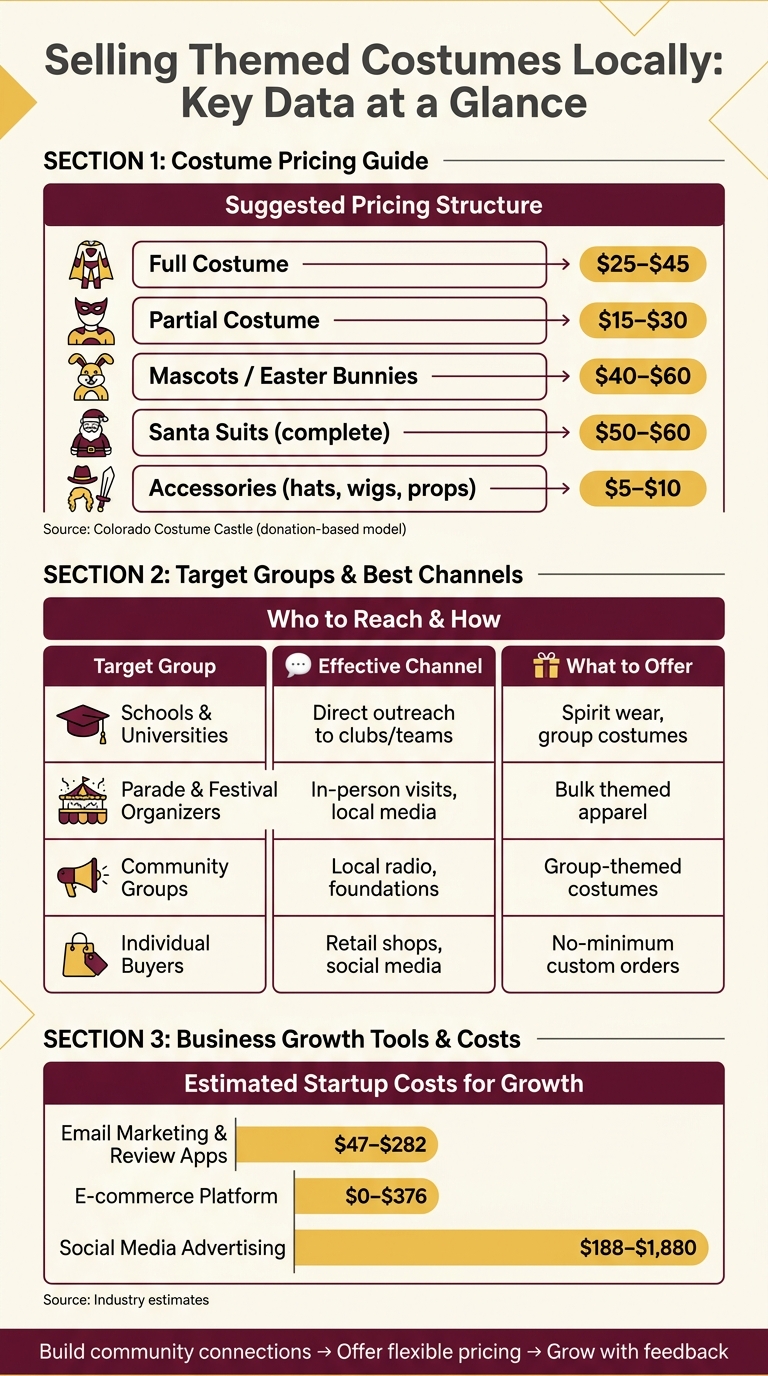
Colorado Costume Castle, a home-based business in Greeley, Colorado, uses a donation-based pricing model. They suggest average prices that keep costumes affordable for schools and community events while covering expenses. Here’s an example of their pricing breakdown:
| Costume Type | Suggested Price/Donation |
|---|---|
| Full Costume | $25–$45 |
| Partial Costume | $15–$30 |
| Mascots / Easter Bunnies | $40–$60 |
| Santa Suits (complete) | $50–$60 |
| Accessories (hats, wigs, props) | $5–$10 |
This approach ensures accessibility while maintaining financial sustainability. As Colorado Costume Castle advises:
"Consider your financial resources and compensation for the time it takes to maintain, launder, dry clean, retire or add costumes." [2]
Connect with Community Organizers and Buyers
Themed Costume Business: Pricing, Channels & Growth Tools at a Glance
Build Relationships with Local Organizers
Connecting with local decision-makers often works better than relying on traditional advertising. Groups like schools, sports teams, non-profits, and parade committees are dependable customers - they usually need group costumes by a deadline and often return each year. By building strong relationships, you position yourself as the go-to local solution for themed costumes while reinforcing a community-first approach.
Take the time to visit these organizers during business hours to discuss their upcoming events. Highlighting your local roots - whether you're "Lander-based" or "Wyoming-born" - can foster trust that a distant online vendor simply can't match. Many organizers come to the table with ideas but lack detailed designs. This is your chance to shine by turning their rough concepts into polished costumes. As Bear Creek Originals explains:
"Bring completed vector files, a sketch on a napkin or just an idea floating around in your head, and we'll get it on a hat, shirt, jacket-back, blanket or whatever material you need." [5]
Offering a no-minimum order policy can also help smaller groups or first-time organizers feel more comfortable testing a theme without committing to a large order. Once these connections are made, staying organized and managing orders efficiently becomes essential.
Collect and Manage Group Orders
Group orders can quickly become complicated without a proper system in place. To streamline the process, use an online form to collect size details and track responses in a spreadsheet. This helps you monitor names, sizes, quantities, and payment statuses, avoiding last-minute confusion as deadlines approach.
It’s also crucial to set and communicate a firm deadline for orders. Transparency about timelines helps manage expectations. For instance, Wyoming Vibes Apparel makes timing clear to their customers:
"Our current production timeframe is 5-7 business days plus shipping time. If you require an item by a certain deadline for a gift or special event, please reach out to us prior to placing your order." [6]
Promote Costumes Through Local Channels
Once orders are underway, it’s time to spread the word using trusted local channels. Post flyers on bulletin boards at libraries, grocery stores, and recreation centers. Partner with local radio shows or community podcasts to build visibility. Snow Deep Designs, a screen-printing studio in Wyoming, successfully raised its profile by engaging with local media and community projects. [3]
Keep your online presence active by sharing photos of completed costumes to attract more local organizers. If your costumes are displayed in a retail location, use that space to highlight upcoming event themes and catch the attention of walk-in customers who might not have realized they needed a costume until they saw yours.
| Target Group | Effective Channel | What to Offer |
|---|---|---|
| Schools & universities | Direct outreach to clubs/teams | Spirit wear, group costumes [4] |
| Parade & festival organizers | In-person visits, local media | Bulk themed apparel [4] |
| Community groups | Local radio, foundations | Group-themed costumes [3] |
| Individual buyers | Retail shops, social media | No-minimum custom orders [3][4] |
Run and Grow a Small Costume Business
Organize Production and Inventory
Using a made-to-order model can help keep upfront costs low and avoid dealing with unsold inventory. As you notice higher demand for certain themes - like holiday mascots, parade characters, or school spirit costumes - you can start building a small inventory of your best-selling items.
To store your costumes effectively, set up a dedicated space such as a garage or basement. Use labeled containers and hangers to make the most of the available room. For instance, Colorado Costume Castle, a home-based business in Weld County, Colorado, organizes thousands of costumes from a residential basement and garage using this method [7]. To maintain costume quality, handle all cleaning yourself instead of relying on customers for laundering [2].
For seasonal items like Santa suits or mascots, a reservation system can help you avoid double-booking and align production schedules with demand [2]. Once your production and inventory are in order, make sure your business complies with all local legal and financial guidelines.
Handle Payments, Taxes, and Legal Basics
If you're running a home-based costume business, you'll likely need a local business permit. Colorado Costume Castle, for example, became a Class II Home Based Business in April 2020 after meeting local zoning requirements:
"In April 2020 the Costume Castle became an official Class II Home Based Business (with the ever grateful help of a customer who navigated the way through the tangle of government requirements)." - Kathy Rickart, Owner, Colorado Costume Castle [7]
Contact your county clerk's office early to understand the specific requirements in your area. On the financial side, keep detailed records of all transactions, even if you use a flexible or donation-based pricing model. Compare your revenue against costs like materials, cleaning, and replacements to ensure profitability. When designing costumes, opt for original or historically inspired designs to avoid potential legal issues. These designs also tend to be more durable and appealing to customers [1].
Grow the Business Using Connectivity and Feedback
Customer feedback is one of the best tools to help your costume business grow. After events, reach out to organizers to learn what worked well and what could be improved. These conversations might even spark ideas for new costume themes. Use your local connections to build an email list and collect feedback regularly - email marketing is a cost-effective way to boost customer engagement, with startup costs for basic tools ranging from $47 to $282 [8].
If you're selling online, analytics can guide your production decisions. Look at which costume pages get the most traffic and conversions to determine what to focus on next. Introducing limited-run designs tied to specific events can create urgency and let you test new themes without committing to large inventories. If a limited run sells out quickly, it’s a strong indicator that the design could become a regular part of your offerings.
| Growth Tool | Estimated Cost | What It Does |
|---|---|---|
| Email marketing & review apps | $47–$282 | Automates feedback requests and builds repeat customers |
| E-commerce platform | $0–$376 | Hosts your store and tracks customer data |
| Social media advertising | $188–$1,880 | Reaches local customers and tests new costume ideas |
Source: [8]
Conclusion
Selling themed costumes for local events and parades offers a rewarding small business opportunity rooted in community connections. The formula is simple: identify what local groups need, maintain fair pricing, and consistently show up for schools, churches, theaters, and parade organizers. This tried-and-true approach highlights the importance of fostering strong relationships within your community.
Offering accessible pricing tiers not only draws in customers but also encourages repeat business. This way, one-time buyers are more likely to return season after season.
Successful businesses in this space do more than just sell costumes - they become part of the community fabric. As Suzi Sellers of Silhouettes Costumes shared:
"These connections with 'The Cody Gunfighters' and museum curators as well as historical organizations led to development of the Buffalo Gals... as well as good local customers who value historical accuracy." [1]
As discussed earlier, understanding local needs and forming direct relationships are the cornerstones of success. This type of growth thrives on personal engagement. Whether you’re running a small home studio or setting up a booth at a parade, tailoring your offerings to reflect your community’s unique character ensures your business becomes a cherished part of local celebrations.
FAQs
Should I sell or rent costumes?
Choosing whether to sell or rent costumes largely depends on your business goals and the audience you're targeting. Renting is a smart option for events like parades or parties, as it can generate steady income over time while keeping initial expenses lower. On the other hand, selling is ideal for niche markets, such as historical reenactors or collectors who are on the hunt for one-of-a-kind pieces.
Many costume businesses strike a balance by offering both options - renting out costumes for short-term needs while selling select items to appeal to a broader range of customers. The key is to match your strategy to your community's preferences and the inventory you can manage effectively.
How do I find my town’s best costume themes?
Dive into your local community to uncover costume ideas that resonate with popular themes in your area. Start by checking out community theaters, schools, and churches - they often host themed events or productions that can spark inspiration.
Another great option? Look into local festivals, parades, or historical reenactments. These events often highlight traditions or styles unique to your town, offering a treasure trove of ideas.
By connecting with local organizations and observing the costumes people wear at these gatherings, you’ll get a better sense of what themes are a hit in your community.
What permits do I need to sell from home?
To sell physical products from your home in Wyoming, you'll need to obtain a seller's permit from the Wyoming Department of Revenue. On top of that, some cities or counties may require you to have a local business license or a home occupation permit. Be sure to review your local regulations carefully to make sure you're meeting all necessary requirements.
Current contact path
Need Weird Network WiFi, custom apparel, or scoped help?
Use the contact form; removed product, checkout, research, and newsletter funnels stay offline.