Loading…

Scaling Rural Internet: Cost Challenges and Solutions
By weirdtoo·July 27, 2026·8 min read
Why rural internet costs more and how funding, mixed network tech, shared assets, and automation cut per-home costs.
Scaling Rural Internet: Cost Challenges and Solutions
Rural internet costs more for one plain reason: providers spend more miles, labor, and equipment on fewer customers. If you want to cut the cost, the short answer is this: use the right mix of funding, network type, shared infrastructure, automation, and stopgap access.
Here’s the article in simple terms:
- The main cost problem: too much build cost spread across too few homes
- The biggest cost buckets: civil work, backhaul, labor, power, and upkeep
- The main network choices: fiber, fixed wireless, and low-Earth orbit satellite
- The main ways to cut cost: grants, loans, local partnerships, shared assets, and faster permits
- What ISPs can do now: match network type to terrain and density, automate support work, and cut truck rolls
- What to do when full build-out still fails on cost: use public WiFi and hotspot sites as a stopgap
A rural build can cost 2x to 4x more per home passed than a denser build in many parts of the U.S., mainly because trenching, boring, and backhaul do not get much cheaper just because fewer people live there. And when field crews have to drive long distances for installs and repairs, day-to-day costs stay high.
My takeaway: the lowest-cost path is not “build fiber everywhere first.” It is usually a layered plan: use fiber where homes cluster, fixed wireless where homes spread out, satellite where terrain blocks both, and public hotspot access where a full build still does not make sense.
If you want a simple way to think about it, this is the whole article at a glance:
| Area | What drives cost | What helps cut it |
|---|---|---|
| Build | Trenching, boring, long routes | Grants, shared assets, better route planning |
| Backhaul | Distance to existing fiber | Co-location, shared middle-mile links |
| Last mile | Sparse homes, rough terrain | Mix fiber, fixed wireless, satellite |
| Support | Truck rolls, labor, remote power | Remote diagnostics, AI chat/voice, workflow automation |
| Access gaps | Full build still too expensive | Managed WiFi hotspots at community sites |
In short: rural internet gets cheaper when you avoid overbuilding, reuse what is already there, and phase service in smart steps.
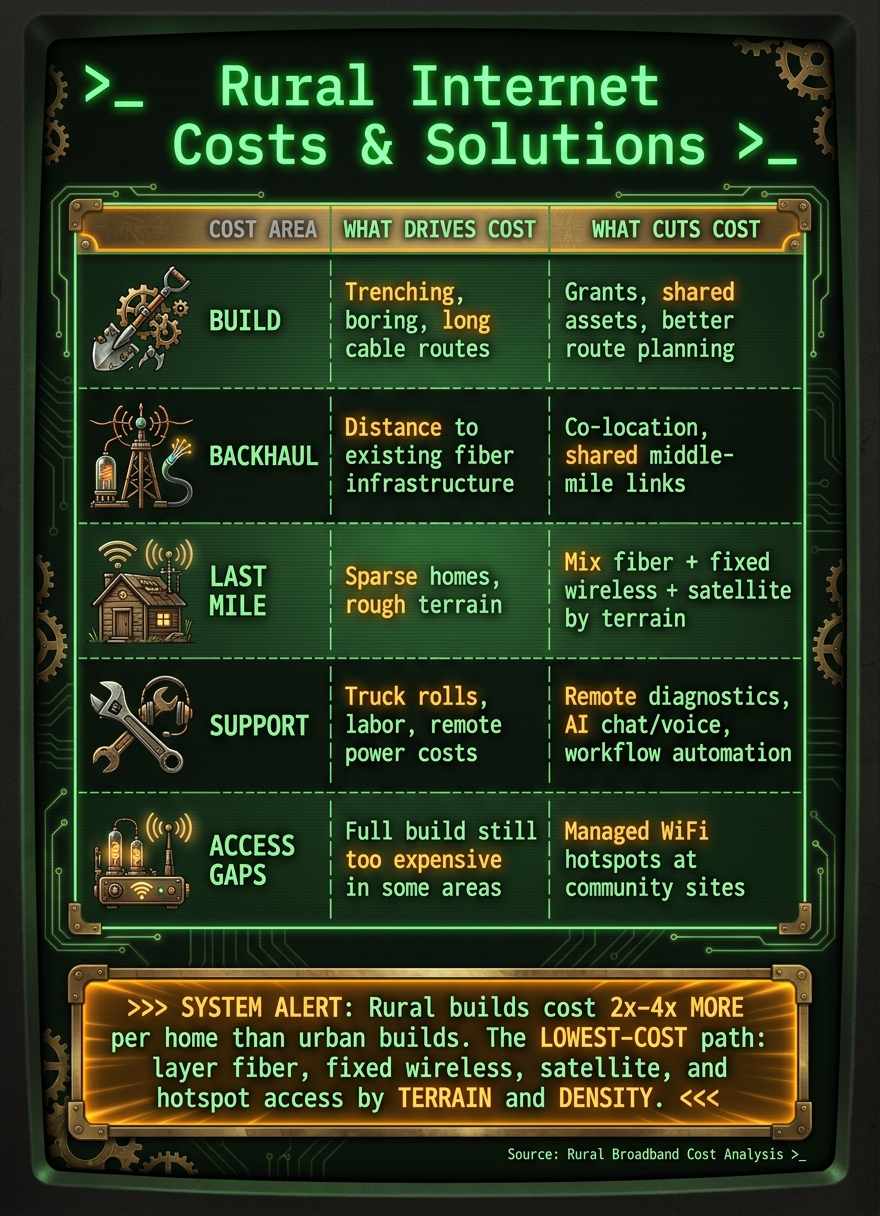
Rural Internet Cost Drivers & Solutions: A Visual Breakdown
The Biggest Cost Drivers in Rural Broadband Builds
Fiber, Backhaul, and Civil Work Costs Add Up Fast
Rural broadband budgets usually get squeezed by three big cost buckets: civil work, backhaul, and operations.
Civil work is often the biggest hit. Trenching and directional boring can cost more than the fiber going into the ground. And that’s where the math gets rough fast: when digging costs climb, the cost per home passed climbs with them.
Backhaul can be another major line item. If nearby fiber routes don’t exist - or they’re too far away to connect without extra work - the cost jumps again.
Last-Mile Technology Choice Drives Cost per Premise
The right last-mile option depends on a few plain factors: terrain, population density, and available capital.
Fiber, fixed wireless, and low-Earth orbit satellite each come with a different tradeoff. Some ask for more money upfront but can serve more homes over time. Others help you reach people faster, but with different operating costs.
There’s no one-size-fits-all answer here. A flat, clustered service area looks very different from a mountain road with homes spread miles apart.
Labor, Power, and Maintenance Keep Operating Costs High
Operating costs also stay high in rural areas for a simple reason: each customer takes more time and effort to serve.
Labor, truck rolls, customer support, remote site power, and routine maintenance all cost more when customers are spread across long distances. Weather makes it tougher too. Repairs take longer, crews travel farther, and costs keep stacking up.
That puts smaller operators in a bind. When so much of the budget goes to keeping the network running, there’s less left to put back into new buildouts.
When these costs stay high, funding, partnerships, and permitting reform become the next places operators look to control spend.
sbb-itb-342b8b2
Funding and Policy Tools That Cut Rural Internet Costs
When fiber, backhaul, labor, and civil work make rural builds too expensive to pencil out, funding and policy support help close the gap. In these areas, outside funding and faster approvals aren't just helpful. They're often what makes the project possible.
Grants and low-interest loans cut upfront CAPEX in high-cost areas, which helps turn projects into workable builds that might otherwise stall. Federal programs focus on the highest-cost zones in particular, helping offset per-home costs that private capital alone often can't carry.
Co-ops, municipal networks, and local partnerships can also bring costs down. They do that by sharing assets, existing infrastructure, and labor. It's a pretty simple idea: if a community can use what's already there, the build gets cheaper.
Faster permitting and streamlined rights-of-way approvals help in a different way. They reduce delays, rework, and idle crew time, which lowers total project cost and keeps the schedule from slipping.
The next cost lever is network design - choosing the right technology and operating model for the terrain.
How ISPs Can Scale Rural Internet at Lower Cost
Once funding and permitting take some pressure off the front end, the next big factor is network design. That’s what decides whether a rural build stays within budget or starts getting expensive fast.
Match Network Technology to Terrain and Density
Rural ISPs keep costs down when they match each area to the right network type. Fiber makes sense for backbone routes and places where homes are grouped together. Fixed wireless works well for sparse last-mile coverage. Satellite should be the fallback when terrain gets in the way of both.
That approach matters because every mile you don’t build saves money for the next phase. In rural markets, that kind of discipline can make the difference between a project that keeps moving and one that stalls out.
Share Infrastructure and Automate Routine Work
Once the right mix of network tech is in place, the next place to cut cost is operations. A lot of savings come from avoiding duplicate assets and reducing truck rolls.
Shared backhaul, co-location, and reuse of current infrastructure help ISPs avoid paying for expensive assets that are already in the region. It’s a simple idea: if the asset is there and can do the job, don’t build it again.
On the operations side, automation is a direct way to lower day-to-day costs for rural ISPs. Cloud-managed network monitoring, remote diagnostics, and predictive maintenance can cut truck rolls and reduce field dispatches that don’t need to happen.
AI voice and chat agents can also take care of routine support requests and billing questions. That cuts inbound call volume and gives staff more time for higher-value work. Billing and provisioning workflows can be automated too, which reduces back-office manual hours and lowers maintenance costs across the board.
Use Public WiFi and Hotspot Models Where Full Build-Out Is Not Yet Viable
Some areas still won’t support a full build right away. When that happens, hotspot access can help bridge the gap.
Managed WiFi hotspots at businesses, libraries, and community hubs give people a way to get online while the full build-out is still not viable. It’s not the end goal, but it can extend access sooner without forcing an ISP into a build that doesn’t yet make financial sense.
Conclusion: Build a Lower-Cost Rural Internet Strategy With the Right Mix
Rural builds stay expensive for a simple reason: too many fixed costs are spread across too few customers.
The answer isn’t one big move. It’s a mixed strategy. ISPs that control costs well match the right technology to the terrain, go after federal funding, share infrastructure, and automate routine support work. That mix works best when each part is done together and in the right order.
Sometimes, though, a full build still doesn’t pencil out. When that happens, interim access can help close the gap. Managed WiFi hotspots at local businesses and community spaces give people a temporary way to get online without waiting for a full build to become financially workable.
Rural broadband tends to scale better with a layered plan: use funding, share infrastructure, automate routine work, and add interim access where full builds still fall short.
FAQs
When does fiber make sense in rural areas?
The answer misses the question about when fiber makes sense in rural areas.
Instead, it talks about an enterprise product for AI agents in voice and chat workflows, including managed access, guardrails, and escalation rules. That’s a different topic.
If you want, send over the correct source text for this FAQ and I’ll rewrite it.
How can ISPs lower truck roll costs?
The original answer doesn’t address truck roll costs at all.
Instead, it talks about an AI development platform. More specifically, it describes tools for managing, automating, and building with AI agents, including:
- a command center
- a CLI
- a Python SDK
- an agentic IDE
It also mentions artifact management, verification tests, support for both hobbyists and professional developers, and that the platform is available at no charge.
Are public hotspots a real short-term solution?
The current answer misses the actual point.
It talks about an enterprise AI product for voice and chat agents: guardrails, escalation rules, engineer-led setup, and an improvement loop. That may be useful in its own lane, but it does not address public hotspots or rural internet scaling.
If the topic is public access and rural connectivity, the answer needs to focus on things like:
- Public Wi-Fi hotspots in libraries, schools, transit hubs, parks, and town centers
- Fixed wireless and LTE/5G options for hard-to-reach areas
- Fiber backhaul and middle-mile buildout
- Subsidy programs, grants, and public-private funding models
- Network capacity, uptime, coverage gaps, and device access
- Affordability for households that may live in coverage areas but still can’t pay for service
Right now, the response is solving a different problem. It explains how to run customer-facing AI agents inside an enterprise setting, not how to expand internet access in underserved places.
A better answer would connect public hotspot planning with rural scale issues. For example, it could explain how a county or ISP might use hotspot clusters as a stopgap while building out fixed wireless or fiber, or how schools and community centers can act as anchor sites for local coverage.
So the gap is pretty simple: wrong subject matter. The answer should be rewritten around connectivity infrastructure, access points, cost, and rural deployment constraints instead of AI agent operations.
Current contact path
Need custom apparel or scoped help?
Use the contact form; removed product, checkout, research, and newsletter funnels stay offline.