Loading…

Print-on-Demand Margins, Actually
By weirdtoo·October 26, 2026·10 min read
Count every order cost - production, shipping, fees, returns, ads - to calculate true print-on-demand contribution and break-even price.
Print-on-Demand Margins, Actually
I price a print-on-demand product by what remains after the order costs - not just the printing bill. In one hypothetical $30.00 T-shirt order, production and shipping leave $12.00, a 40% gross margin. Fees, ads, and a returns allowance cut that to $4.80 before overhead. That is not take-home pay.
Before listing, I check:
- Revenue: Price after discounts, plus customer-paid shipping, excluding sales tax.
- Order costs: Production, packaging, shipping, fees, returns, ads, and artist compensation - each counted once.
- What remains: Contribution pays toward overhead; net profit is what remains afterward.
I use those numbers to test break-even prices and decide whether to keep, reprice, bundle, or pause a product. Free shipping still has a bill. <u>Unknown costs stay marked unknown</u> until I check supplier quotes and actual orders.
How Much Can You REALLY Make with Print-on-Demand? Honest Profit Breakdown with Examples + Supplier
sbb-itb-342b8b2
Count Every Order Cost
Build your worksheet from supplier invoices and platform statements - not catalog rates alone. Before adding printing, packaging, or pick-and-pack charges, check whether the base cost already includes them. Count every variable cost once so you can see how much of the listing price remains as contribution profit.
| Cost | Charge type | What to record |
|---|---|---|
| Production | Per item | Blank product; check whether decoration is bundled |
| Decoration | Per item; sometimes setup | Printing, embroidery, extra placements, digitization |
| Fulfillment | Per order or item | Pick-and-pack charges, only if billed separately |
| Packaging | Per order or item, depending on supplier | Standard packaging or paid upgrades; check what’s bundled |
| Shipping | Per shipment | Supplier shipping and applicable surcharges |
| Platform fees | Per listing, per order, or percentage-based | Applicable listing fees, commissions, and transaction fees |
| Payment fees | Percentage plus fixed amount | Processing on the applicable checkout total |
| Discounts | Per order or percentage | Reduce revenue; don’t also subtract as an expense |
| Refunds, reprints, and chargebacks | Per incident, then averaged per order | Unrecovered losses |
| Advertising | Allocated per order/customer | Ad spend by order or customer |
| Artist compensation | Per item, percentage, or fixed fee | Royalties, licensing, or commissioned work; record royalties and licensing here, not in overhead |
Track fixed overhead by month and allocate it separately from variable order costs.
Production Costs, Platform Fees, and Taxes
Give production, shipping, and collected sales tax separate columns. Check which platform fees apply: listing, commission, transaction, processing, or subscription fees. Stripe’s standard U.S. processing rate is 2.9% + $0.30, but check current terms before listing.[5][6]
Processing fees may apply to shipping and collected sales tax. Tax collected for remittance is not revenue, even when it adds to the amount used to calculate processing fees.[5][7]
Shipping Charges and Checkout Totals
Free shipping changes who pays. The shipping bill stays. Include customer shipping payments in revenue, then deduct the supplier’s shipping charge separately. Even if you charge the exact carrier amount, you still pay processing fees on that payment.
Test mixed-product carts before setting your shipping policy. One order can produce multiple shipments.[5][8]
| Policy | Checkout total, before tax | Seller-paid shipping gap | Advantage | Drawback |
|---|---|---|---|---|
| Customer-paid shipping | Product price + shipping | Supplier cost minus collected shipping | Visible shipping recovery | Higher checkout total |
| Free shipping | Product price only | Full shipping charge | Simple offer | Lower contribution |
| Built into product price | Higher product price; no separate shipping charge | Supplier cost minus built-in allowance | Recovery through pricing | Costs may exceed allowance |
Shipping policy can change margin more than sellers expect - and determine whether a product breaks even at the target price.
Discounts, Returns, and Advertising Costs
Record coupons as lower revenue, not as an expense. Estimate unrecovered refunds, reprints, and chargebacks using refunded revenue plus replacement production, shipping, and fees, minus any supplier credit. Don’t count refunded revenue twice.
Read the supplier’s policy before promising replacements. Manufacturing-defect coverage may exclude buyer remorse or sizing exchanges.[1][4]
Customer acquisition cost = ad spend ÷ attributed new customers. Include order-level ad spend in variable costs and keep overhead separate.[2][5][6]
Carry these per-order numbers into the next section’s pricing examples and break-even tests.
Hypothetical Profit Calculations for 3 Products
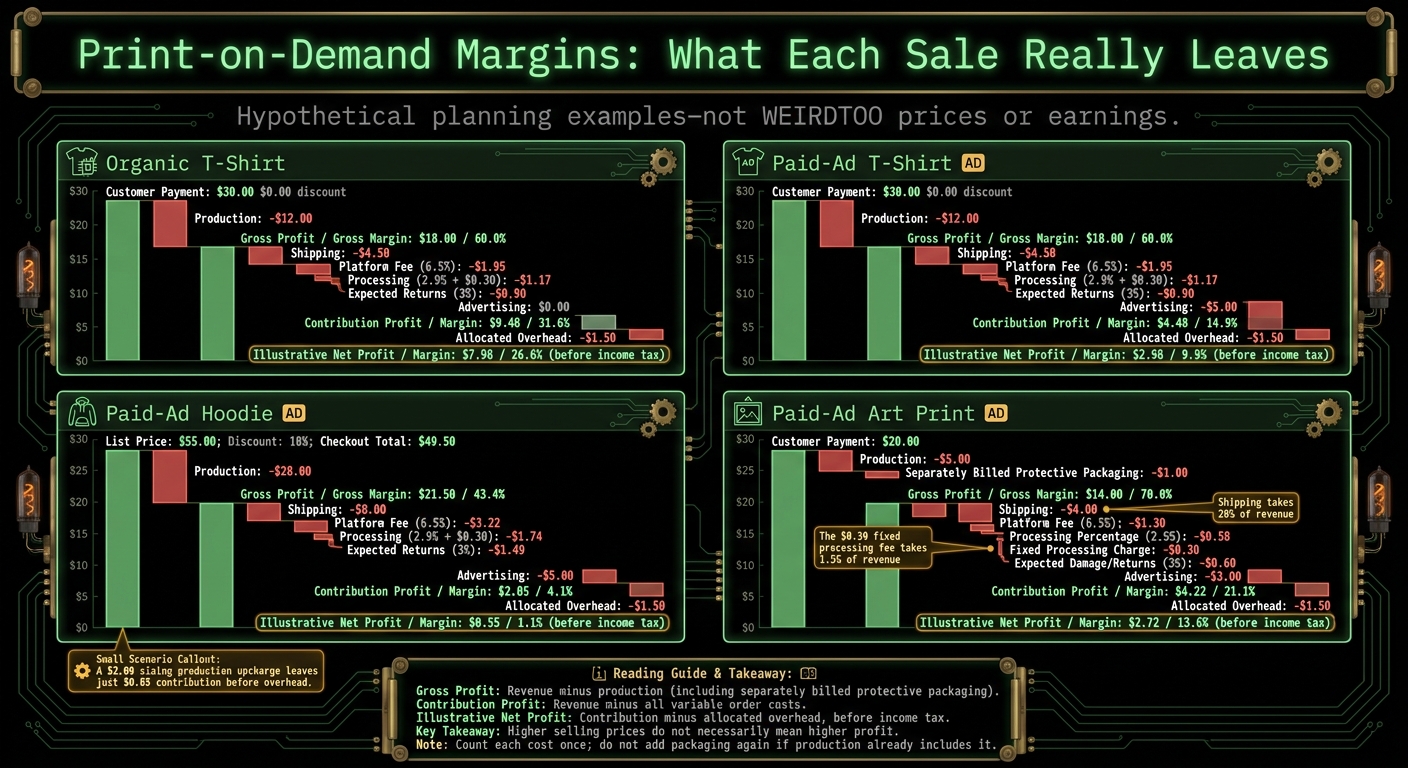
Print-on-Demand Margins: What Each Sale Really Leaves
These hypothetical planning examples assume seller-paid shipping, a 6.5% platform fee, processing at 2.9% + $0.30, and $1.50 in overhead per order. They are not WEIRDTOO prices or earnings.
Each table shows what remains after production, shipping, fees, return allowances, ads, and overhead.
T-Shirt: What Remains From a $30.00 Price
A $30.00 shirt with $12.00 production leaves $18.00 in gross profit. Shipping, fees, returns, ads, and overhead still need to come out.
Calculation Organic sale Paid-ad sale Customer payment: $30.00 − $0.00 discount $30.00 $30.00 Production −$12.00 −$12.00 Gross profit / gross margin $18.00 / 60.0% $18.00 / 60.0% Shipping −$4.50 −$4.50 Platform: 6.5% × $30.00 −$1.95 −$1.95 Processing: 2.9% × $30.00 + $0.30 −$1.17 −$1.17 Expected returns/replacements allowance: 3% −$0.90 −$0.90 Advertising $0.00 −$5.00 Contribution profit / margin $9.48 / 31.6% $4.48 / 14.9% Allocated overhead −$1.50 −$1.50 Illustrative net profit / margin, before income tax $7.98 / 26.6% $2.98 / 9.9%
Hoodie: Shipping and Sizing Costs
The paid-ad hoodie leaves less contribution profit than the paid-ad T-shirt. Add a $2.00 production upcharge for sizing, and the hoodie leaves just $0.05 before overhead.
Calculation Paid-ad hoodie Paid-ad T-shirt Checkout total after discount $49.50 ($55.00 less 10%) $30.00 Production −$28.00 −$12.00 Gross profit / gross margin $21.50 / 43.4% $18.00 / 60.0% Shipping −$8.00 −$4.50 Platform: 6.5% of payment −$3.22 −$1.95 Processing: 2.9% of payment + $0.30 −$1.74 −$1.17 Expected returns/replacements allowance: 3% −$1.49 −$0.90 Advertising −$5.00 −$5.00 Contribution profit / margin $2.05 / 4.1% $4.48 / 14.9% Allocated overhead −$1.50 −$1.50 Illustrative net profit / margin, before income tax $0.55 / 1.1% $2.98 / 9.9%
Art Print: Packaging, Shipping, and Fixed Fees
For this $20.00, 8 × 10-inch print, count separately billed packaging as a direct cost. If production already includes it, don't count it twice.[6]
Calculation Amount Customer payment $20.00 Production −$5.00 Protective packaging −$1.00 Gross profit / gross margin $14.00 / 70.0% Shipping −$4.00 Platform: 6.5% × $20.00 −$1.30 Processing percentage: 2.9% × $20.00 −$0.58 Fixed processing charge −$0.30 Expected damage/returns allowance: 3% −$0.60 Advertising −$3.00 Contribution profit / margin $4.22 / 21.1% Allocated overhead −$1.50 Illustrative net profit / margin, before income tax $2.72 / 13.6%
Shipping takes 20% of the print's revenue. The $0.30 fixed processing fee takes another 1.5% of the $20.00 order. When testing bundles, use actual combined packaging and shipping costs, then use these contribution margins to work out break-even prices.
Find Break-Even Prices and Decide What to Sell
Calculate a Price That Covers Costs
Work backward from the contribution profit in the examples above to find your minimum price.
Contribution break-even covers variable costs only. Business break-even covers fixed costs too. Break-even units = fixed costs ÷ average contribution per order.[2]
Set a per-order contribution target that covers fixed costs and your profit goal at your expected order volume. Include every variable cost: production, fulfillment shipping, payment fees, ad spend, and a reprint or service allowance. Keep the payment-fee assumption used in the examples above.[6][5] Allow 3% to 5% for misprints and customer-service losses.[4]
Compare Coupons, Free Shipping, and Ad Costs
Hypothetical sensitivity test - not WEIRDTOO prices or earnings.
Scenario What changes Contribution impact 15% coupon on a $15 mug with $8 production cost The price paid drops Amount left falls from about $7 to $4.37.[7] Free shipping on a $35 T-shirt The seller pays shipping Amount left falls from about $23.91 to $19.10.[5] Paid acquisition Ad spend increases Contribution after other variable costs sets the ceiling for customer acquisition cost (CAC).[2]
Check coupons and free shipping against contribution after acquisition costs, not just sales revenue.[2] Use the change in contribution to judge whether a SKU still earns enough at your target volume.
Keep, Reprice, Bundle, or Pause Products
Rank products by contribution dollars after ads, then workload, then sales volume.[3] Run the same cost check on every SKU before deciding what to keep, reprice, bundle, or pause.
| Decision | What the numbers show | Action |
|---|---|---|
| Keep | Contribution meets your dollar target at realistic volume | Track contribution and workload by SKU. |
| Reprice | Discounts or seller-paid shipping push contribution below target | Increase the affected price or narrow the promotion. |
| Test a bundle | Combined fulfillment costs improve contribution, and fixed transaction fees spread across more revenue.[1] | Check packaging and shipping quotes before discounting. |
| Pause | The price buyers will pay cannot cover costs and required contribution | Stop promoting the product until costs or demand change. |
Conclusion: Check the Numbers Before Listing
Use this worksheet for each SKU to check whether the price covers the costs in the earlier model.
Use a Worksheet and Review Actual Orders
After the break-even test, record the quote date and destination ZIP code. Use actual order data to check each product’s price, then compare estimated costs with what you paid.
| Worksheet field | Enter or calculate |
|---|---|
| Product | Item, size, and print options |
| List price | Price before sales tax |
| Discount | Dollar reduction |
| Customer-paid shipping | Shipping collected at checkout |
| Revenue | List price − discount + customer-paid shipping; exclude sales tax |
| Production | Product, printing, and setup |
| Fulfillment shipping | Provider’s delivery charge |
| Platform fees | Applicable per-order charges |
| Processing | Percentage fee + fixed charge |
| Returns/reprints allowance | Expected returns, reprints, and service losses |
| Advertising | Ad spend per order |
| Contribution profit | Revenue − all variable costs |
| Contribution margin | Contribution profit ÷ revenue × 100 |
| Overhead allocation | Per-order share of fixed costs |
| Break-even unit price | Unit price where contribution covers allocated overhead |
Check estimates against actual orders monthly. Recalculate when platform policies or ad costs change.[6][5][1] Adjust the worksheet price until it covers costs and leaves room for overhead and profit.
Include royalties or design fees in the same worksheet - not just product and shipping costs.
Include Artist Compensation in Pricing Plans
WEIRDTOO’s OddDrip store will price for product costs and artist compensation. Treat this as a planning example, not a payout claim.
Build artist compensation into the price rather than paying it from whatever remains.[2]
FAQs
How should I price products before I have sales data?
Add up every order-level cost: product, printing, shipping, platform fees, payment processing, and estimated customer acquisition costs. Then add a 40%–60% buffer over that total to cover unexpected returns, fee increases, and advertising fluctuations. Treat this buffer as a planning assumption, not a guaranteed cushion.
Before publishing, calculate net margin:
(retail price − all order-level costs) ÷ retail price
Express the result as a percentage. If it falls below your minimum profit target, adjust the price. Mark unknown costs as estimates rather than leaving them out.
Use print-on-demand to test interest, then update your cost estimates as sales data comes in.
How do I factor my own time into profit?
Time spent on design, store management, and marketing often acts as a fixed cost. Estimate your monthly hours, multiply them by an hourly wage for yourself, and add that amount to your fixed operating expenses.
To find your break-even sales volume, divide total monthly fixed costs by the contribution margin per product. Round up to the next whole unit. If sales don’t cover those costs, your unpaid labor is helping fund the business.
Can repeat purchases justify higher ad costs?
Yes. Repeat purchases increase customer lifetime value and help cover the cost of acquiring that customer. Later orders often need no extra ad spend, which can improve overall profit even when the first order leaves little margin.
Before spending more on ads, check net margin - not gross markup. Track your blended customer acquisition cost, and focus on premium pricing that draws repeat buyers rather than shoppers who only want the lowest price.
Current contact path
Need custom apparel or scoped help?
Use the contact form; removed product, checkout, research, and newsletter funnels stay offline.