Loading…
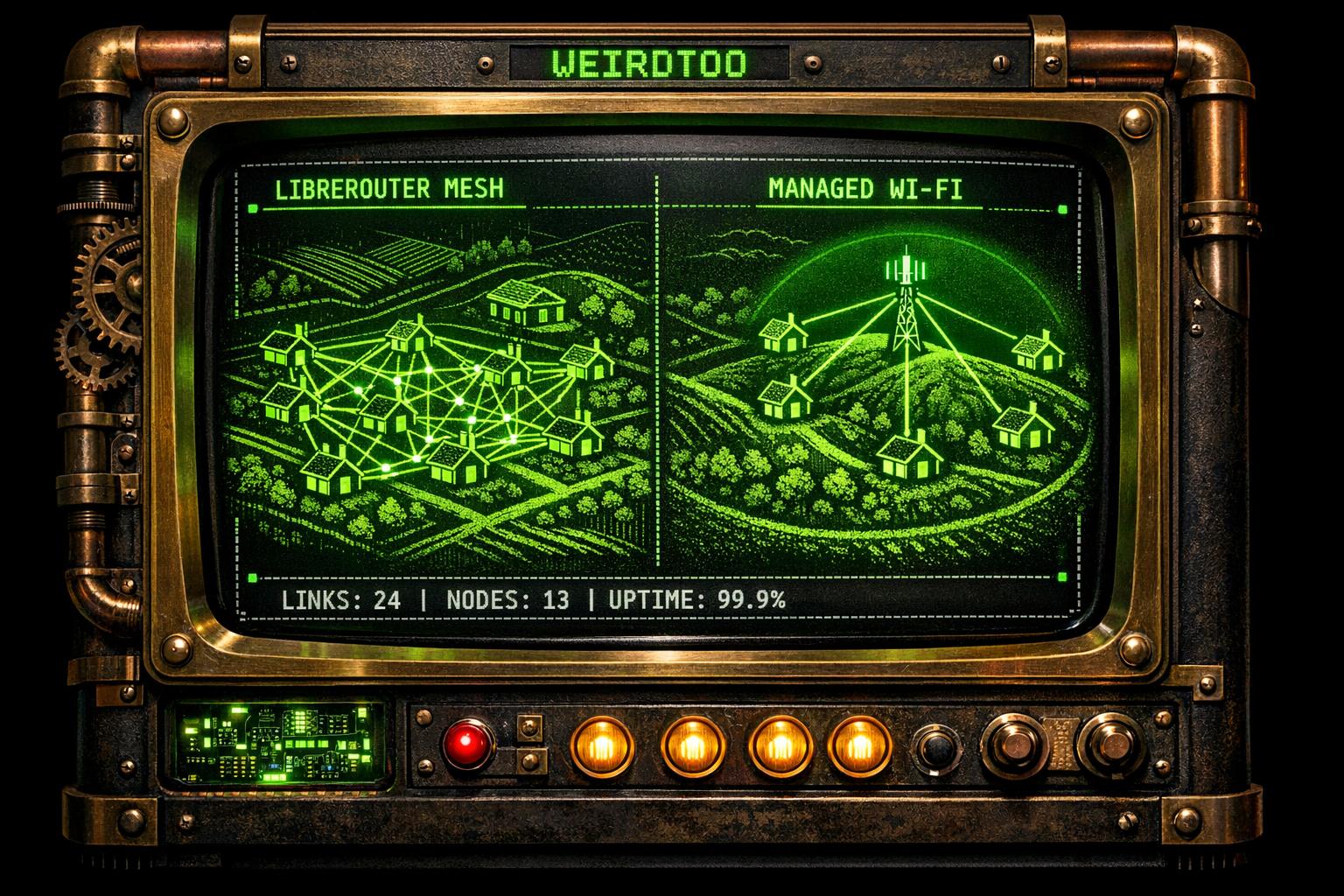
LibreRouter: Affordable Networking for Communities
By weirdtoo·April 25, 2026·8 min read
Compare an open-source mesh router and a managed Wi‑Fi service to weigh community control versus turnkey convenience for rural and underserved connectivity.
LibreRouter: Affordable Networking for Communities
Four billion people lack internet access globally, with most living in rural or underserved areas. Traditional telecom providers often overlook these regions due to low profitability. Two solutions tackle this issue in different ways:
- LibreRouter: A community-driven, open-source hardware and software platform designed for wireless mesh networks. It’s durable, solar-compatible, and repairable using local resources. Communities can manage networks themselves, making it cost-effective long-term.
- WEIRDTOO LLC: A managed Wi-Fi service targeting rural areas and trailer parks. It offers no upfront equipment costs, revenue-sharing models, and 24/7 remote support. Ideal for communities needing quick, hassle-free connectivity.
Quick Comparison
| Criteria | LibreRouter | WEIRDTOO LLC |
|---|---|---|
| Initial Cost | Hardware purchase required | No upfront equipment costs |
| Monthly Fees | None after purchase | $0–$15.47+ based on plan |
| Expertise Needed | Community-managed setup and maintenance | Minimal; full support provided |
| Scalability | Expands via mesh nodes | Plans scale up to 3,000+ logins |
| Maintenance | Community-led repairs | 24/7 remote monitoring included |
| Best For | Self-reliant communities | Small businesses, trailer parks |
Your choice depends on whether you prefer control and autonomy (LibreRouter) or ease and convenience (WEIRDTOO LLC).
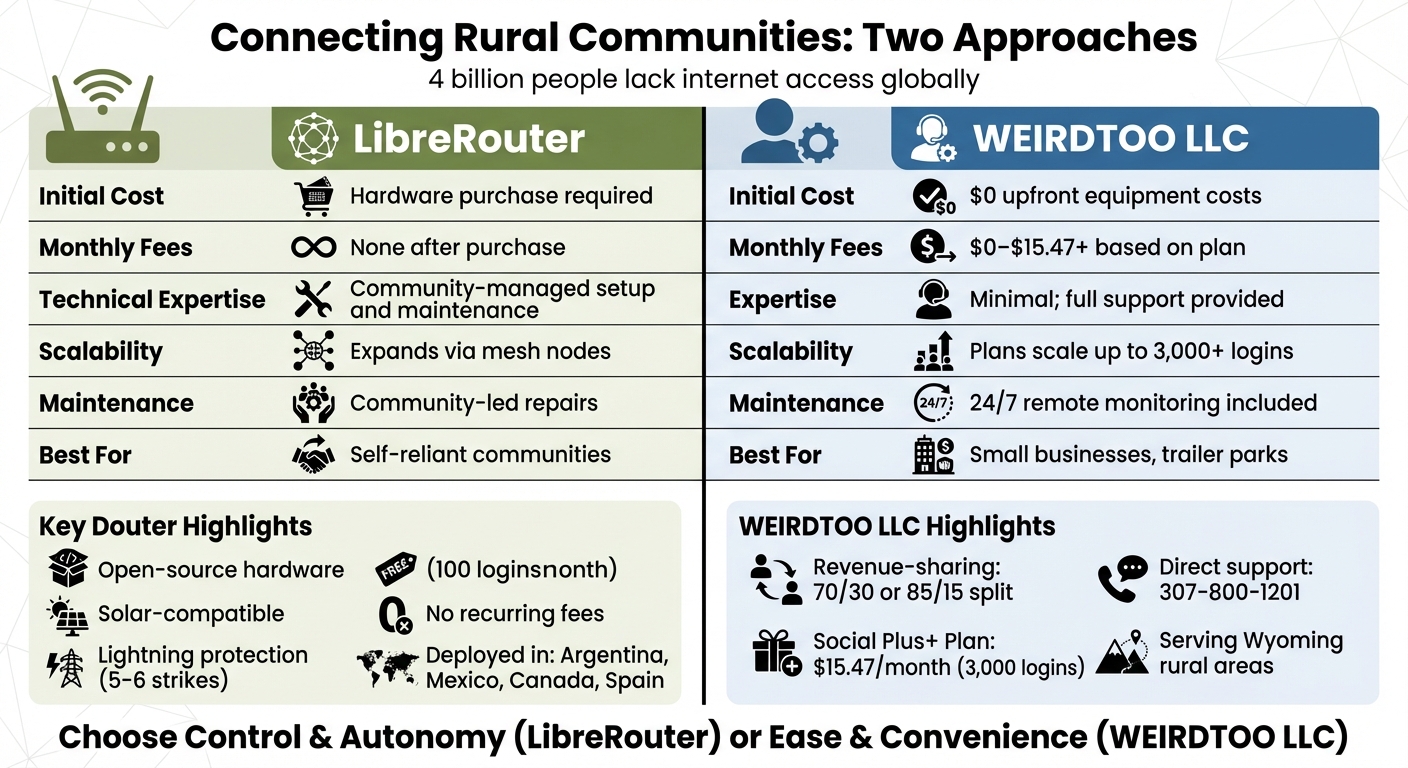
LibreRouter vs WEIRDTOO LLC: Rural Internet Solutions Comparison
From Idea to Installation: How to Grow a Mesh Network in Your City
sbb-itb-342b8b2
1. LibreRouter
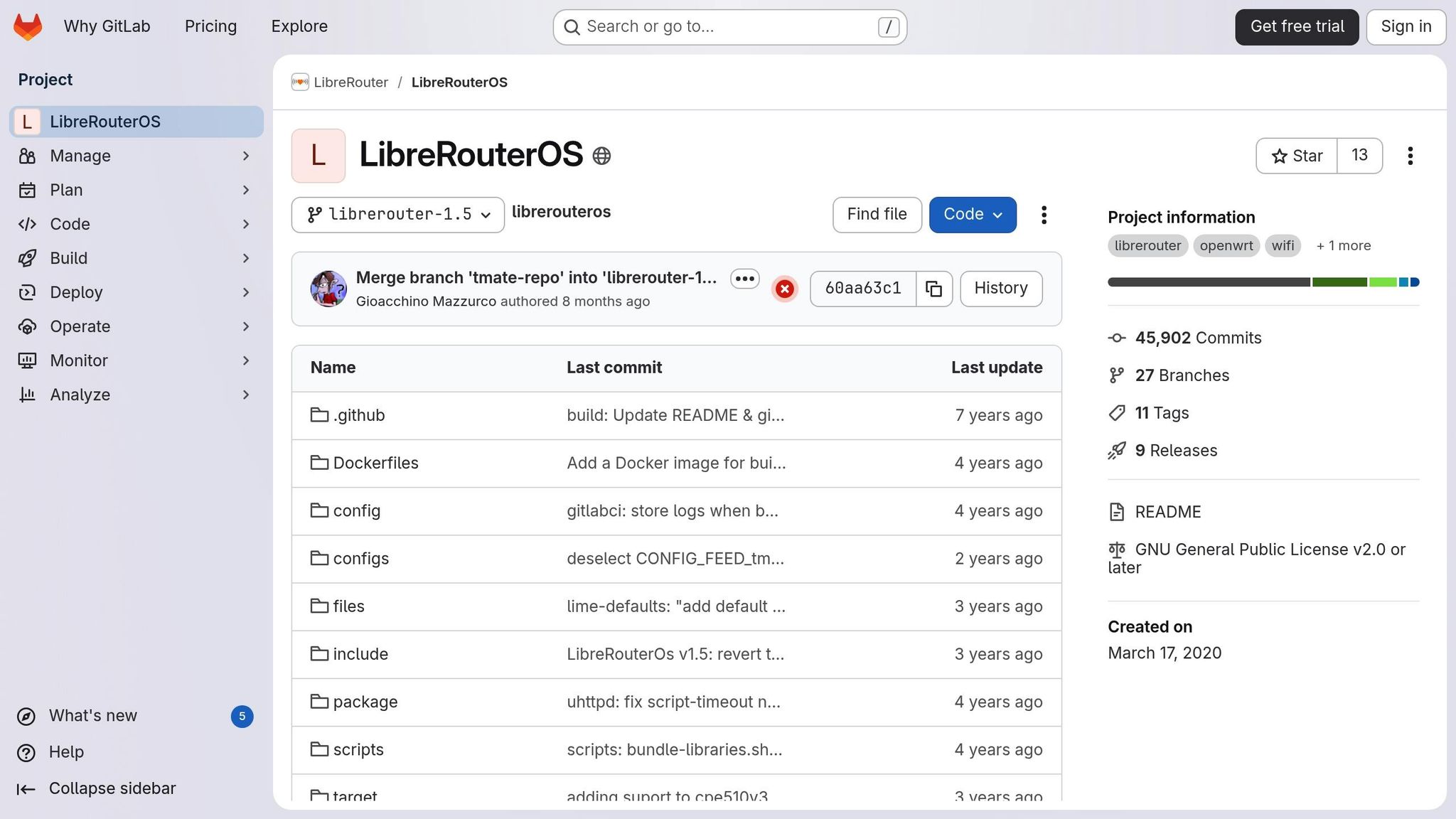
The LibreRouter is crafted to meet the needs of community networks, focusing on durability and ease of repair. It features a three-radio setup: two 5 GHz radios delivering 300 Mbps for mesh backhaul and a 2.4 GHz radio dedicated to client access, effectively bypassing the limitations of half-duplex communication [1].
What sets the LibreRouter apart is its weatherproof design, built to endure tough outdoor conditions. It includes lightning protection capable of handling five to six strikes before needing any component replacements [1]. A Microchip ATTiny13 8-bit AVR MCU acts as a hardware watchdog, ensuring the system can recover from software issues in remote areas [5]. The router is versatile in its power options, supporting 12–36 V via PoE, making it compatible with solar panels, batteries, or standard mains electricity.
Powered by LibreMesh software, which is based on OpenWrt, the LibreRouter simplifies network setup with automated mesh configuration, IP assignment, and DNS management. This makes it easy for communities to deploy and expand their networks. Additional features include LibreNet6 VPN support and a remote troubleshooting dashboard, reducing the need for on-site maintenance [1][4]. These features make the LibreRouter a practical and dependable option for underserved regions.
| Component | Specification |
|---|---|
| Processor | Qualcomm Atheros QCA9558 MIPS @ 750 MHz |
| Memory | 128 MB DDR RAM / 16 MB Flash |
| Radios | 2× 5 GHz (300 Mbps), 1× 2.4 GHz |
| Ethernet | 2× Gigabit ports with PoE Passthrough |
| Power Input | 12–36 V (solar, battery, or mains compatible) |
| Expansion | 2× mPCIe slots, 2× USB 2.0 ports |
Although no official retail price has been disclosed, the LibreRouter is designed to be affordable for rural communities with limited budgets [1]. Its rugged build and automation features make it a cost-effective and reliable solution for improving connectivity in remote areas. Successful deployments have been recorded in countries like Argentina, Mexico, Canada, and Spain [1][3]. Additionally, it received ENACOM certification in Argentina in September 2019, clearing regulatory barriers for broader usage [6].
2. WEIRDTOO LLC
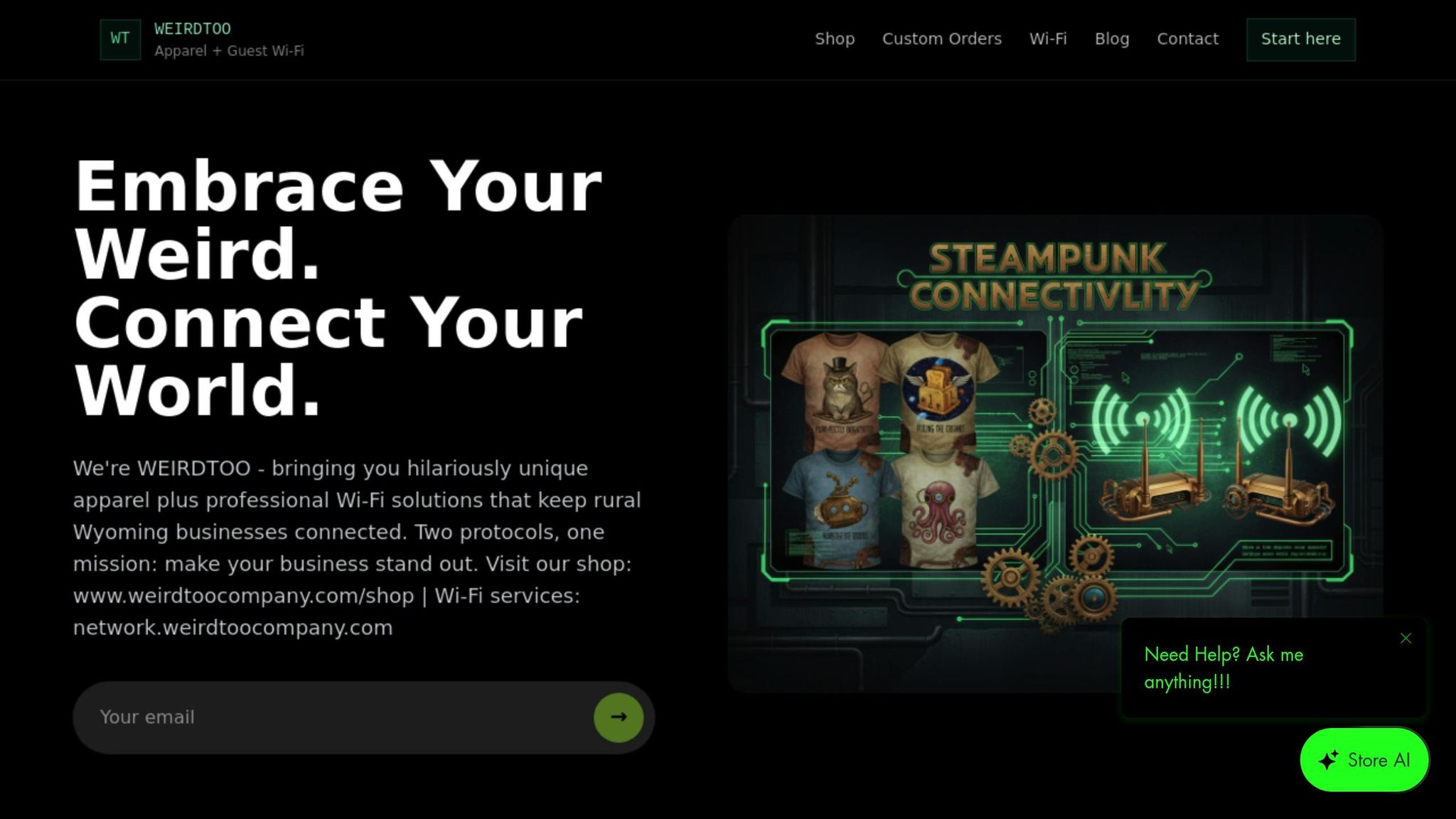
WEIRDTOO LLC, based in Alpine, Wyoming, takes a different approach to improving internet access for underserved communities. While LibreRouter focuses on affordable hardware for mesh networks, WEIRDTOO specializes in Wi-Fi hotspot management services, targeting rural areas and small communities often overlooked by major ISPs. Founded by Isaac A., the company serves locations up to four hours away, including trailer parks, restaurants, and other venues in need of reliable connectivity. Instead of charging high equipment fees, WEIRDTOO's model revolves around revenue-sharing partnerships, making their services more affordable for smaller communities.
Their offerings include customizable splash pages with tailored branding, remote hubs for managing pricing and bandwidth, and continuous monitoring to keep networks running smoothly. On the technical side, they provide advanced analytics, customer data capture, and API integrations, which allow for more robust connectivity options. Unlike big providers that often require long-term contracts and hefty upfront costs, WEIRDTOO offers flexible revenue-sharing options:
- 70% partner / 30% WEIRDTOO for full-service setups (minimum $300 monthly revenue required)
- 85% partner / 15% WEIRDTOO for DIY setups with a $125 monthly retainer
Their pricing plans are designed to grow with community needs. For example, the free Basic Plan supports up to 100 logins per month, while the Social Plus+ plan costs $15.47 per month and supports up to 3,000 logins. For higher usage, additional sessions are priced at $20 per 5,000 logins. This tiered system allows communities to start small and expand as demand increases.
Focusing on Wyoming’s rural areas, WEIRDTOO provides a level of personalized service that larger providers often can't match. With a small team offering direct, weekend support, they ensure that communities can reach them easily at 307-800-1201, avoiding frustrating automated systems. This hands-on, flexible approach makes WEIRDTOO a valuable player in addressing connectivity challenges in remote regions.
Advantages and Disadvantages
This comparison highlights the key trade-offs between LibreRouter and WEIRDTOO LLC, two distinct approaches to connecting underserved communities. Each offers unique strengths and limitations depending on the community's expertise and budget.
LibreRouter stands out for its affordability and long-term savings. Its open-source design empowers communities to repair devices using locally available parts and standard tools [1][3]. With robust lightning protection capable of withstanding up to six strikes [1], it’s particularly suited for rural areas prone to electrical storms. Additionally, its three-radio design eliminates the typical 50% throughput loss common in mesh networks [5][1]. However, this solution requires community-led setup and maintenance, which can be a hurdle for groups needing a more hands-off, ready-to-go option.
On the other hand, WEIRDTOO LLC offers a fully managed service. Their turnkey solution eliminates upfront equipment costs through revenue-sharing partnerships, handling installation, configuration, and 24/7 monitoring. This makes it an attractive option for communities lacking technical resources. The Basic Plan is free and supports up to 100 logins monthly, while the Social Plus+ plan costs $15.47 per month for up to 3,000 logins. With direct phone support at 307-800-1201 and weekend availability, WEIRDTOO provides a level of personalized service that larger providers often cannot. However, ongoing monthly fees and revenue-sharing requirements may be a drawback, with partnerships requiring either $300 minimum monthly revenue for full-service or a $125 monthly retainer for DIY setups.
| Criteria | LibreRouter | WEIRDTOO LLC |
|---|---|---|
| Initial Cost | Hardware purchase required | No upfront equipment costs |
| Monthly Fees | None after purchase | $0-$15.47+ depending on plan |
| Technical Expertise | Required for setup and maintenance | Minimal - full support provided |
| Scalability | Mesh network expands with more nodes | Plans scale from 100 to 3,000+ logins |
| Maintenance | Community-managed with local parts | 24/7 remote monitoring included |
| Best For | Tech-savvy communities seeking autonomy | Small businesses and trailer parks needing turnkey solutions |
This side-by-side comparison highlights how each solution tackles rural connectivity from different perspectives.
The decision boils down to whether a community values technological independence with LibreRouter's open-source model [2] or prefers the convenience of WEIRDTOO's managed service. For communities with technical expertise and limited recurring budgets, LibreRouter may provide a more sustainable option. Meanwhile, WEIRDTOO is ideal for those needing immediate connectivity without the burden of technical management. These trade-offs provide a clear framework for determining which solution best fits a community's needs.
Conclusion
Both solutions tackle critical connectivity issues in underserved areas, but the choice between LibreRouter and WEIRDTOO LLC depends on what matters most to your community. LibreRouter emphasizes technological independence with its open-source hardware, allowing communities to handle repairs using locally available parts [1]. Designed for rural environments, it’s an excellent fit for areas where self-reliance is a priority. However, it does require someone within the community to manage the technical setup and ongoing maintenance.
On the other hand, WEIRDTOO LLC offers a fully managed service that eliminates technical hurdles. With a revenue-sharing model that removes upfront equipment costs and 24/7 monitoring for support, it’s ideal for small businesses and trailer parks in Wyoming needing immediate, hassle-free connectivity.
For communities with technical expertise and limited recurring budgets, LibreRouter’s one-time hardware investment may provide a more sustainable option over time. Conversely, those looking for quick connectivity without the responsibility of technical management may find WEIRDTOO LLC’s turnkey service more appealing.
Ultimately, the decision hinges on whether your community values hands-on control or hands-off convenience. Carefully consider your technical resources and budget to determine which approach aligns best with your needs. Both options offer meaningful steps toward closing the digital divide in rural and underserved regions.
FAQs
Do I need internet experts to manage a LibreRouter mesh?
No, you don’t need tech experts to handle a LibreRouter mesh. It’s built to be user-friendly and easy to maintain by members of the community. Plus, there’s plenty of detailed documentation and resources available to guide you through setup, deployment, and upkeep - making it manageable even for those without technical expertise.
How far can a LibreRouter mesh link reach outdoors?
A LibreRouter mesh link usually covers a distance of 1 to 2 kilometers outdoors. However, the actual range can vary depending on factors like weather conditions, obstacles, and how the antennas are configured. To get the best performance, focus on a proper setup and reducing any potential sources of interference.
How do I choose between LibreRouter and a managed Wi‑Fi service?
Choosing between LibreRouter and a managed Wi-Fi service boils down to your priorities and specific requirements. LibreRouter is designed for community-driven networks, making it a great fit for underserved areas where flexibility, autonomy, and cost-conscious solutions are essential. On the other hand, managed Wi-Fi services are professionally maintained and user-friendly but often sacrifice the level of control and customization that LibreRouter provides. If independence and local control are your main goals, LibreRouter is a solid option. For those who prioritize simplicity and professional support, managed services might be the better route.
Current contact path
Need custom apparel or scoped help?
Use the contact form; removed product, checkout, research, and newsletter funnels stay offline.