Loading…

internet to all routers
By weirdtoo·December 18, 2025·9 min read
Ways to bring reliable internet to every router in rural Wyoming using wired backbones, mesh networks, hotspot management, funding and local partnerships.
internet to all routers
Struggling with internet connectivity in rural Wyoming? Here's how to fix it.
Wyoming's vast landscapes make reliable internet access a challenge. High infrastructure costs, outdated systems, and environmental factors often leave rural communities with slow or expensive internet. But there are solutions to ensure every router stays connected:
- Wired Network Backbones: Ethernet connections or powerline adapters provide stable speeds.
- Wireless Mesh Networks: Ideal for large or complex properties, these systems improve coverage.
- Hotspot Management Systems: Useful for businesses, offering remote monitoring and guest Wi-Fi features.
- Local Solutions: Companies like WEIRDTOO LLC provide tailored services, revenue-sharing models, and local support.
For businesses and communities, reliable internet isn't just a luxury - it's a necessity for education, work, and growth. With the right strategies and partnerships, even Wyoming's toughest connectivity challenges can be tackled.
Rural internet connectivity solutions with Jesse Hirsh | Field Trials E2
Common Router Connectivity Problems
When routers lose connectivity, the cause often lies in a mix of technical glitches and environmental factors. Pinpointing these issues is key to creating a more dependable network.
How to Identify Connectivity Issues
Weak signals and interference are some of the most common problems. For instance, RF interference can disrupt wireless signals, while physical barriers in the Fresnel zone can weaken signal quality [2]. Even something as simple as poor router placement can result in dead zones throughout a building.
In mesh networks, performance can drop significantly with each additional hop - each one can reduce throughput by nearly 50% [2]. To avoid this, limit the number of repeater access points. Start troubleshooting by checking the router’s indicator lights: a solid green or white light usually means all is well, while orange, red, or flashing lights signal issues [7]. Test the connection on several devices to figure out whether the problem is isolated to one device or affects the entire network [7].
Weather conditions can also play a major role. Rain, snow, fog, and high humidity can all weaken signal strength. In Wyoming winters, for example, ice and snow can shift antennas or block line-of-sight connections, leading to connectivity problems.
For rural businesses relying on cellular routers or mobile hotspots, weak signals from nearby towers can cause slow speeds, unreliable WiFi, and dropped calls [3].
These technical hurdles are often made worse by the infrastructure challenges unique to rural areas.
Infrastructure Problems in Rural Areas
Wyoming’s geography presents distinct challenges for connectivity. Expansive open spaces, uneven terrain, and dense forests make rolling out high-speed internet infrastructure both difficult and costly [5]. Line-of-sight services, for example, require clear, unobstructed views - a tough ask in areas with hills and trees [5].
Outdated infrastructure adds to these difficulties. Many rural regions still depend on old copper telephone lines for DSL service. These lines deliver unreliable speeds that worsen the farther you are from the provider’s central office [5]. Satellite internet, while offering broad coverage, suffers from high latency, making activities like video calls frustrating [5].
The high cost of building fiber networks in areas with complex terrain further discourages investment, leaving rural communities lagging behind their urban counterparts [5].
How to Extend Internet to All Routers
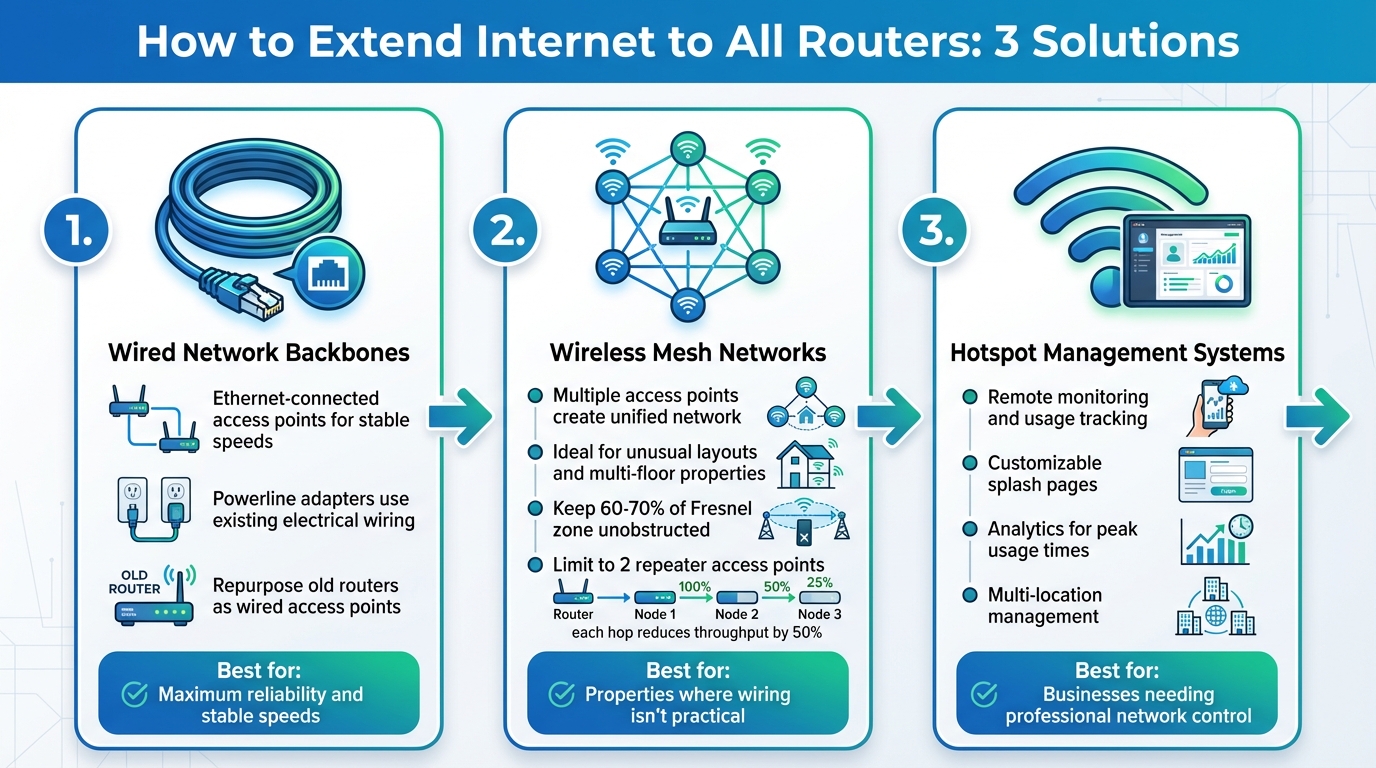
3 Methods to Extend Internet Connectivity to All Routers
Expanding your network to ensure reliable connectivity across all routers can be a challenge, but with the right strategies, it’s entirely achievable. Here are some practical solutions tailored to different setups, budgets, and device needs.
Installing Wired Network Backbones
For rock-solid reliability, hardwired connections are the gold standard in multi-router networks. Ethernet-connected access points outperform wireless alternatives by avoiding signal loss and ensuring stable speeds [8].
If running new Ethernet cables isn’t feasible, powerline adapters are a clever workaround. These devices use your home’s existing electrical wiring to transmit data, making them especially handy in older buildings or multi-story homes where adding new cables would be disruptive or expensive. Some advanced powerline adapters even double as access points, adding extra functionality [8].
Got an old router gathering dust? Repurpose it as a wired access point by connecting it to your main router with an Ethernet cable [9]. For spaces where wiring isn’t an option, wireless mesh networks are the next best solution.
Setting Up Wireless Mesh Networks
When running physical cables isn’t practical, wireless mesh networks step in as a strong alternative. These systems use multiple access points to create a unified network with consistent speeds and seamless coverage. They’re particularly effective for properties with unusual layouts, multiple floors, or tricky dead zones [8].
A real-world example of mesh networking at scale is the Philly Community Wireless project in Philadelphia. In this initiative, rooftop antennas form the backbone of a wireless mesh network, providing widespread connectivity in the Kensington and Fairhill neighborhoods [1].
Before setting up a mesh network, it’s crucial to conduct a radio site survey. This helps identify potential interference and ensures optimal placement of access points. To maximize performance, aim for clear line-of-sight positioning, keeping at least 60–70% of the Fresnel zone unobstructed. Limit your design to no more than two repeater access points per gateway, as each additional hop can cut throughput by about 50%. Ideally, keep the network to a single mesh hop from the gateway to client devices [2].
Using Hotspot Management Systems
Hotspot management systems add a professional edge to your network by enabling remote monitoring, usage tracking, and custom splash pages. These platforms are especially useful for businesses that span multiple locations or remote areas, like those in Wyoming.
For instance, customizable splash pages can display local promotions, business updates, or community news. Meanwhile, analytics tools provide insights into peak usage times and help identify connection issues early. Designed to work with your existing setup, these systems are a practical solution for managing networks in remote or spread-out locations, whether you’re running a single site or multiple operations across a large area.
sbb-itb-342b8b2
Funding Options and Partnership Models
Expanding connectivity without breaking the bank is possible. By tapping into government programs and forming local partnerships, communities can significantly lower initial costs and establish long-term solutions for better connectivity.
Government Grants and Subsidies
Programs like Universal Service Funds are designed to finance community-focused connectivity projects. These funds help small businesses and local organizations enhance their infrastructure without bearing the full financial load [4]. Additionally, state broadband initiatives and rural development grants target underserved areas, making them particularly valuable for places like rural Wyoming.
Collaborating with Local Service Providers
Teaming up with local ISPs and community networks offers a practical way to deliver affordable, high-quality internet to households [4]. For these partnerships to thrive, financial sustainability is key. Policies that ease access to funding, simplify licensing for smaller providers, and promote spectrum sharing can play a big role in empowering these local efforts [4].
WEIRDTOO's Solutions for Wyoming Businesses
WEIRDTOO LLC, based in Alpine, Wyoming, offers practical internet solutions tailored to the unique connectivity challenges faced by businesses in the state. From trailer parks to restaurants and remote venues, WEIRDTOO focuses on delivering reliable and cost-effective guest Wi-Fi, ensuring even underserved communities can stay connected.
Hotspot Management Features
WEIRDTOO's platform provides guest Wi-Fi with customizable splash pages, allowing businesses to showcase their branding while collecting valuable customer data like email addresses and phone numbers. Through remote hubs, owners can manage pricing, bandwidth, and user access from anywhere.
For businesses looking for an affordable option, the Basic Plus+ plan costs $7/month and includes features like password protection, video ads, data capture, advanced analytics, and up to 3,000 logins per month. For those just starting out, the free Basic Plan covers essential guest Wi-Fi needs with 100 logins per month, with the flexibility to purchase an additional 5,000 sessions for $20.
70/30 Revenue-Sharing Model
WEIRDTOO's revenue-sharing model splits earnings 70% to the partner and 30% to WEIRDTOO, eliminating the need for upfront equipment costs. The Full-Service plan requires a minimum revenue of $300/month, while the Equipment+Support option includes a $100 monthly support fee. For more hands-on businesses, the DIY+Support plan offers an 85/15 split with a $125 retainer. This flexible structure allows Wyoming businesses to generate income from their Wi-Fi networks without heavy initial investments.
Local Support for Rural Wyoming
WEIRDTOO prides itself on offering personalized, local support within a 4-hour radius of Alpine. The small team understands Wyoming's rugged terrain and the connectivity hurdles that come with it. With 24/7 remote monitoring and troubleshooting, as well as weekend-focused support, they ensure businesses in rural areas get the help they need when they need it most.
Founder Isaac A brings 1.5 years of experience working directly with Wyoming communities, focusing on locations often overlooked by larger providers. Businesses looking for tailored solutions can reach the team at 307-800-1201 or via email at contact-us@weirdtoocompany.com. WEIRDTOO is ready to help Wyoming businesses stay connected and thrive.
Conclusion
Ensuring every router in your network has internet access is entirely possible. Whether you're tackling unreliable connections in a trailer park, extending coverage across multiple buildings, or bridging the gaps in rural Wyoming, solutions like wireless mesh networks, bridge systems, and hotspot management platforms can make a real difference. These tools are especially crucial for Wyoming's unique connectivity challenges.
For Wyoming's communities and businesses, dependable internet isn't just a convenience - it’s essential. From healthcare facilities relying on patient monitoring devices to security systems that need uninterrupted coverage, reliable connectivity supports critical operations [6].
WEIRDTOO has firsthand experience addressing these challenges. With 1.5 years of work in rural Wyoming, their Alpine-based team provides local support within a 4-hour radius and offers flexible revenue-sharing models. This approach helps Wyoming businesses upgrade their networks without the burden of steep upfront costs.
FAQs
How do wireless mesh networks help improve internet access in rural areas?
Wireless mesh networks are transforming internet access in rural areas by creating a flexible, self-sustaining system where every router (or node) works as both a transmitter and receiver. This design allows data to travel over long distances without relying on costly fiber installations or a network of cell towers. Even better, if one node goes offline, the system automatically reroutes traffic, ensuring consistent connectivity for essential activities like video calls, remote work, and online learning.
These networks are also budget-friendly. They use low-power equipment that can be installed on existing structures like utility poles or barns and can run on solar power or batteries. By sharing this infrastructure, multiple households or businesses can connect to a single broadband source. This setup keeps costs down while still delivering stable internet speeds.
But the benefits go beyond just affordability. Mesh networks give communities the power to manage their own connectivity. Local residents can learn how to maintain and grow the network, adding more nodes as needed. This hands-on approach helps close the digital gap by bringing reliable, affordable internet to areas that traditional providers often overlook.
What are the advantages of using hotspot management systems for businesses?
Hotspot management systems make Wi-Fi and network management easier by offering a centralized, cloud-based platform. With this setup, businesses can configure, monitor, and maintain all their access points and hotspots remotely. This eliminates the hassle of manual, on-site adjustments and ensures the network performs consistently. Tasks like firmware updates, security patches, and configuration changes can be automated, saving time and reducing the chance of mistakes.
These systems also improve both security and user experience. Built-in features like encryption, password controls, and device isolation help protect the network. At the same time, businesses can customize splash pages and user access controls to engage customers with branded messages or promotions. Plus, real-time analytics provide valuable insights into customer behavior, such as traffic patterns and usage trends. For cafés, hotels, and retail spaces, this transforms a basic internet connection into a secure, reliable tool that can also drive revenue.
How does WEIRDTOO support local businesses with its revenue-sharing model?
WEIRDTOO has crafted a revenue-sharing model aimed at helping local businesses succeed. The approach emphasizes fairness and transparency, fostering partnerships that cater to the specific needs of rural areas, such as those in Wyoming. Although the finer details of the model aren't outlined here, the focus remains on collaboration that benefits both parties.
To learn more about how WEIRDTOO can assist your business, consider contacting their team for tailored guidance.
Current contact path
Need Weird Network WiFi, custom apparel, or scoped help?
Use the contact form; removed product, checkout, research, and newsletter funnels stay offline.