Loading…
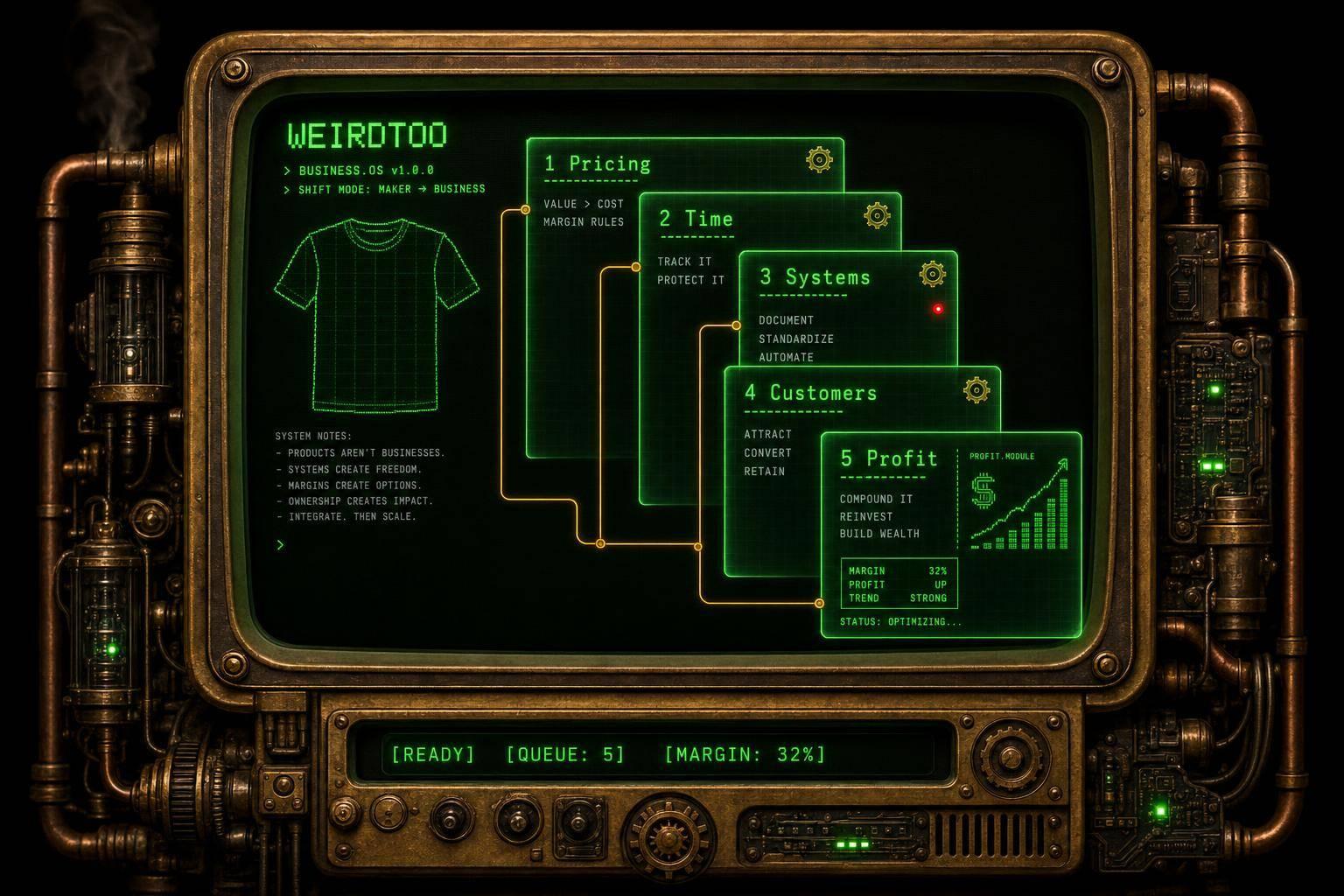
How to Shift from Making Shirts to Running a Business
By weirdtoo·June 22, 2026·11 min read
Learn 5 practical steps to move from making shirts to running a t-shirt business, with tips on pricing, time, systems, customers, and profit.
How to Shift from Making Shirts to Running a Business
A lot of small shops don’t fail because they make bad products. They stall because the owner is still operating like a skilled maker instead of a business operator.
That distinction matters more than most people realize.
If you make custom apparel, print products, decorated goods, or any hands-on service, it’s easy to confuse constant activity with real progress. Orders come in, you stay busy, customers need things fast, and the calendar fills up. From the outside, it looks like growth. But inside the business, margins stay thin, systems stay messy, and stress keeps rising.
The video behind this article centers on a practical truth: making shirts is a craft; running a business is a separate discipline. The speaker frames that shift through five operational changes - pricing, time, systems, customer relationships, and owner-level thinking.
For small business owners, this is bigger than apparel. The same pattern shows up in consulting, creative work, trades, local services, and rural businesses: valuable skill, weak structure.
This article expands on those ideas and translates them into a more durable operating model.
Why So Many Skilled Makers Stay Stuck
Many businesses start the same way. Someone buys equipment, learns a process, makes something people like, and gets asked to do more. That momentum feels validating. It can even produce decent revenue for a while.
But early demand hides structural problems.
When a business is still being run like a hobby or side project, you often see the same symptoms:
- Pricing is based on what feels acceptable, not what sustains the business
- Jobs are accepted too quickly and too cheaply
- Important details live in text threads, DMs, notebooks, or memory
- Turnaround times are vague
- Rush work becomes normal
- The owner spends all week producing and no time improving operations
- Revenue comes in, but profit stays disappointing
In other words, the business is powered by effort rather than design.
That works until the owner hits capacity.
sbb-itb-342b8b2
Key Takeaways
- Stop pricing emotionally. If your prices only cover materials and a little extra, you’re buying yourself a job, not building a company.
- Treat time like limited inventory. If you don’t control your calendar, customer urgency will control it for you.
- Memory is not a workflow. Order forms, approvals, checklists, and tracking systems reduce preventable mistakes.
- Repeat customers are often worth more than constant prospecting. Follow-up and consistency create compounding revenue.
- Owner time must be scheduled on purpose. If every hour goes to production, nothing improves.
- Not every customer is your customer. Raising prices may remove poor-fit buyers and create room for better ones.
- A simple system beats a scattered one. You do not need complex software to become more professional.
- Busy is not the same as profitable. The test is whether your workload produces margin, stability, and better decisions.
1. Stop Pricing Like a Hobbyist
One of the strongest points in the video is also one of the most uncomfortable: many small operators price from fear.
They fear losing the order. They fear charging "too much." They fear hearing no.
So they quote low, skip design fees, absorb setup time, ignore overhead, and hope volume makes up the difference. It usually doesn’t.
What hobby pricing looks like
Hobby-style pricing tends to be:
- Reactive
- Inconsistent
- Based on competitors’ visible prices
- Detached from true labor time
- Weak on profit protection
This is especially dangerous in custom work because hidden labor is everywhere: revisions, sourcing, approvals, communication, troubleshooting, remakes, packaging, and delivery coordination.
If you only price the blank and the print, you’re not pricing the job. You’re pricing a fraction of the work.
What business pricing does differently
A real pricing model accounts for:
- Materials
- Production labor
- Design or setup time
- Equipment wear
- Software and subscriptions
- Packaging
- Administrative time
- Error margin
- Profit
That last item matters. As the speaker emphasizes, profit is not something to apologize for. It is what allows reinvestment, replacement, payroll, tax readiness, and resilience when mistakes happen.
Without margin, one bad order can wipe out the gain from several good ones.
A better way to think about price
Instead of asking, "What will people pay?" start with:
- What does this job actually cost me?
- How long will it really take?
- What level of service am I including?
- What minimum margin does this business require?
That shift turns pricing from guesswork into policy.
Practical test
Take one recent job and calculate:
- Total material cost
- Total time spent, including messages and revisions
- Any overhead connected to fulfilling it
- Actual dollars earned after all of the above
Then divide by hours worked.
If the result feels disappointing, the issue may not be effort. It may be your model.
2. Manage Time Like It’s Inventory
The video makes a sharp comparison: time should be treated like blanks, vinyl, or any other finite resource. That’s exactly right.
Small operators often act as if time can stretch indefinitely. It can’t. It only gets borrowed from evenings, weekends, family time, sleep, or strategic work.
The hidden cost of loose scheduling
When you don’t define your schedule, several things happen:
- Rush requests become the default
- Customer interruptions dictate your focus
- Small mistakes increase because you’re context-switching all day
- Turnaround times become unreliable
- You spend your best energy reacting instead of producing
This is one of the biggest reasons owners feel constantly behind even when they’re working nonstop.
Why "I’ll get it done ASAP" is a trap
That phrase sounds helpful, but operationally it creates ambiguity. It trains customers to expect speed without structure, and it prevents you from planning the work properly.
A business owner needs defined lanes such as:
- Quote and message windows
- Design and proofing blocks
- Production days
- Pickup or shipping days
- Limited rush capacity
This doesn’t make you less helpful. It makes you more reliable.
Time discipline creates better customer service
A structured workflow is often perceived as professionalism. Customers are usually more comfortable with a clear timeline than with an owner who sounds endlessly available but misses details.
In service businesses, predictability often beats urgency.
Practical step
Before taking on new work next week, block time for:
- Production
- Admin
- Customer communication
- Problem-solving
- Growth work
Then quote turnaround based on capacity, not optimism.
3. Build Systems Instead of Running on Memory
This may be the most universally useful lesson in the video.
If order details live in your head, sticky notes, text messages, social DMs, and half-finished notebook pages, you do not have a business system. You have a stress engine.
The speaker puts it bluntly: memory is not a system.
Why this breaks faster than people expect
At low volume, memory can seem good enough. You remember sizes, colors, names, placement notes, pickup dates, and revisions.
Until you don’t.
Custom work contains a lot of variables. In decorated apparel alone, one order might include:
- Different sizes
- Different garment colors
- Multiple print locations
- Name variations
- Artwork edits
- Special instructions
- Separate due dates
That complexity compounds fast. Once volume increases, relying on recall becomes expensive.
What a simple system should include
You do not need enterprise software to improve this. A solid basic workflow can be built with forms, shared docs, Trello-style boards, spreadsheets, or task tools.
At minimum, a repeatable order system should include:
- Customer intake form
- Order details in one place
- Quote approval
- Artwork or mockup approval
- Payment status tracking
- Production checklist
- Delivery or shipping status
The goal is not sophistication. The goal is consistency.
Why systems protect profit
Operational mistakes are not just annoying; they cost money.
When a shop forgets one youth size, misses a revision, or starts production before approval, the owner pays in time, materials, and trust. A checklist may feel boring, but boring processes are often what make a small business stable.
A useful operator mindset
If you do something more than once, it deserves a process.
That applies beyond shirts. It applies to client onboarding, CRM follow-up, estimates, invoices, reporting, and content approvals too. For the kind of small businesses WEIRDTOO serves, this is where AI and automation can be genuinely useful: not replacing judgment, but reducing friction in repetitive workflow.
4. Focus on Relationships, Not Just Orders
The video makes an important shift here: a customer order is not only a transaction; it can be the start of a recurring revenue stream.
That is a smarter lens for small operators.
Why repeat buyers matter so much
A one-time order has acquisition cost every time. You spend time finding the customer, answering questions, proving credibility, and setting expectations.
A repeat customer already knows your process.
That means:
- Faster approvals
- Less friction
- Lower selling effort
- Better forecasting
- Higher lifetime value
For shops serving teams, schools, clubs, churches, events, or local businesses, repeatability is often where the real opportunity lives.
The overlooked power of follow-up
Many makers finish the order, deliver it, and move on. Operationally, that leaves money on the table.
A better approach is simple:
- Confirm the order landed correctly
- Ask whether everything met expectations
- Note likely future needs
- Set a reminder to check in later
This does not need to feel salesy. It can be service-oriented.
For example, a youth sports order today can become hoodies, warmups, parent apparel, or next-season reorders later. A local company’s event shirts can lead to uniforms, hats, giveaway items, or seasonal campaigns.
Relationship thinking changes service design
Once you view the customer as an ongoing account rather than a one-off sale, you start asking smarter questions:
- What will they probably need next?
- How can I make reordering easier?
- Can I preserve artwork, sizes, and preferences for faster repeat work?
- What communication style helps them most?
That is how a vendor becomes a trusted operational partner.
5. Think Like an Owner, Not Just a Worker
This is the most strategic point in the video and the one many exhausted business owners resist because they feel too busy to do it.
That is exactly why they need it.
Workers ask: What must get done today? Owners ask: What needs to improve so the business works better next month?
You need both modes. But if worker mode consumes everything, the business never matures.
The danger of permanent production mode
If all your time goes into fulfillment:
- Pricing issues remain uncorrected
- Bad-fit customers stay in the mix
- Bottlenecks keep repeating
- Tools never get organized
- Marketing never gets structured
- Cash flow stays volatile
You end up with motion but not leverage.
What owner-time actually looks like
Owner-time does not have to mean a retreat, whiteboard session, or complex planning stack. In a lean business, it may be just one hour a week used well.
That hour can be used to review:
- Which orders were most profitable
- Which jobs caused avoidable friction
- Where communication broke down
- Whether turnaround promises were realistic
- What can be standardized
- Which customer types are worth pursuing more intentionally
This is operational leadership, not abstract strategy.
Why this matters beyond apparel
This pattern applies to any founder-led service business.
Consultants stay busy serving clients but never productize repeat work. Local service companies keep taking calls but never document intake. Creators produce constantly but never build an editorial system. Rural businesses solve problems daily but never install better follow-up.
In each case, the business remains owner-dependent because the owner is acting only as labor, not as architect.
A Useful Framework: From Craft to Capacity
The video is nominally about shirt businesses, but the deeper lesson is about capacity design.
To move from "I make things" to "I run a company", you need to upgrade five layers:
1. Financial discipline
Know your costs, margins, and minimum viable price.
2. Calendar control
Schedule work based on actual capacity, not emotional availability.
3. Process reliability
Create repeatable workflows so quality doesn’t depend on memory.
4. Relationship continuity
Treat each good customer like future revenue, not completed history.
5. Strategic review
Reserve time to improve the machine, not just feed it.
That is how a side hustle becomes an operation.
Where This Advice Is Especially Strong
The practical strength of the video is that it avoids vague motivation and focuses on decisions operators can make immediately. It doesn’t pretend growth comes from mindset alone. It ties mindset to mechanics.
That matters because many small businesses do not need more hustle. They need:
- Cleaner quoting
- Better order capture
- More realistic turnaround policies
- Follow-up routines
- Capacity boundaries
- Profit-aware pricing
These are boring fixes, but boring fixes often produce the biggest relief.
What the Video Does Not Fully Explore
To add useful context, it’s worth noting a few areas that were implied rather than fully developed.
Technology selection is secondary to workflow clarity
The speaker mentions different tools and notes, which is helpful, but the bigger truth is this: the best software will not fix a vague process. Define the steps first, then choose tools.
Not all growth should be accepted
The video encourages better systems and more intentional pricing, but another useful filter is customer fit. Some jobs should be declined because they damage capacity or margin.
Follow-up should be documented, not left to good intentions
Relationship-building works best when reminders and customer notes are captured in a simple CRM or task system. Otherwise, good service becomes dependent on memory again.
None of that contradicts the video’s advice. It strengthens it.
A Simple Weekly Operating Reset
If you want to apply the video’s ideas without overcomplicating them, use this short weekly review:
Review last week
- Which jobs made money?
- Which jobs caused stress?
- Where did time leak?
- What customer questions repeated?
Adjust this week
- Update one pricing rule
- Define one turnaround expectation
- Improve one checklist or form
- Follow up with one completed customer
- Block one hour for owner review
That is enough to start building momentum.
Conclusion
The biggest shift is not from one printing method to another, or from one tool to better software. It’s the shift from doing work to designing a business that can do work well.
The video’s central message is simple and useful: if you keep operating like a hobbyist, your business will keep producing hobby-level results, no matter how talented you are.
Skill gets you started. Systems keep you sane. Pricing protects your future. Relationships create repeat business. Owner thinking turns effort into growth.
If you’re always busy but never ahead, that is not just a workload issue. It may be the sign that your business now needs a different operating model than the one that got it off the ground.
Source: "The Shift From "Making Shirts" to "Running a Business"" - TheRhinestoneWorld, YouTube, May 2, 2026 - https://www.youtube.com/watch?v=Sf_cIOHOBfc
Current contact path
Need Weird Network WiFi, custom apparel, or scoped help?
Use the contact form; removed product, checkout, research, and newsletter funnels stay offline.