Loading…

How to Market Reseller ISP Services
By weirdtoo·April 25, 2026·15 min read
Community-focused and digital tactics—door-to-door outreach, referral programs, guest Wi‑Fi, clear pricing, and analytics—to grow reseller ISP customers in underserved areas.
How to Market Reseller ISP Services
Reseller ISPs serve communities by providing internet access without heavy infrastructure investments. They often operate in underserved areas, such as rural regions or trailer parks, offering affordable and reliable connectivity. Effective marketing can help these providers stand out against larger corporations.
Key Strategies:
- Community Engagement: Build trust by joining local organizations, sponsoring events, and maintaining a visible presence (e.g., yard signs, flyers, or partnerships with local businesses).
- Digital Marketing: Use Facebook ads, YouTube videos, and email campaigns to educate potential customers and highlight service benefits like reliability and local customer support.
- Referral Programs: Reward existing customers for bringing in new clients with service credits or free months of service.
- Local Partnerships: Collaborate with small businesses to offer guest WiFi solutions or cross-promotions that benefit both parties.
- Clear Messaging: Focus on practical benefits (e.g., no buffering, reliable speeds) and avoid technical jargon or gimmicky pricing.
Why It Matters:
- Over 55% of WISP owners rely on word-of-mouth, but consistent marketing is needed to reach new customers.
- Local providers have an edge by emphasizing personalized service and community involvement.
By combining grassroots efforts with targeted digital strategies, reseller ISPs can effectively grow their customer base while addressing the unique needs of their communities.
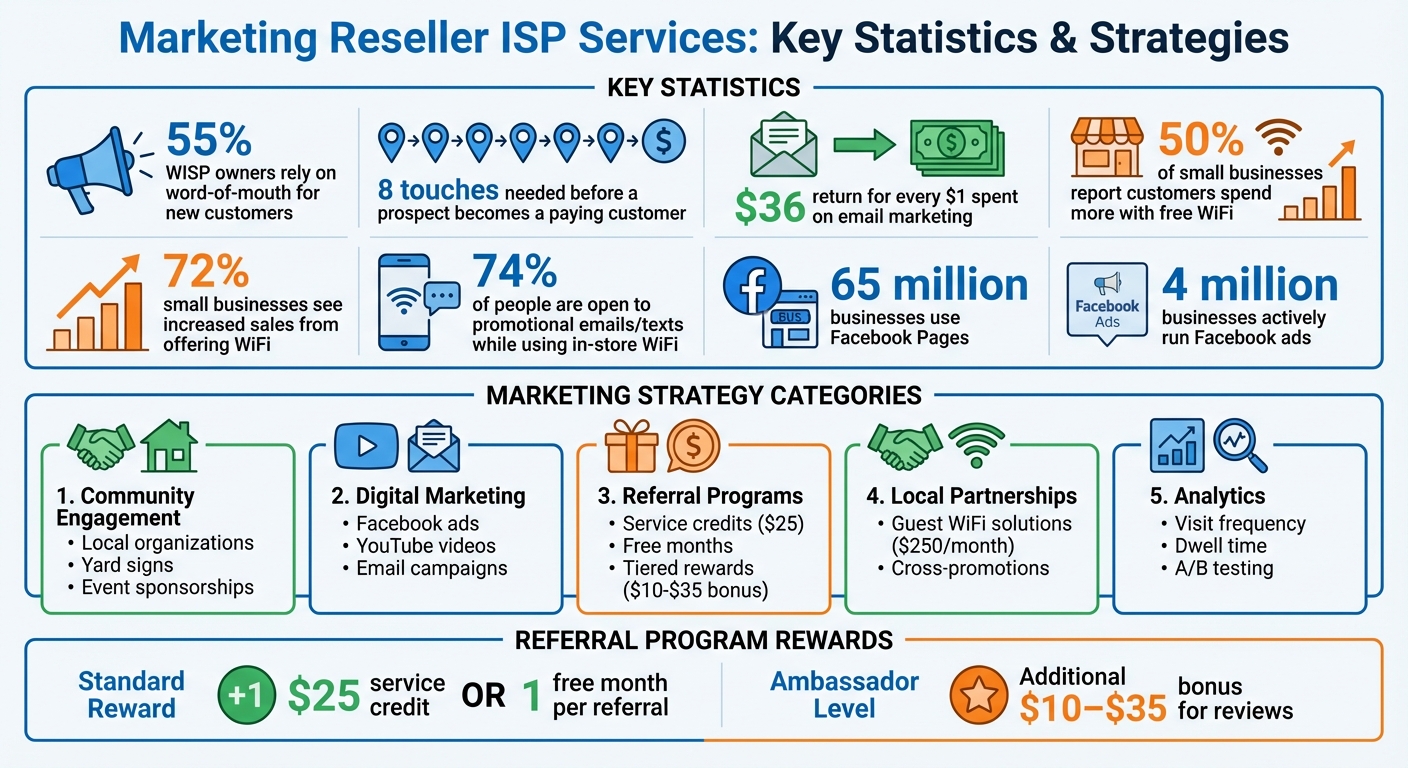
Marketing Statistics and Strategies for Reseller ISP Services
Building Your Brand Identity
Focus on Local and Community Needs
Earning trust in rural markets means showing you’re part of the community, not just another outsider. Mark Griffin from Preseem highlights this idea perfectly:
Membership in local organizations builds customer trust [2].
Joining groups like the local chamber of commerce, boards of trade, or industry associations such as WISPA can instantly boost your credibility. In tight-knit communities, these connections show you’re invested in the area and its people.
A physical presence is just as important. One long-standing local provider takes a simple but effective approach: after every new installation, their technicians leave behind yard signs and door hangers for neighbors. This creates visible social proof right where potential customers live [2]. Similarly, Cherry Capital Connection uses targeted flyers to engage specific neighborhoods, informing them about upcoming fiber network plans. They require 66% participation before beginning construction, ensuring the community feels involved in the process [2]. This transparency reassures residents that the infrastructure isn’t just being installed for them - it’s being built with them.
For reseller ISPs working in underserved areas like trailer parks, it helps to simplify the tech talk. Brief animated videos can explain the technology, while emphasizing reliability and local support over technical jargon [2]. And when your company shows up at local events, sponsors youth sports teams, or partners with beloved local businesses, you’re no longer just an internet provider - you’re a neighbor people trust [6]. This kind of grassroots approach naturally builds a brand that feels authentic and connected.
Use Genuine Branding That Stands Out
Once you’ve established your local presence, your brand’s personality becomes your secret weapon. Mark Griffin puts it simply:
The unique personality of your business is one of your greatest tools [2].
Unlike big corporate providers with generic branding and impersonal customer service, you have the chance to make a real connection. Short videos introducing your team or showcasing your mission to close the digital divide can go a long way in humanizing your brand. These personal touches help customers see you as more than just a faceless company [2].
Being upfront about your offerings is another key to authentic branding. Instead of gimmicky "teaser rates" that jump after a year, stick with straightforward flat-rate pricing that includes taxes [5]. When marketing your services, focus on real-life benefits: “no more buffering during Netflix marathons,” “reliable internet for remote work,” or “fast browsing for the whole family” [5]. This kind of outcome-driven messaging connects with what people actually care about - reliable, worry-free internet they can depend on every day.
sbb-itb-342b8b2
Digital Marketing Strategies
Social Media Marketing for Local Businesses
Facebook ads are a game-changer for small businesses. Why? Because that's where your customers are. As Mark Griffin, Content Lead at Preseem, explains:
Facebook advertising is critical for small businesses. Let's face it, your customers are using Facebook so if you want to reach them, you should consider Facebook ads. [2]
The numbers back this up: 65 million businesses use Facebook Pages, and 4 million actively run Facebook ads [2]. A smart strategy is to upload your customer list and create "lookalike" audiences - targeting people with similar profiles in your service area [2].
Businesses like XL Broadband and E-vergent Wireless are already seeing success. Evan Galvin from XL Broadband uses Facebook to share animated explainer videos and customer testimonials, educating potential customers about the differences between fixed wireless and satellite internet [2]. Meanwhile, Joe Falaschi at E-vergent Wireless keeps his ads hyper-focused on his company’s coverage area, ensuring a steady flow of new customers [2].
YouTube is another effective platform, especially for retargeting. Pre-roll ads featuring customer reviews or special promotions can re-engage website visitors [2]. For resellers in underserved areas, short, relatable videos - such as those showing how reliable internet supports remote work, online learning, or seamless streaming - often resonate more than technical details [3, 7]. LinkedIn also offers opportunities for B2B services, allowing businesses to connect with local professionals and join relevant groups [6].
Other tactics to consider include running social media polls to boost engagement, responding to all reviews (which can increase customer spending by nearly 50% [8]), and leveraging guest WiFi login screens at partner locations to gather social media followers automatically [1].
But don’t stop at social media - email campaigns can take your customer engagement to the next level.
Email Campaigns for Customer Engagement
Email marketing is a powerhouse, delivering an average of $36 for every $1 spent [8]. The secret lies in personalization and automation, not generic blasts. By setting up automated drip campaigns, you can welcome new subscribers, re-engage inactive customers, and send timely messages triggered by specific actions - like hitting a service milestone or leaving a sign-up page incomplete [13, 16, 19].
For local resellers, guest WiFi is a goldmine for email collection. When customers log in to a partner’s WiFi network, you can capture their email addresses in exchange for free access. And here’s the kicker: 74% of people are open to receiving promotional emails or texts while using in-store WiFi [3]. This strategy ensures your email list grows with people already in your service area.
Focus your email content on clear pricing and practical benefits, like buffer-free streaming, reliable remote work, or lag-free gaming [5]. Avoid teaser rates and instead highlight your local customer support [7, 16]. As Rob Glover, Senior Copywriter at LocaliQ, puts it:
Newsletters keep your brand name relevant with your core audience for months and years to come. [8]
Segmenting your email list by zip code allows you to share hyper-local updates, such as network expansions or community events [10]. This builds trust and ensures your brand stays top-of-mind when neighbors ask for internet provider recommendations.
Take WEIRDTOO LLC in Alpine, Wyoming, as an example. Their focus on clear communication and hyper-local targeting shows how combining social media and email campaigns can effectively engage underserved communities. These strategies not only connect with customers but also reinforce trust and loyalty over time.
Local Community Outreach
Door-to-Door Outreach and Local Events
When it comes to building trust, nothing beats face-to-face interaction. It’s no wonder that over 55% of WISP operators rely on word-of-mouth as their primary way of gaining new customers [2]. But here’s the catch: it typically takes about eight touches before a prospect becomes a paying customer [2].
One way to boost visibility in your area is by having service technicians leave door hangers or set up lawn signs after completing installations [2]. It’s a simple yet effective strategy to make your presence known.
Local events are another great way to establish credibility. By joining your local Chamber of Commerce or Board of Trade, you can connect with other business owners and position yourself as a trusted local provider [2][3]. Sponsoring community activities like kids' sports teams or underwriting traffic updates on local radio stations also keeps your brand top of mind - without coming across as overly promotional [2][6].
Take a page from Wave 7 Communications in Enfield, North Carolina. They partnered with their local library to set up a free Wi-Fi access point, which not only provided a valuable service but also introduced residents to their affordable service plans. This initiative helped them build trust, especially among those wary of trying out a new provider [11].
These personal interactions naturally create opportunities for partnerships with local businesses.
Partnerships with Local Businesses
Once you’ve established a strong local presence, teaming up with nearby businesses can extend your reach and solidify your role in the community. This approach sets you apart from larger, impersonal providers.
Local businesses need reliable internet just as much as residents do - and they can become some of your most valuable partners. Consider this: 50% of small businesses say their customers spend more when free Wi-Fi is available, and 72% report an increase in sales because of it [3]. That’s a win-win scenario waiting to happen.
Using tools like Google Maps, you can pinpoint businesses offering free Wi-Fi but lacking a solid marketing strategy [3]. By providing them with a guest Wi-Fi solution that includes a white-label dashboard, you can help them gather customer data and gain insights for their marketing efforts. Meanwhile, you secure a recurring service contract - a mutually beneficial arrangement [4].
Trailer parks and RV parks are another promising avenue for reseller ISPs. Providers like WEIRDTOO LLC (https://weirdtoocompany.com) showcase how tailored solutions can address the unique connectivity challenges in these underserved communities.
Cross-promotion with local businesses is another way to create shared benefits. For example, you could put together a community coupon book featuring discounts from restaurants, barbershops, and museums - alongside an exclusive offer for your internet services [2]. Or, team up with a local restaurant and a movie theater to offer a “dinner and a movie” package that includes a free month of internet for new customers [6].
Another idea? Pitch a secondary wireless connection as a backup solution for businesses. It’s a practical service that not only adds value but also generates steady revenue [5].
Customer Incentives and Referral Programs
Setting Up Referral Programs
Your current customers can be your most powerful advocates. A referral program can transform happy customers into enthusiastic promoters of your service.
For instance, you can offer one free month of service for each successful referral [5]. This type of reward is straightforward and easy for customers to explain to their friends. Alternatively, a $25 service credit per referral is another simple yet effective option [2][3].
To take it a step further, consider implementing a tiered reward system. In 2019, ISP Management introduced an "Ambassador level" for customers who not only referred new sign-ups but also left positive reviews on platforms like Facebook and Google. These ambassadors earned an additional $10–$35 bonus on top of the standard $25 credit [2]. This dual-incentive strategy not only attracts new customers but also boosts your online reputation.
Incentives can extend beyond referrals. For example, you could offer new customers a service credit in exchange for allowing a lawn sign to be placed on their property for one to two weeks [2]. In New Lisbon, Indiana, NLBC takes a creative approach by having technicians distribute door hangers to neighbors immediately after completing an installation [2].
Now, let’s look at how limited-time promotions and bundled offers can further enhance your customer acquisition strategy.
Limited-Time Discounts and Service Bundles
To complement your referral program, consider offering limited-time discounts and service bundles. Time-sensitive promotions encourage quick decision-making by presenting genuine value rather than temporary teaser rates [5].
Service bundles can also boost customer retention while increasing the perceived value of your offerings. For example, business clients might appreciate a package that combines internet access with managed guest Wi‑Fi solutions. This type of bundle addresses a specific business need and creates a recurring revenue stream - providers can typically charge around $250 per month for managed Wi‑Fi marketing services [4].
Another way to engage customers is through community-focused bundles. Collaborate with local businesses like restaurants, barbershops, or museums to create a coupon book that includes discounts for your internet services alongside exclusive local offers [2]. This approach strengthens your connection with the community while delivering extra value to new customers. A great example is WEIRDTOO LLC, which tailors service packages for underserved areas in Wyoming, such as trailer parks and rural businesses (https://weirdtoocompany.com).
Finally, leverage customer data collected through guest Wi‑Fi logins to automate "bring a friend" campaigns via email or SMS [3]. This tactic turns your business clients’ locations into effective lead generation hubs, further expanding your reach.
Tracking and Improving Your Marketing
Using Analytics to Improve Targeting
WiFi analytics can be a game-changer for fine-tuning your marketing strategies. By using a branded login, you can capture valuable customer data like emails, phone numbers, and social profiles [12][1]. This information lays the groundwork for more informed and effective marketing decisions.
"WiFi marketing analytics allows local businesses to understand their customer audience and make informed marketing decisions." - MyWiFi Networks [3]
Dive into metrics such as visit frequency, dwell time (how long customers stay connected), and the time since their last visit. These insights can help you identify your most loyal customers and spot those who might be at risk of churning [12][1][9]. Footfall analysis is another useful tool - it reveals how many WiFi users are actually entering your location versus just passing by [9]. If you notice patterns in connection times, you can strategically schedule promotional messages to hit during peak periods.
Audience segmentation takes your targeting to the next level. Group customers by demographics like age and gender, location, or visit history to send messages that truly resonate [12][3]. For instance, you could offer referral incentives to repeat visitors with high dwell times, while first-time visitors might appreciate a welcome discount or a bundled service offer.
Testing your marketing efforts is crucial. Use A/B testing to compare different email subject lines or splash page pop-ups to identify what drives better conversion rates [8]. You can also set up smart triggers that automatically send out a promotion as soon as a guest disconnects from your network [3].
This data doesn’t just refine your messaging - it also helps you adapt your strategies to fit the local context.
Adjusting Campaigns for Local Audiences
With the insights gained from your analytics, you can tailor your campaigns to meet the specific needs of local communities. Generic, one-size-fits-all campaigns rarely make an impact. Instead, focus on addressing local concerns and preferences. For example, analyze regional internet usage patterns and peak times to craft messages that feel personal and relevant [7]. If customers in a specific area, such as a trailer park, frequently experience slow speeds during prime time, emphasize benefits like "reliable streaming" or "lag-free gaming" instead of simply highlighting Mbps numbers [5].
Feedback from the community can also guide your messaging. Keep an eye on Yelp reviews or conduct informal interviews to uncover common frustrations, like "Netflix buffering" or "poor customer support from big providers" [5]. Use this feedback to position your service as the solution. For instance, if teaser rates that spike after six months are a common complaint, highlight your flat, transparent pricing as a major advantage [5]. In close-knit rural areas, word-of-mouth is incredibly influential - over 55% of wireless ISPs report it as their top source of new customers [2].
Companies like WEIRDTOO LLC (https://weirdtoocompany.com) have proven that focusing on local support and avoiding gimmicks like teaser rates resonates far more with these communities than corporate buzzwords about bandwidth. Use your WiFi data to distinguish between new and repeat users, then adjust your strategies for customer retention versus acquisition accordingly [9]. If a specific location shows low dwell time, it could indicate coverage issues. Address the technical problem first, then promote your "wall-to-wall coverage" as a selling point [5].
Finally, take advantage of hyper-targeted digital advertising. Use your analytics insights to refine your audience targeting within your service areas, ensuring your ad dollars are spent on reaching potential customers who can actually use your services [2]. By staying consistent and focusing on local needs, you can cut through the noise and connect meaningfully with your audience.
The EASY WAY to Sell Fibre Without Infrastructure and Earn a Fortune!
Conclusion
The success of marketing for reseller ISPs hinges on building local trust and refining strategies with data. Unlike massive corporate providers, reseller ISPs thrive by presenting themselves as part of the community - neighbors who genuinely understand the unique needs of their area. Grassroots tactics, like yard signs and door hangers, can play a big role in gaining local customers [2]. Pairing these efforts with clear pricing and reliable local support helps foster long-term customer loyalty.
Word-of-mouth remains a powerful driver of growth. Structured referral programs - such as tiered systems that reward customers with credits and offer "Ambassador" perks like cash bonuses for reviews - can turn happy customers into enthusiastic advocates [2]. To amplify this, use a mix of direct mail, local sponsorships, and hyper-targeted social media ads to meet potential customers where they spend their time. Keep in mind, it often takes around eight interactions to convert a prospect into a customer [2].
Analytics should be your compass. Monitor metrics like visit frequency, dwell time, and regional usage patterns to identify what’s working and where adjustments are needed. These insights reinforce the effectiveness of community-centered strategies. By prioritizing community engagement, consistent branding, and data-informed decisions, you can build a thriving reseller ISP business.
FAQs
How can reseller ISPs connect with and support their local communities?
Reseller ISPs can deepen their connections with local communities by actively participating in events like farmers’ markets or town meetings. These occasions provide a great opportunity to showcase services and gather firsthand feedback on what residents value most - whether it's faster speeds, better reliability, or improved coverage. By engaging face-to-face, providers can build trust and demonstrate their commitment to addressing real-world concerns.
Staying visible and accessible is equally important. Leveraging hyper-local social media groups and keeping a Google Business profile up-to-date ensures the ISP remains top of mind for potential customers. Another great approach? Offering guest Wi-Fi hotspots in popular gathering areas, such as community centers or trailer parks. A branded portal for these hotspots - featuring local news, events, or even quirky merchandise from WEIRDTOO LLC - can subtly reinforce the message that the provider understands and values the community’s unique character. Adding perks like loyalty programs or community-focused newsletters can further set the service apart from larger competitors.
Hosting quarterly events, such as “Internet Open Houses,” can also make a big impact. These gatherings allow residents to test services, ask questions, and share their input on coverage needs. Efforts like these not only foster a sense of partnership but also help ISPs fine-tune their offerings, positioning themselves as a reliable, locally rooted alternative to big-name providers.
What are the best digital marketing strategies for promoting reseller ISP services?
If you're looking to market reseller ISP services, focusing on local visibility and targeted outreach is key. Start by optimizing your Google Business profile. Make sure your business pops up in searches like “internet service in [city].” Keep your address, hours, and contact details accurate - this not only helps potential customers find you but also builds trust.
Next, use audience segmentation to create ads tailored to specific groups. Whether you're targeting based on location, internet usage habits, or household types, platforms like Google, Facebook, and Instagram are perfect for running geo-targeted campaigns that won’t break the bank. On top of that, consider creating content like blog posts, videos, or case studies. Highlight how your services solve connectivity issues, especially in underserved areas. This type of content not only improves your search rankings but also positions your brand as reliable and relatable.
Don’t overlook your guest Wi-Fi splash pages - these can be a goldmine for collecting emails or encouraging social media logins. Use this info to send out promotions or build loyalty programs. By combining these strategies with a strong community focus and authentic branding, you can set yourself apart from big-name providers and build meaningful customer relationships.
How can reseller ISPs grow their customer base using referral programs?
Referral programs are an affordable way to turn happy customers into enthusiastic promoters of your service. People tend to trust recommendations from friends, making them more likely to act on these suggestions. A well-thought-out referral program can help grow your subscriber base quickly. Start by setting clear goals - like bringing in a specific number of new customers each month - and offer rewards that appeal to both the referrer and the new customer. Popular incentives include a free month of service, small bill credits, or even an upgrade to a premium feature.
Keep the process hassle-free. Provide each customer with a unique referral link or code, and make sure to promote the program across multiple channels like email, text messages, and a dedicated webpage. Automated tools can help you track referrals and distribute rewards efficiently. Regularly remind customers of the perks with messages like, "Earn a free month for every friend you refer", to keep their interest alive. For reseller ISPs like WEIRDTOO, referral programs work especially well in underserved communities, helping to build trust and grow your customer base - all without the need for costly advertising campaigns.
Current contact path
Need Weird Network WiFi, custom apparel, or scoped help?
Use the contact form; removed product, checkout, research, and newsletter funnels stay offline.