Loading…

How to Collect Feedback for Better ISP Services
By weirdtoo·February 2, 2026·11 min read
Practical methods for ISPs to collect, analyze, and act on customer feedback—surveys, meetings, and real-time tools to boost reliability and retention.
How to Collect Feedback for Better ISP Services
Collecting feedback is essential for improving internet service provider (ISP) offerings, especially in rural or underserved areas where reliable internet access is critical. Here’s how you can use customer feedback to enhance service quality, reduce churn, and boost satisfaction:
- Set clear goals: Identify what you want to improve, such as network reliability, customer support, or pricing. Use metrics like Net Promoter Score (NPS), Customer Satisfaction Score (CSAT), and Customer Effort Score (CES) to measure progress.
- Understand your audience: Segment users into groups (e.g., families, remote workers) and tailor your approach to their specific needs.
- Use practical methods: Combine surveys, community meetings, online forums, and real-time feedback tools to gather insights. Keep surveys short and simple, and consider incentives to encourage participation.
- Analyze and act on feedback: Organize responses into categories, identify recurring issues, and prioritize fixes that impact the most users. Use data to guide decisions, such as upgrading equipment in areas with frequent outages.
- Communicate changes: Let customers know how their feedback led to improvements. Transparency builds trust and increases loyalty.
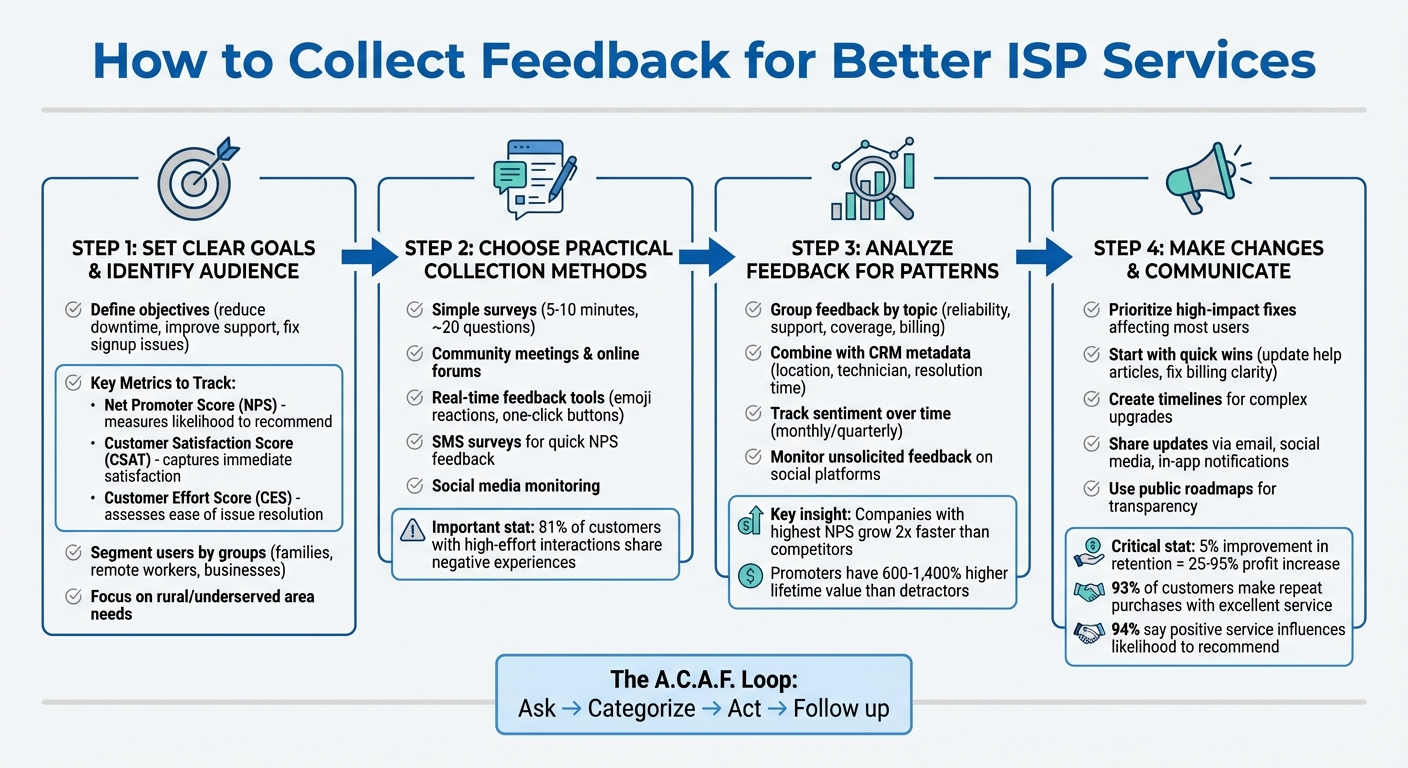
4-Step Process for Collecting and Acting on ISP Customer Feedback
What is customer feedback and 5 ways to collect it!
sbb-itb-342b8b2
Step 1: Set Clear Feedback Goals and Identify Your Audience
Before diving into feedback collection, take a moment to define what you’re aiming to achieve. Are you trying to reduce network downtime, speed up customer support, or pinpoint issues during the signup process? Having clear objectives ensures the feedback you gather turns into actionable insights.
Break your goals into categories like overall satisfaction, specific service pain points, or technical challenges [4]. For instance, you might set a goal to boost your Net Promoter Score (NPS) by 15% before Q4 [5]. Establish a baseline through recurring surveys to track progress and identify emerging issues [4].
Another crucial step is understanding your audience. Different user groups - say, remote workers versus families - often have unique priorities. Leverage your CRM data to create detailed user personas [8]. For example, WEIRDTOO (https://weirdtoocompany.com) focuses on underserved Wyoming communities, recognizing that a one-size-fits-all approach doesn’t work in diverse areas.
Once you’ve nailed down your goals and audience, the next step is deciding on the right metrics to measure success.
Choose the Right Metrics to Track
Metrics help translate customer feedback into measurable outcomes. Here are three key ones to consider:
- Net Promoter Score (NPS): This measures how likely customers are to recommend your service. It’s straightforward, gets high response rates, and ties directly to growth [4]. Apple, for instance, hit an NPS of 68 in 2024 by consistently acting on post-purchase feedback [7].
- Customer Satisfaction Score (CSAT): This score captures immediate satisfaction after specific interactions, using simple rating systems like stars, emojis, or numbers [4].
- Customer Effort Score (CES): This assesses how easy it was for a customer to resolve an issue. It’s a strong predictor of loyalty and repeat business [4].
For internet service providers (ISPs), technical metrics like uptime percentages, connection speeds at different times of day, and network performance during peak hours are essential [1]. In underserved areas, tracking the cost per Mbps can help ensure fair pricing [6]. Keep surveys concise - around 5–10 minutes or roughly 20 questions - and consider offering small incentives like digital guides or gift cards to encourage participation [3].
Tailor your metrics to address specific challenges faced by rural communities.
Address the Needs of Rural and Underserved Areas
Rural areas often face unique internet challenges that urban providers might overlook. Unreliable internet impacts everything from remote work to education and healthcare. And poor customer experiences? They’re a major driver of churn, with 89% of professionals switching providers because of them [5]. In smaller, close-knit communities, bad experiences spread quickly via word-of-mouth.
Using geographic filters can help pinpoint the specific needs of rural customers [7]. For example, trailer park residents might value affordability and consistent uptime more than ultra-fast speeds, while small businesses may prioritize reliable bandwidth during working hours. Free government data, like that from the U.S. Bureau of Economic Analysis, can reveal spending trends in rural regions [8]. When analyzing this data, check the "coefficient of variability" in Census reports to ensure the information is accurate [6]. Face-to-face interviews in smaller communities can also provide candid, valuable feedback [7].
Step 2: Choose Practical Feedback Collection Methods
Once you’ve nailed down your goals and identified your audience, it’s time to pick feedback tools that align with your community’s tech habits. A solid approach blends structured methods like surveys and interviews with organic feedback from social media and reviews [2]. This combination helps you get clear answers to your specific questions while also capturing candid, unfiltered reactions. Keep in mind, 81% of customers who face high-effort service interactions will share negative experiences with others [4]. If you make it tough for customers to provide feedback, you risk losing out on crucial insights.
Next, let’s look at how simple surveys can streamline direct input.
Create Simple Surveys for Direct Input
Short, straightforward surveys are an easy way to tap into your customers' opinions. Use the language they use - for instance, if they say, “the internet keeps cutting out,” don’t replace it with technical terms like “intermittent connectivity issues” [3].
For areas with limited internet access, consider printed surveys handed out at community centers or included with billing statements. SMS surveys can also work well, especially for gathering quick Net Promoter Score (NPS) feedback right after a service call [9]. These direct methods help pinpoint the core issues affecting your service.
Host Community Meetings and Online Forums
Face-to-face conversations offer a unique opportunity to understand how your service impacts the community on a deeper level [2]. This kind of in-person research can highlight gaps that online surveys might overlook [6].
Hold regular town halls or focus groups in easily accessible locations. For communities spread over larger areas, online forums - like Facebook Groups - can be a practical alternative. Take WEIRDTOO as an example: they serve Wyoming communities within a four-hour travel radius and use online spaces to maintain personal connections in rural areas (https://weirdtoocompany.com). In smaller or remote communities, word-of-mouth and personal interactions are key.
Add Real-Time Feedback Options
Scheduled feedback is great, but real-time input captures raw, immediate reactions that might otherwise be forgotten. Add one-click feedback options - like emoji reactions or thumbs up/down buttons - on key pages such as sign-up, billing, and support [7]. These tools make it easy for customers to share their thoughts with minimal effort.
Automated surveys triggered after a support ticket closes or a technician visit ends are another effective way to collect feedback. This reduces recall bias and improves response rates [4][9]. To track overall sentiment, use free tools like Google Alerts to monitor mentions of your service on social media and local forums. Since 63% of consumers feel companies need to improve at listening to feedback [9], actively responding to customer input can help build trust.
You might also consider setting up a public feature request board using tools like Trello. This allows customers to suggest and vote on improvements, giving them a sense of ownership while helping you prioritize changes that matter most [4].
Step 3: Analyze Feedback to Find Patterns and Priorities
Once you've gathered feedback, the next step is to organize it into meaningful insights. This process turns raw data into a roadmap for making targeted improvements. The focus should be on spotting recurring themes and identifying which issues require immediate action.
Group Feedback by Topic
Start by categorizing feedback into clear topics like reliability, customer support, coverage gaps, billing issues, or technical bugs [7][10]. This makes it easier to identify the most common concerns. For instance, if a large number of customers mention that their "internet keeps cutting out", it’s a clear sign that reliability is a pain point.
To deepen your analysis, combine this feedback with metadata from your CRM system. Include details such as customer location, the technician assigned to their case, time to resolution, and the specific product involved [10]. This enriched data can help you uncover patterns you might otherwise miss. For example, frequent outages in a specific neighborhood or recurring issues tied to a particular router model could surface. For ISPs operating in rural areas, this kind of location-based analysis is especially useful for identifying regional service challenges or repeated outages [4].
Focus on the issues that impact a larger group of customers rather than isolated complaints [3]. Not all feedback carries the same weight - some negative reviews might stem from one-off misunderstandings, while others could highlight deeper, systemic problems [10].
Once you've identified key themes, keep tracking these metrics over time to monitor how customer sentiment evolves.
Track Customer Sentiment Over Time
Regularly tracking customer sentiment helps you spot trends and measure the impact of your changes. Use consistent metrics and ask the same questions at regular intervals - monthly or quarterly - to establish a baseline and detect shifts [4][11]. Segment your data by customer tier, location, or service type to determine whether satisfaction dips are widespread or limited to specific areas [10]. Research shows that companies with the highest NPS (Net Promoter Score) in their industry grow at least twice as fast as their competitors [4]. Additionally, "promoters" (customers scoring 9–10) have a lifetime value 600% to 1,400% higher than "detractors" [4].
Don’t ignore unsolicited feedback - it often provides valuable insights. Use social listening tools to monitor platforms like Facebook, X, Google, and Yelp for organic sentiment [4][7]. Review support tickets and chat logs for recurring frustrations that might not show up in surveys [10][11]. Keep in mind that 81% of customers who experience high effort during a service interaction are likely to speak negatively about the company [4]. Addressing these concerns early can stop small issues from snowballing into major dissatisfaction.
Step 4: Make Changes and Update Your Customers
Taking action on feedback is where the magic happens. Insights are only valuable if they lead to improvements - and when customers see those improvements, it strengthens their trust and keeps them invested in your service.
Focus on the Most Impactful Changes
Start with the easy wins. Small fixes like updating help articles, repairing broken links, or clarifying billing statements can make a big impression quickly [4]. These tweaks demonstrate that you're listening and taking action while you work on resolving larger challenges.
For more complex issues, like upgrading networks or replacing equipment, create a clear timeline [1]. Focus on areas that experience frequent outages or recurring problems, and streamline support processes to reduce wait times. The priority should always be on addressing issues that impact the largest number of users or cause the most frustration [10][7]. It’s also important to separate recurring, high-impact problems from isolated complaints that don’t reflect broader trends [10][5]. Why does this matter? Because even a 5% boost in customer retention can translate into a profit increase of 25% to 95% [4]. In other words, targeted improvements can lead to substantial gains.
Once you've made these changes, the next step is just as critical: letting your customers know.
Share Updates with Your Community
When updates are ready, communicate them promptly through email, social media, or in-app notifications [4][12]. Be specific about how customer feedback influenced the changes. For example, you could say, "Thanks to your input, we’ve made this improvement."
"We see our customers as invited guests to a party, and we are the hosts. It's our job every day to make every important aspect of the customer experience a little better." – Jeff Bezos, Founder, Amazon [4]
For major updates, consider using tools like Trello to share a public roadmap. This allows customers to see what’s being worked on and when they can expect results [4]. Transparency like this not only builds confidence in your service but also encourages more constructive feedback. And when customers notice that their suggestions lead to real changes, they’re more likely to stick around. In fact, 93% of customers are likely to make repeat purchases with businesses that deliver excellent service [4].
Conclusion
Turning feedback into meaningful action is how you bridge the gap between understanding customer needs and delivering real improvements. A well-structured feedback process can help identify service issues before they escalate into customer churn or a spike in support calls [10]. For ISPs working with underserved communities - where resources are often limited - this approach ensures you prioritize the fixes that matter most, whether it’s addressing network capacity issues or resolving specific connectivity challenges [1][10].
Closing the loop by informing customers about the changes you’ve made builds trust and fosters loyalty. When you say, “We listened, and we made this change because of your feedback,” it transforms a simple service interaction into a long-term partnership [10]. The impact is clear: improving customer retention by just 5% can lead to profit increases ranging from 25% to 95% [4].
To make this happen, follow the A.C.A.F. Loop: Ask for feedback, Categorize it by issue type (like speed, billing, or reliability), Act on the insights, and Follow up with the customers who contributed [4]. This method ensures every piece of feedback directly informs your service goals. For community-based ISPs, regular reviews of network performance and customer satisfaction are key to staying aligned with evolving user needs [1]. It’s a practical way to deliver meaningful service improvements that resonate with the communities you serve.
And with 94% of consumers saying a positive service experience strongly influences their likelihood to recommend a provider [4], every bit of feedback becomes a chance to enhance your reputation and elevate the quality of your service over time.
FAQs
How can ISPs gather and use customer feedback to improve rural internet services?
ISPs have an opportunity to make rural internet services better by focusing on customer feedback. This can be achieved through methods like surveys, community meetings, or digital tools that gather input on user experiences, challenges, and preferences. By actively listening, providers can pinpoint specific problems such as network capacity limitations, outdated equipment, or service gaps.
In rural areas, where traditional providers often miss the mark, setting up two-way communication channels builds trust and ensures solutions are designed with the community in mind. When ISPs consistently act on the feedback they receive, they not only improve customer satisfaction but also make smarter decisions about upgrades, resulting in more dependable and tailored internet services for these underserved regions.
What’s the best way to gather feedback to improve internet services for underserved communities?
When reaching out to underserved communities, it's crucial to use methods that are inclusive, accessible, and respectful of their specific circumstances. A mix of approaches works best: think online surveys, phone calls, community meetings, or face-to-face interviews. This variety ensures that everyone has an opportunity to share their thoughts, regardless of their situation. Keep your questions simple and sensitive to their background to make participation as easy as possible.
Trust is a big deal here - be upfront about how their feedback will lead to meaningful changes. For those without reliable internet access, try hosting local events or handing out paper surveys. And don’t stop there. Following up regularly to share how their input is shaping decisions helps build a sense of partnership and shows that their voices are being heard.
How do internet providers use customer feedback to improve their services?
Internet providers step up their game by actively listening to their customers. They gather feedback through surveys, feedback forms, and direct conversations, ensuring the questions are clear and focused. This approach helps them zero in on the most pressing issues, making the feedback both actionable and relevant.
Once feedback is collected, it’s paired with network performance data to pinpoint areas that need immediate attention - whether it’s improving reliability, boosting speed, or enhancing customer support. By addressing these key concerns, providers can allocate resources where they’re needed most, driving real improvements in service quality and customer satisfaction.
Current contact path
Need Weird Network WiFi, custom apparel, or scoped help?
Use the contact form; removed product, checkout, research, and newsletter funnels stay offline.