Loading…

Good coverage.
By weirdtoo·December 15, 2025·12 min read
Explains causes and practical solutions for the rural digital divide—coverage gaps, high costs, fixed wireless, community networks, and BEAD funding.
Good coverage.
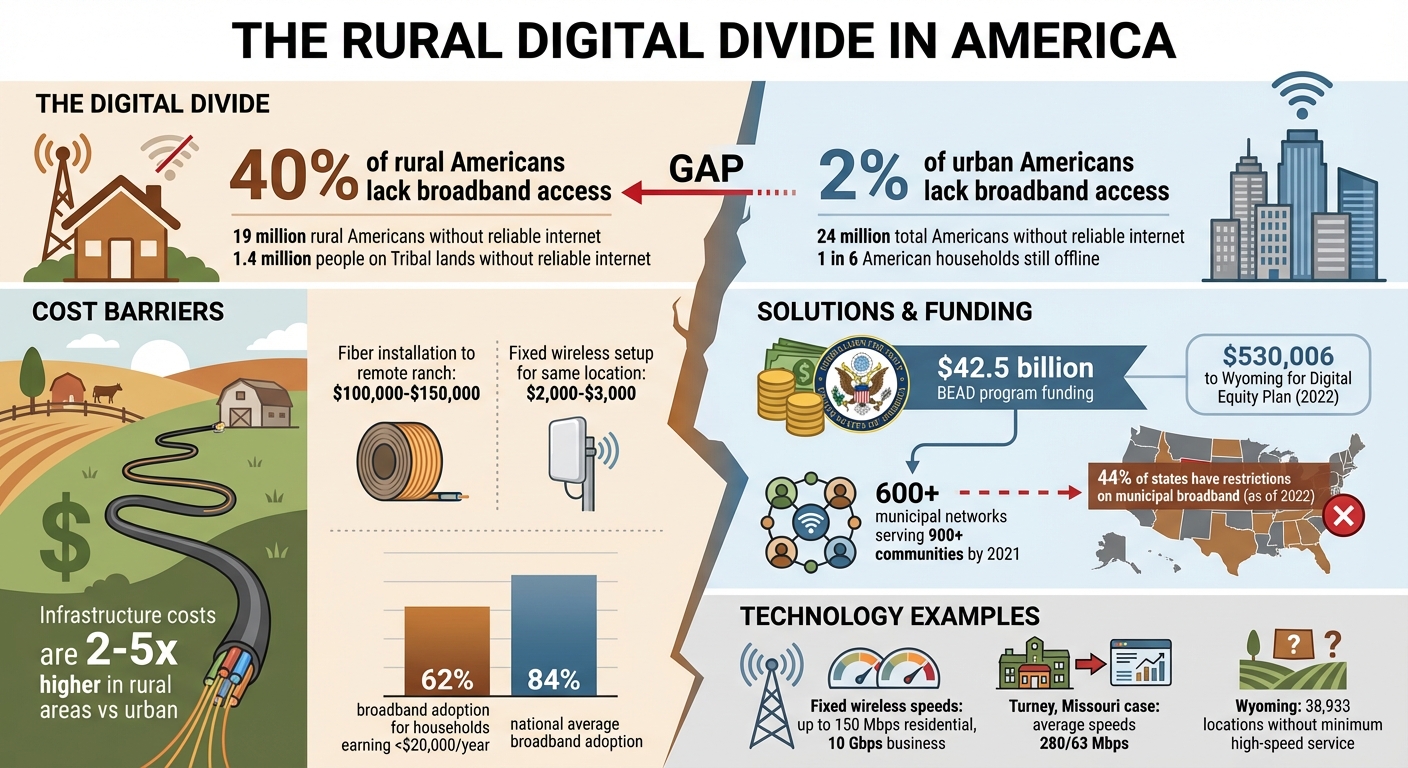
Rural Americans face a digital divide that impacts health, education, and local economies. Nearly 40% lack broadband access, compared to just 2% in urban areas. This gap affects daily life - students miss online learning, businesses lose growth opportunities, and telehealth services fall short.
Efforts to address this include local initiatives, government funding like the $42.5 billion BEAD program, and tailored solutions such as fixed wireless networks. Challenges like high costs, tough terrain, and outdated infrastructure persist, but community-led models and partnerships with smaller providers are making progress.
Key takeaways:
- Access gaps: 19 million rural Americans lack reliable internet.
- Cost barriers: Infrastructure costs are 2-5x higher in rural areas.
- Solutions: Fixed wireless, municipal networks, and federal programs like BEAD.
- Community efforts: Local providers and cooperatives play a crucial role.
Reliable internet is more than a convenience - it's a necessity for modern life. Addressing these gaps requires targeted, community-driven solutions supported by public and private partnerships.
Rural Digital Divide Statistics and Solutions Overview
Common Barriers to Reliable Internet Coverage
Infrastructure Gaps and Geographic Obstacles
In many underserved areas, sparse infrastructure and difficult terrain make reliable internet access a challenge. For example, Wyoming has 38,933 locations without minimum high-speed service [4]. Mountains, forests, and rugged landscapes drive up installation costs, creating significant hurdles.
"Drilling through mountains is expensive, and connecting a single ranch that might not have neighbors for miles and miles is economically unviable." (Cowboy State Daily) [4]
Matt Larsen, co-founder of Vistabeam, paints a clear picture of the issue: "If you've got a ranch that sits 25 miles out of town and 20 miles of that is dirt road snaking past very few homes, building fiber out that direction could be $100,000 to $150,000 just to get to that one home" [4]. In contrast, a fixed wireless setup for the same location might cost only $2,000 to $3,000 [4]. Even basic infrastructure, like power lines, often takes longer to establish than the internet towers themselves [4]. On top of that, outdated infrastructure in these regions leads to frequent outages and slower speeds, making an already difficult situation worse [3]. These physical and economic barriers combine to make connectivity in remote areas a persistent challenge.
Affordability and Outdated Service Models
High costs to build and maintain infrastructure in rural areas often result in expensive service - or no service at all. In fact, the cost per household in these areas can be 2 to 5 times higher than in urban settings [5], making it tough for providers to see a worthwhile return on investment. This leaves many communities with limited or overpriced options.
Take Parkman, a small town northwest of Sheridan, Wyoming. Despite the installation of some fiber optics for the local ATM and jukebox, internet access remains so limited and costly that the local bar and grill only accepts cash or checks [4]. To make matters worse, large telecommunications companies frequently lobby for state laws that restrict alternatives like municipal broadband. This reduces competition and discourages improvements to existing infrastructure [2][6]. While affordability is a major issue, even the services that are available often fall short due to outdated models and poor planning.
Coverage Quality and Dead Zones
Even in areas where internet service is available, poor network design can create frustrating dead zones. Chad Bolling, Broadband Manager at the Wyoming Business Council, highlights the problem:
"Topography and sparse populations create additional challenges" [4].
The terrain adds unique complications. Matt Larsen explains, "If you've got someone who's way out there and they're in a bowl surrounded by hills and trees, it's tough to get wireless into granite in the ground, it's super expensive to get fiber to" [4]. While satellite internet might seem like a solution, it has its own limitations. As Larsen points out, "The more people who get on satellite, the less capacity there is for everyone. So, if we just sent out Starlink terminal to everyone who didn't have internet, the system would get overloaded" [4]. This results in inconsistent service, leaving residents and businesses struggling to stay connected.
Strategies for Expanding Coverage
Choosing the Right Technologies for Your Community
When selecting technologies, it's essential to focus on what your community truly needs [7]. Fixed wireless networks, often referred to as WISPs (Wireless Internet Service Providers), are a practical option for rural areas where installing cables isn't realistic. Unlike standard Wi-Fi, which is meant for short-range indoor use, fixed wireless utilizes specialized hardware to extend connectivity over much greater distances [8].
Here’s how a WISP network works: it starts with a fiber connection at a central hub, like a datacenter or commercial building. From there, relay sites - installed on structures such as water tanks, homes, or cell towers - carry the signal using wireless backhauls. To connect homes and businesses, Customer-Premises Equipment (CPE) is mounted on rooftops, creating a direct link to these relay sites [8]. This setup can provide residential speeds of up to 150Mbps and business connections as high as 10Gbps [8].
These technical frameworks lay the groundwork for customized solutions in more complex environments, such as multi-unit housing or outdoor spaces.
Designing Wi-Fi for Multi-Unit and Outdoor Areas
Providing reliable Wi-Fi in multi-unit housing, trailer parks, or RV parks requires a different approach than single-family homes. Strategic placement of routers can transform patchy coverage into consistent service, while weather-rated equipment ensures durability in areas with extreme temperature changes.
Start by mapping the property to identify obstacles and dead zones. This step is especially useful in rural or multi-unit setups where connectivity issues are common. Install access points on elevated structures to maximize coverage, and for larger complexes, consider mesh networks to fill in gaps where a single router might fall short. For multi-unit residences, centralized management systems can help balance bandwidth, ensuring one user doesn’t hog the connection at the expense of others. Although weather-rated equipment may have a higher initial cost, it minimizes replacement expenses over time.
Using Managed Hotspot Platforms
Once hardware is in place, efficient management becomes the next priority in delivering dependable coverage. Centralized hotspot platforms are particularly useful for small businesses and community spaces, offering tools to simplify guest Wi-Fi management. These platforms let you create branded splash pages, collect customer data like email addresses and phone numbers, and even resolve technical issues remotely [25,27]. In rural areas, such as Wyoming, some providers offer 24/7 remote monitoring through revenue-sharing models, keeping operational costs manageable.
The best platforms also include features like bandwidth control, usage analytics, and the ability to set pricing tiers or time limits. Some even allow for video ads on splash pages, creating an additional revenue stream. Remote management tools are especially valuable when your nearest customer is miles away down a dirt road. Look for platforms that offer API integration and multi-language support to ensure compatibility with existing systems and to meet the needs of diverse communities.
Bringing Broadband to Underserved Communities at Open Broadband
sbb-itb-342b8b2
Funding and Organizational Models
Expanding internet access in rural areas requires significant investment, but there are plenty of funding options available. The challenge lies in aligning the right funding source with an organizational model that meets the specific needs of the community.
Community-Led and Cooperative Models
Municipal networks and cooperatives give communities direct control over their internet infrastructure. By 2021, more than 600 municipal networks were serving over 900 communities across the U.S. [2]. These models are particularly effective in rural areas where large internet providers often lack financial motivation to invest. A great example is Greenlight, North Carolina's first community-owned fiber-to-home network, operated by the City of Wilson. Greenlight offers affordable internet to residents in public housing and provides 100 Mbps speeds to after-school programs, libraries, and community centers [2]. Beyond Wilson, the network has extended its reach to neighboring areas like Pinetops and Vick Family Farms. It even launched a 10-week "Fiber Optics Basics" course to train local residents [2].
Despite their success, municipal broadband efforts face challenges. As of 2022, 44% of states had laws or other restrictions limiting municipal broadband, often due to lobbying by large providers [2]. However, progress is being made. In 2023, Colorado repealed its restrictions, and in 2022, both Maine and New York introduced new funding programs for municipal broadband [2]. Rural electric cooperatives also play a big role. Minnesota's RS Fiber, for instance, has prioritized long-term reliability in its fiber deployments [5]. Other organizations, like XNET WIFI, collaborate with local governments and cooperatives to pinpoint areas most in need of connectivity [5]. These efforts are increasingly supported by state and federal initiatives.
Accessing Government and State Funding Programs
Federal programs such as BEAD (Broadband Equity, Access, and Deployment), CPF (Capital Projects Fund), and DEA (Digital Equity Act) provide substantial resources for rural and Tribal broadband projects. These programs are largely administered by states, which means communities must work closely with state broadband offices during the planning stages [9]. States are also required to develop comprehensive broadband plans that outline investment priorities and incorporate local input [10]. If a community's needs are not included in these plans, it could jeopardize their chances of securing funding.
Applications for these programs require detailed documentation, including evidence of coverage gaps, cost estimates, and community support. Policies like "Dig Once", which coordinate broadband installation with road construction, can significantly lower costs. Success often hinges on political support and the ability to tap into multiple funding sources.
Partnering with Local Wi-Fi Providers
Collaborating with smaller, locally focused providers can help communities reduce upfront costs through revenue-sharing agreements. Unlike large providers that often require communities to cover all infrastructure costs, smaller operators typically offer more flexible solutions. For instance, some Wyoming-based providers offer a 70/30 revenue split, where the community retains 70% of the fees while the provider handles equipment, monitoring, and 24/7 support, with a minimum monthly revenue guarantee of $300. Communities with existing infrastructure can negotiate a higher split - up to 85/15 - by opting for a DIY support model, which typically comes with a monthly retainer of around $125.
These partnerships work best when providers are familiar with the unique challenges of rural areas, such as long distances between customers, harsh weather, and limited on-site technical expertise. Remote management capabilities are critical, especially when customers live miles apart, and revenue-sharing models help keep costs predictable for communities operating on tight budgets.
Maintaining Reliable and Equitable Coverage
Getting a network up and running is just the first step. To ensure long-term success, it’s essential to focus on consistent monitoring, fair access policies, and programs that help everyone make the most of connectivity.
Monitoring and Maintenance
Keeping a network reliable means staying on top of key metrics like uptime, latency, throughput, and packet loss. Monitoring these factors helps catch problems early and maintain user trust [11]. Tools like remote dashboards with automated alerts are especially useful for resolving issues in rural or hard-to-reach areas.
Regular updates, security checks, and performance reviews also play a big role in maintaining stability [12][13]. For communities that rely on local providers, remote management tools are invaluable, especially when traveling between sites isn’t practical. These practices not only keep the network running smoothly but also support better bandwidth management.
Bandwidth Management and Fair Use Policies
Fair access to bandwidth is critical for equitable connectivity. Tools like Quality of Service (QoS) settings and session limits ensure bandwidth is distributed fairly among users. For example, in Turney, Missouri, a wireless broadband system installed in September 2021 used a community-level intelligent router to dynamically allocate bandwidth. This setup provided households with average speeds of 280/63 Mbps [15].
Clear policies around fair use are just as important. When users understand how bandwidth is managed, it helps create a reliable and inclusive network environment.
Building Digital Inclusion Programs
Connectivity alone isn’t enough. Bridging the gap requires digital literacy, affordable devices, and local support. For instance, households earning less than $20,000 annually have a broadband adoption rate of just 62%, compared to the national average of 84%.
Collaborating with local organizations like libraries, churches, nonprofits, and university extension programs can make a real difference [14]. These groups often have strong ties to the community and can help implement effective digital inclusion programs. In Minnesota, the Department of Education has recommended funding digital navigator programs within community-based organizations to provide one-on-one guidance.
On a larger scale, programs like the FCC's Lifeline Program offer monthly broadband service discounts to eligible households, with extra support for those on tribal lands. In 2022, Wyoming received $530,006 through the Digital Equity Act to develop a comprehensive Digital Equity Plan that includes community engagement and data collection [9]. These efforts work best when they address all aspects of digital inclusion: affordable services, accessible devices, and the skills to use them effectively.
Conclusion
Bridging the digital divide in underserved communities calls for targeted, thoughtful solutions. It’s not just about providing internet access - it’s about addressing the unique challenges posed by geography, affordability, and infrastructure gaps. Broadband access has become a critical factor in shaping opportunities for education, healthcare, jobs, and overall quality of life, earning its role as a "super determinant of health" [1][2][6]. Yet, around 24 million people in the U.S. still live in areas without reliable internet - 19 million in rural regions and 1.4 million on Tribal lands - making the urgency for action impossible to ignore [1].
Tackling these issues requires strategies tailored to specific community needs. Solutions must combine technology with inclusive programs to make a real difference. Collaboration is key - state, local, and tribal governments, alongside community organizations and service providers, must work together to address regional challenges [2][5]. Technologies like fixed wireless, mesh networks, and 5G can play a significant role, especially when paired with initiatives like digital literacy training, affordable device programs, and accessible local support systems [1]. These efforts build on earlier successes in deploying technology and funding models that prioritize local needs.
Funding remains a cornerstone of these efforts. Federal and state investments, along with creative local partnerships, are essential to offset the higher costs of serving rural and remote areas [5].
Ultimately, achieving meaningful connectivity goes beyond simply getting people online. It’s about ensuring equitable access and empowering everyone - regardless of income, race, or location - to make full use of digital tools. With roughly 1 in 6 American households still offline, the road ahead demands both technical innovation and a commitment to addressing systemic inequities [16].
FAQs
What makes it challenging to provide reliable internet in rural areas?
Providing dependable internet access in rural areas isn’t without its hurdles. One major issue is low population density, which translates to fewer customers to help offset the costs of building and maintaining infrastructure. This makes large-scale investments harder to justify financially.
On top of that, the long distances between rural homes and towns demand extensive cabling or wireless networks. Setting up these systems isn’t just expensive - it’s also time-consuming to maintain.
The challenges don’t stop there. Rugged terrain and the isolation of many rural areas add another layer of complexity. These conditions drive up both the time and expenses required to bring broadband services to these regions, often leaving underserved communities struggling to access affordable, reliable internet.
How can community-led models and cooperatives expand internet access in underserved areas?
Community-led models and cooperatives are making a big difference in bringing internet access to areas that need it most. By tapping into local expertise and teamwork, these initiatives create solutions that work well for the specific challenges of underserved communities.
By collaborating directly with residents, cooperatives can pinpoint where connectivity is lacking and design infrastructure plans that fit the community's needs. This hands-on approach often lowers costs, boosts efficiency, and ensures the network is built to address real-world challenges. Plus, these models focus on fairness, striving to provide reliable, high-quality internet access to everyone - no matter where they live or how much they earn.
What are the best technologies for improving internet access in rural areas?
Expanding internet access to rural communities often involves leveraging fiber-optic networks and satellite internet, especially low-earth orbit (LEO) satellites. Fiber-optic networks are known for their fast and reliable speeds, but they require a substantial investment in infrastructure. This makes them a great option for areas where installing cables is practical.
For more isolated regions, LEO satellites provide a workable solution by delivering high-speed internet without the need for extensive ground installations. These satellites help close the connectivity gap in underserved areas, offering more consistent and reliable access. When paired with community-led initiatives, these technologies can improve both coverage and affordability, making internet access more attainable for everyone.
Current contact path
Need Weird Network WiFi, custom apparel, or scoped help?
Use the contact form; removed product, checkout, research, and newsletter funnels stay offline.