Loading…

Gate way mangminet devices. can dubel as a wifi device.
By weirdtoo·December 11, 2025·10 min read
Dual-purpose gateway devices combine modem, router, and Wi-Fi to deliver scalable, cost-effective internet for rural communities, businesses, and public spaces.
Gate way mangminet devices. can dubel as a wifi device.
Gateway management devices combine internet traffic handling and Wi-Fi distribution, making them ideal for larger spaces or underserved areas. These devices extend connectivity to public spaces like schools and parks, offering reliable internet where traditional infrastructure is limited. They merge modem, router, and Wi-Fi access point functions into one unit, reducing costs and simplifying setup.
Key takeaways:
- Dual-purpose functionality: Handles internet traffic and Wi-Fi distribution.
- Community impact: Expands Wi-Fi access to underserved areas, including rural spaces.
- Efficient design: Combines modem, router, and Wi-Fi access point, cutting down on hardware and maintenance.
- Advanced features: Dual-band Wi-Fi, cloud-based management, and failover options for uninterrupted service.
These devices are particularly useful for rural communities, businesses, and public spaces, providing scalable, reliable, and cost-effective internet solutions.
How Gateway Devices Function as Wi-Fi Solutions
Core Components of Gateway Devices
Gateway devices bring together three critical functions into a single unit: a modem, a router, and a Wi-Fi access point [3][4][6]. The modem connects to your Internet Service Provider (ISP) and pulls data into your home or business. The router then takes over, ensuring that data is sent to the right devices on your network.
Inside these devices, an integrated RF chipset does the heavy lifting for wireless communication. It includes a baseband processor, power amplifier, and antennas, while a microcontroller manages firmware and configuration settings [5]. Flash memory stores the firmware, operating system, and your personalized settings [5].
This combination of hardware and software makes gateways incredibly sophisticated. They handle error control, direct data packets efficiently, and manage transmission speeds effectively [4]. By integrating these components, gateways simplify network operations, making them a practical and cost-effective solution.
Benefits of Dual-Purpose Devices
Having a single device that combines gateway and Wi-Fi functionality offers some clear advantages. It reduces physical clutter, cutting down on cables and the need for multiple devices. This streamlined setup is especially helpful for rural areas or community networks where technical expertise and resources might be limited [3][6]. For small businesses or underserved regions, managing one device instead of several is a game-changer.
This approach also lowers hardware costs and simplifies maintenance [7][8][9][10]. Some options even eliminate recurring fees or contracts, offering free upgrades and support [9]. For Internet Service Providers (ISPs) and network administrators, troubleshooting is easier with just one device to inspect.
However, there is a trade-off. All-in-one devices may lack the flexibility of separate components. For example, standalone devices might allow you to upgrade individual parts or access advanced features like VPNs or Quality of Service controls [3][6]. But for communities or businesses focused on quick, reliable connectivity, the simplicity of a combined device often outweighs the limitations, offering faster setup and less complexity overall.
Key Features of Dual-Purpose Gateway Devices
Wi‑Fi Capabilities for Community Networks
Dual-band functionality is a must-have for reliable community Wi‑Fi networks. These devices operate on both the 2.4 GHz band, known for its longer range and ability to penetrate walls, and the 5 GHz band, which offers faster speeds. This dual-band setup ensures a balance between coverage and performance while minimizing interference between connected devices [11]. By splitting traffic across the two bands, network capacity improves significantly. High-end models can handle over 50 active devices, while basic units may struggle with 15–25 devices. Features like band steering take it a step further by automatically guiding compatible devices to the most suitable band. Additionally, the ability to create multiple SSIDs allows administrators to separate user groups, enhancing both security and ease of management [13]. These capabilities make managing and optimizing community Wi‑Fi networks far more efficient.
Management and Monitoring Tools
Centralized cloud management has transformed how networks are maintained, allowing for remote diagnostics and real-time adjustments without the need for on-site technician visits [11]. These gateway devices include features like content filtering to block harmful websites, bandwidth throttling to prevent excessive resource usage, and tiered Wi‑Fi options to offer different service levels. A user-friendly dashboard simplifies network setup and monitoring, making it accessible even for staff who lack technical expertise [12].
Features for Rural and Underserved Areas
For areas with unreliable infrastructure, multi-WAN backup options are crucial. Many gateway devices offer cellular connectivity with dual SIM card setups - one active and one on standby - to ensure automatic failover if the primary wired connection goes down. This guarantees uninterrupted service [13]. In rural environments, the extended range of the 2.4 GHz band becomes especially useful for covering large spaces or navigating physical barriers. Mesh networking further improves coverage by linking multiple access points seamlessly. Enterprise-grade devices also provide regular firmware updates and security patches, ensuring long-term stability and reliability [11][12]. These features make them well-suited for tackling the unique challenges of rural and underserved areas.
✅ How To Add A Router To T-Mobile Home Internet 5G Gateways - Tips and Tricks
sbb-itb-342b8b2
Deployment Options for Underserved Communities
When it comes to providing internet access to underserved areas, deployment strategies can be tailored to fit the size and specific needs of the community.
Single-Device Setup for Small Sites
All-in-one outdoor Wi‑Fi gateways are a practical solution for single buildings, small businesses, and restaurants. These devices connect to the internet using cellular networks like 4G LTE or 5G [1]. Built to withstand extreme conditions, industrial-grade models can operate in temperatures ranging from -40°F to 176°F (-40°C to 85°C) [1]. Their weatherproof designs, backed by IP67 and NEMA ratings, make them well-suited for harsh climates, such as those in Wyoming, where moisture and dust are common challenges.
Seasonal businesses, like RV parks or campgrounds, can benefit from flexible month-to-month data plans. These plans allow operators to pause billing during off-seasons, helping to manage costs [1]. To optimize signal strength, place hotspots near windows or as close to the nearest cell tower as possible. For areas with weak cellular signals, a booster can amplify the signal up to 32 times [16]. Additionally, limiting the number of connected devices can help maintain network performance and avoid slowdowns.
However, for larger properties, a single-device solution might not be enough.
Multi-Device Setup for Larger Areas
For bigger spaces like trailer parks, RV parks, or community centers that cover multiple acres, a multi-device setup is often necessary. These deployments typically involve a central gateway using fiber or cellular backhaul, with coverage extended through outdoor access points strategically placed throughout the property [15]. Mesh networks are particularly effective here. They allow access points to act as both gateways and repeaters, ensuring smooth internet access as users move across different zones [18].
Cloud-based management tools make it easier to oversee these setups. They enable remote monitoring, bandwidth adjustments, and troubleshooting across all devices [15]. While traditional fiber installations can cost around $27,000 per mile [17], wireless multi-device setups can significantly cut costs in rural areas where fiber trenching isn’t practical.
Mobile and Temporary Connectivity Options
For events, emergencies, or temporary installations, vehicle-mounted or portable gateway devices provide a flexible solution. These devices are especially useful in rural areas where broadband access is limited [17]. Portable units can be deployed quickly and moved as needed, making them ideal for short-term projects or emergency response scenarios.
A great example of this approach is a public Wi‑Fi project in Guerneville, California, which delivered a return on investment of about $13 per resident annually [18]. For communities hesitant to commit to permanent infrastructure, mobile setups offer a low-risk way to test demand and gather data. Battery-powered models that are compatible with solar panels can also provide reliable connectivity in remote locations without consistent access to electricity [1].
How to Choose the Right Device
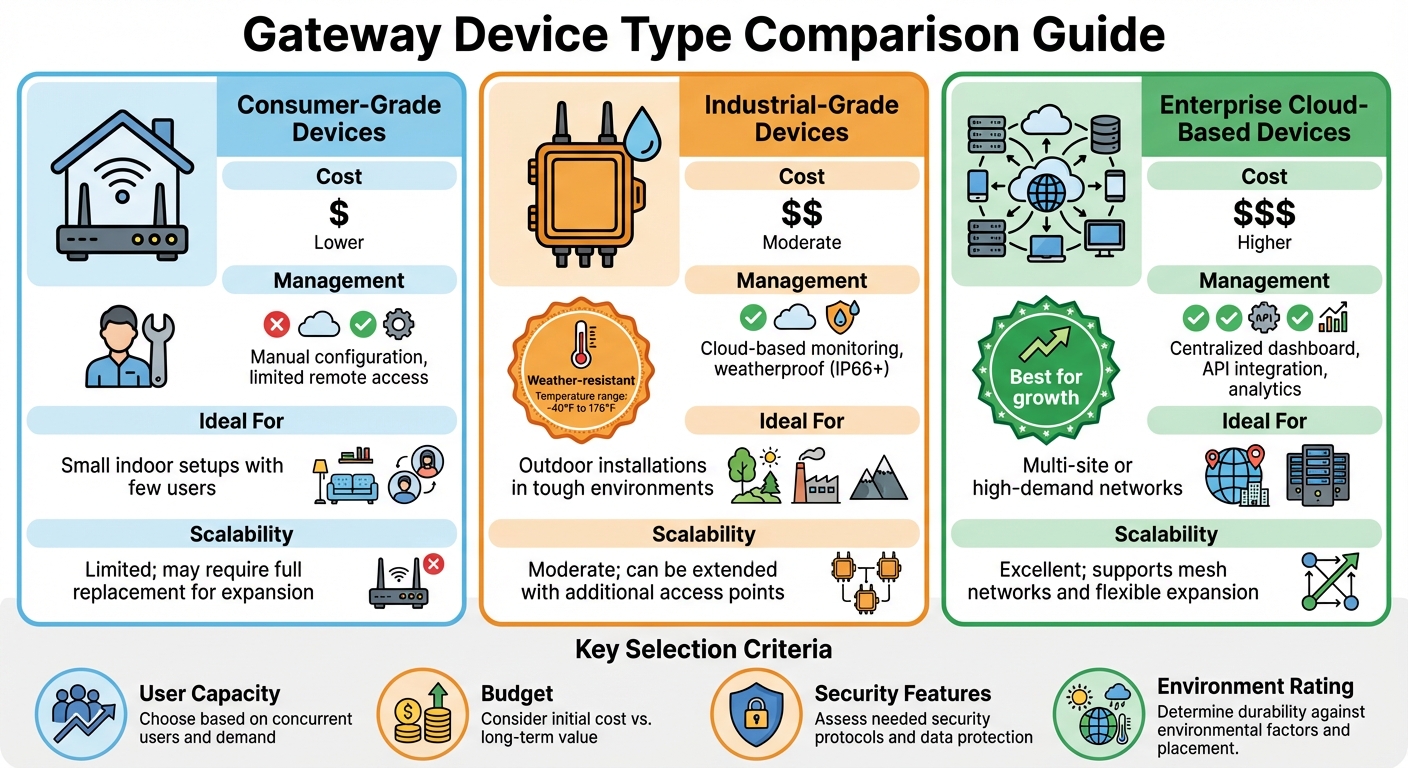
Gateway Device Types Comparison: Features, Costs, and Best Use Cases
When selecting a gateway, think about your specific connectivity needs - whether that's wired Ethernet, Wi‑Fi, or cellular backup powered by broadband bonding [20]. For areas with unreliable service, devices that combine multiple internet connections can offer better reliability and faster speeds [20].
It's also crucial to match the device's technical specifications to the environment where it will be deployed. For outdoor setups, such as those in Wyoming, opt for devices rated IP66 or higher. These models are designed for fixed or mobile configurations and can withstand extreme temperatures, unlike standard consumer-grade units [1][14][19]. The installation setting plays a big role in how well the device performs, so consider this carefully.
Key Selection Criteria
User capacity is a priority. Start by estimating the number of users at peak times and ensure the available bandwidth can handle activities like browsing and streaming without interruptions.
Budget considerations are also important. Weigh the upfront costs against ongoing expenses like data plans, electricity, and maintenance. Fixed Wireless Access (FWA) solutions, especially 5G FWA, can often provide broadband in remote areas at a lower cost than traditional wired options [21].
Security features shouldn't be overlooked. Look for devices with managed Wi-Fi capabilities, including guest network isolation, to keep your business network secure from public access. Cloud-based management tools are a great addition, allowing for remote monitoring and troubleshooting - an essential feature in rural areas where on-site tech support might not be readily available [15]. Additionally, choose devices equipped for emergency situations to maintain connectivity when other systems fail. By focusing on these criteria, you can ensure the device you select meets both the technical and environmental demands of your deployment.
Device Type Comparison
Here’s a quick comparison of different device types to help guide your decision:
| Device Type | Cost | Management | Ideal For | Scalability |
|---|---|---|---|---|
| Consumer-Grade | Lower | Manual configuration, limited remote access | Small indoor setups with few users | Limited; may require a full replacement for expansion |
| Industrial-Grade | Moderate | Cloud-based monitoring, weatherproof (IP66+) | Outdoor installations in tough environments | Moderate; can be extended with additional access points |
| Enterprise Cloud-Based | Higher | Centralized dashboard, API integration, analytics | Multi-site or high-demand networks | Excellent; supports mesh networks and flexible expansion |
Consumer-grade devices are cost-effective for smaller, indoor setups but often fall short when handling heavy loads or outdoor conditions. Industrial-grade models, while more expensive upfront, are built to endure harsh environments, making them a solid choice for challenging deployments. For networks requiring advanced management and scalability, enterprise cloud-based solutions offer robust features, including centralized control and seamless expansion options.
Conclusion
Dual-purpose gateway devices play a crucial role in addressing connectivity challenges in rural Wyoming and other underserved areas. With 25.7% of Wyoming's population lacking internet access and only 10.9% having access to fiber service, the need for reliable solutions is clear [23]. These devices go beyond serving individual homes - they extend connectivity to public spaces, schools, and local businesses, filling critical gaps where traditional providers often fall short [2].
Their affordability and durable design make them especially effective. In areas where 20–25% of households in low-income buildings remain unconnected due to cost barriers [22], these devices provide a practical alternative. By leveraging existing cellular networks and eliminating the need for expensive cabling, they significantly lower infrastructure costs [2, 55]. Built to withstand Wyoming's harsh climates, their industrial-grade design ensures consistent performance [1], which is essential for driving both economic and educational progress.
Beyond basic connectivity, these devices enable transformative services like telemedicine and distance learning, helping bridge gaps in healthcare and education access [24]. In communities where 29% of residents have limited internet options, these devices become more than just tools - they act as catalysts for economic growth and expanded opportunities [23].
Whether used individually or as part of a larger network, dual-purpose gateway devices offer practical, scalable solutions tailored to the needs of rural and underserved areas. Their combination of flexibility, reliability, and cost-efficiency helps these communities thrive in an increasingly connected world.
FAQs
How can gateway devices help improve internet access in rural communities?
Gateway devices are key players in improving internet access in rural areas, blending Wi-Fi capabilities with advanced connectivity tools. These devices can stretch Wi-Fi coverage, handle multiple users effortlessly, and boost network stability using technologies like multi-WAN for distributing traffic and mesh networking to bridge infrastructure gaps.
Built to integrate with cellular networks, these devices make connecting remote areas much more feasible, especially where traditional broadband options are scarce or nonexistent. They streamline network setups, lower costs, and offer a practical way to tackle connectivity issues in underserved regions.
What are the benefits of using a device that combines modem, router, and Wi-Fi functions?
Using a single device that combines the functions of a modem, router, and Wi-Fi can make life a lot easier. For starters, it simplifies the entire setup process - no need to tinker with multiple devices. It also helps cut down on clutter, saving valuable space, and is often more budget-friendly than buying each component separately. On top of that, troubleshooting becomes much simpler since there’s only one device to manage, which can be a big plus for people living in rural or underserved areas.
That said, while these all-in-one devices are super convenient, they might not be the best choice for everyone. If you’re someone who needs top-tier performance, more customization options, or stronger security features, separate devices could be a better fit for your connectivity needs.
How do dual-purpose gateway devices support multiple users and connections?
Dual-purpose gateway devices are designed to handle multiple users and connections with ease, thanks to advanced traffic management and Smart Blending Technology. By combining various network options like Wi-Fi, cellular, and wired connections, they provide consistent and reliable connectivity.
These devices excel at prioritizing essential tasks, minimizing delays, and distributing bandwidth efficiently. This ensures smooth performance, even when demand is high, making them a practical choice for areas with limited network access or communities in need of affordable, dependable infrastructure.
Current contact path
Need Weird Network WiFi, custom apparel, or scoped help?
Use the contact form; removed product, checkout, research, and newsletter funnels stay offline.