Loading…

Fixed Wireless Access and the Digital Divide
By weirdtoo·April 30, 2026·12 min read
Fixed Wireless Access brings fast, low-cost broadband to rural communities, easing deployment, boosting 5G speeds, and helping close the digital divide.
Fixed Wireless Access and the Digital Divide
Fixed Wireless Access (FWA) is reshaping how rural areas access high-speed internet. By using wireless signals instead of costly cables, FWA bridges connectivity gaps in underserved regions where fiber installation can cost $27,000–$64,000 per mile. With speeds reaching 500 Mbps or more, FWA offers a cost-effective and fast-to-deploy alternative, especially for remote communities.
Here’s why it matters:
- Rural Impact: 22.3% of rural Americans lack broadband, compared to just 3% in urban areas. FWA is helping reduce this gap.
- Cost Advantage: Deploying FWA is up to 40% cheaper than fiber in many cases.
- Quick Setup: Networks can be operational in weeks, leveraging existing cellular towers.
- Scalability: 5G advancements allow FWA to deliver faster speeds and lower latency.
Despite challenges like signal interference and reliance on fiber backhaul, FWA is expanding rapidly. In the U.S., licensed FWA coverage grew 145% by late 2025. Programs like the $42.45 billion BEAD initiative are fueling this growth, enabling local providers like WEIRDTOO LLC to serve rural communities effectively. FWA is not just connecting people - it’s enabling education, healthcare, and economic growth in areas that need it most.
What Is Fixed Wireless Internet For Rural Areas? - Emerging Tech Insider
sbb-itb-342b8b2
How Fixed Wireless Access Technology Works
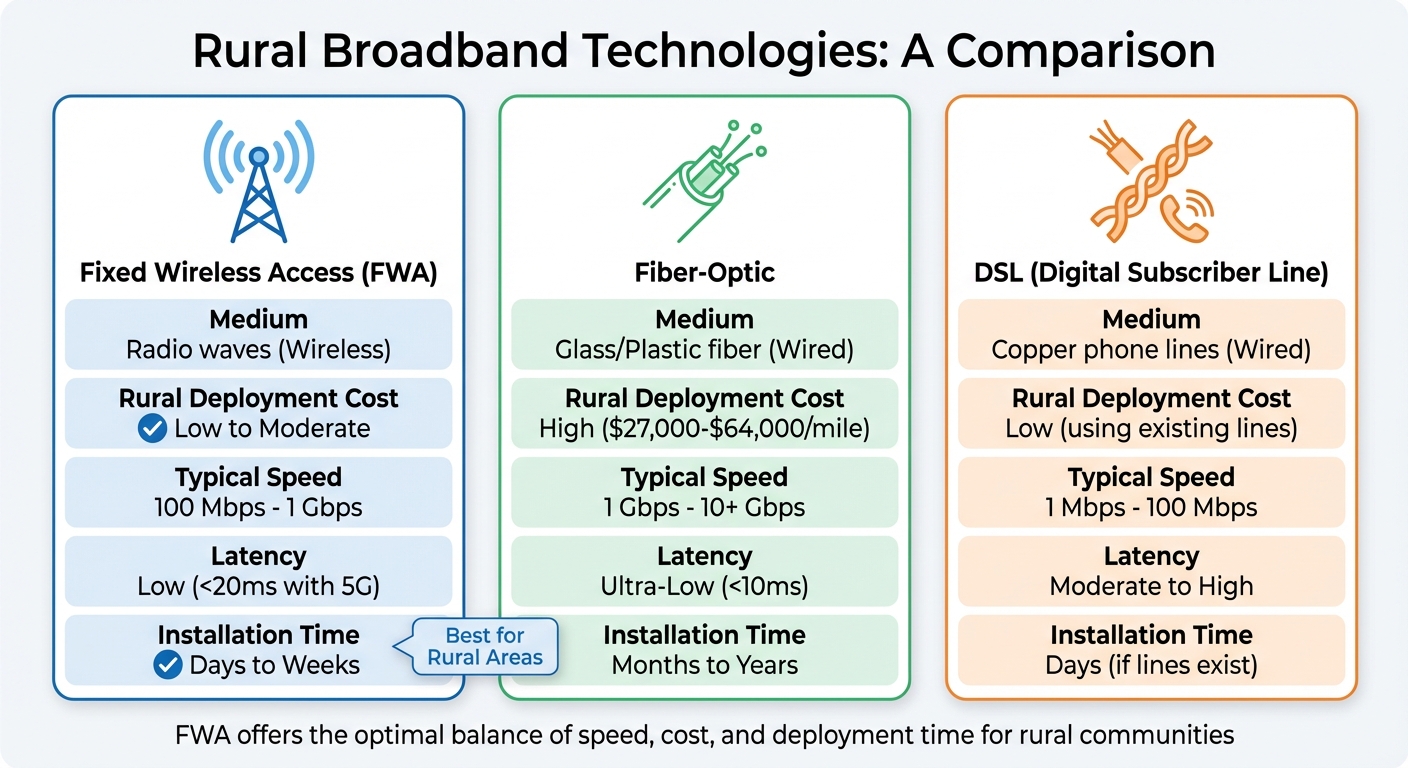
FWA vs Fiber vs DSL: Rural Broadband Technology Comparison
Basic Components and Operation
Fixed Wireless Access (FWA) relies on three key components to deliver internet access without cables. First, base stations - essentially wireless towers or cell sites - emit high-frequency radio signals to users within a 5–10 mile radius [1]. These towers are often placed on elevated structures like existing cellular towers, rooftops, or water tanks to maximize coverage and reduce interference.
Next, at the user's location, a mounted Customer Premises Equipment (CPE), such as a directional antenna, picks up these signals. The CPE then converts the signal into a wired connection, which powers indoor Wi-Fi [1][2]. Unlike mobile wireless systems, the CPE remains stationary, ensuring a more stable connection.
FWA operates across different spectrum bands, each suited for specific needs:
- Low-band frequencies (below 1 GHz): Offer wide coverage and are ideal for rural areas with sparse populations.
- Mid-band spectrum (1–6 GHz, like the 3.5 GHz CBRS band): Balances speed and range, making it effective for rural deployments.
- High-band mmWave (24–100 GHz): Provides ultra-fast speeds but is best for short-range, localized use due to its sensitivity to obstacles [1][2].
For optimal performance, FWA requires a direct line-of-sight or near-line-of-sight between the base station and the CPE. Physical barriers like hills, trees, or dense building materials can weaken the signal. This is why outdoor-mounted CPEs are the standard [1][2]. While the "last mile" connection to the user is wireless, the base stations themselves rely on a strong fiber backhaul to connect to the broader internet [1]. This setup ensures reliable service, especially in areas where traditional cable networks are impractical.
Benefits for Rural Areas
FWA's design makes it an excellent solution for rural communities, offering both cost and deployment advantages. Traditional wired networks often struggle in these areas due to high infrastructure costs, but FWA sidesteps these challenges. For example, deployment costs for FWA are up to 40% lower than fiber in many cases [4]. In Tanzania, local ISPs using solar-powered base stations and point-to-multipoint FWA systems reduced per-user costs by over 60% compared to wired networks [1]. This cost efficiency comes from avoiding expensive trenching and cable installation, which can account for over half of deployment expenses [1].
Another major advantage is speed of deployment. By utilizing existing cellular towers and fiber backhaul, FWA networks can be operational in just weeks [1]. In Illinois, the Connect Illinois broadband initiative used FWA to bring internet access to over 26,000 rural homes and businesses at a fraction of the cost of fiber [1]. Similarly, NBN Co in Australia deployed FWA across more than 500,000 square kilometers of remote farming regions where fiber installation was not feasible [1].
FWA also offers scalability through its modular design. Providers can expand capacity by upgrading equipment on existing towers or adding spectrum channels, avoiding the need for extensive new construction [1]. Modern 5G-based FWA systems deliver impressive performance, with download speeds ranging from 100 Mbps to 1 Gbps and latency as low as 20 milliseconds under ideal conditions. Chris Pearson, President of 5G Americas, highlights this capability:
5G FWA today supports average data rates which can exceed 500 Mbps, with peak data rates as high as 2 Gbps supported in some conditions [2].
| Feature | Fixed Wireless Access (FWA) | Fiber-Optic | DSL (Digital Subscriber Line) |
|---|---|---|---|
| Medium | Radio waves (Wireless) | Glass/Plastic fiber (Wired) | Copper phone lines (Wired) |
| Rural Deployment Cost | Low to Moderate | High ($27,000-$64,000/mile) | Low (using existing lines) |
| Typical Speed | 100 Mbps - 1 Gbps | 1 Gbps - 10+ Gbps | 1 Mbps - 100 Mbps |
| Latency | Low (<20ms with 5G) | Ultra-Low (<10ms) | Moderate to High |
| Installation Time | Days to Weeks | Months to Years | Days (if lines exist) |
FWA’s ability to bypass physical challenges like rocky terrain, dense forests, or mountainous areas makes it an effective alternative to fiber in remote locations. It bridges the gap between outdated DSL systems and the high costs of fiber, offering a practical way to expand internet access in underserved regions [1][4].
How FWA Reduces the Digital Divide
Expanding Rural Internet Access
Roughly 42 million Americans still lack access to fixed broadband speeds of at least 25/3 Mbps. The divide is especially stark in rural areas, where 22.3% of residents remain disconnected, compared to just 3% in urban regions [1]. Fixed Wireless Access (FWA) has emerged as a practical way to bridge this gap. In fact, licensed FWA coverage in the U.S. grew by an impressive 145% between the first FCC Broadband Data Collection release and October 2025 [3], proving its potential to reach areas where traditional broadband infrastructure falls short.
Real-world examples highlight FWA's impact. In Australia, NBN Co used FWA to cover over 500,000 square kilometers of remote farming regions in New South Wales, avoiding the high costs of laying fiber [1]. Similarly, in Northern Arizona, a network operator achieved full FWA coverage across tribal lands using tower-based transmitters, completing the project months faster than a comparable fiber rollout [1].
The numbers back up FWA's rapid growth. Between 2018 and 2022, FWA connections surged by over 70%, and coverage expanded by 8.2% in just six months between 2025 and 2026 [1][3]. This momentum is fueled by federal investments like the $42.45 billion BEAD program and the $20.4 billion Rural Digital Opportunity Fund (RDOF), both of which now recognize FWA as an eligible technology [1]. Chris Pearson, President of 5G Americas, summed it up well:
5G FWA offers an exciting and new promise of connectivity for rural households and businesses throughout the Americas and beyond [2].
These advancements in connectivity aren't just about better internet - they're catalysts for broader economic and social progress.
Economic and Educational Effects
When rural areas gain reliable internet, the effects ripple across the economy and education. Access to high-speed internet allows rural businesses to thrive through eCommerce, digital payment systems, and remote work. Stable connections make video conferencing and cloud-based collaboration tools a reality, unlocking job opportunities that were once out of reach.
In education, FWA plays a critical role in narrowing the "homework gap." As of 2021, 15% of U.S. households with school-aged children lacked a high-speed internet connection [1]. FWA delivers the bandwidth needed for tools like Google Classroom and live HD video conferencing, ensuring students can participate in real-time learning. Naima Hoque Essing, Research Manager at Deloitte Center for Technology, Media & Telecom, emphasizes this point:
FWA's most important impact may be to help narrow the digital divide by improving internet availability in underserved markets [4].
Healthcare also benefits. In 2021, only 38% of rural residents used telehealth services, compared to 53% in urban areas [1]. By enabling access to online medical consultations, FWA reduces the need for costly travel and improves health outcomes for rural patients.
Challenges and Limitations of FWA
FWA has shown promise in connecting underserved areas, but it faces several hurdles - both technical and economic - that need to be addressed before it can fully bridge the digital divide.
Technical Limitations
Despite its growth, FWA is often hindered by natural barriers and severe weather conditions, which can disrupt signal quality. High winds and ice buildup can damage antennas, while materials like concrete and metal in buildings weaken indoor wireless signals. As noted in a technical review:
Signal distribution indoors further complicates last-mile delivery, especially when homes use building materials like concrete or metal that weaken wireless signals. - rsinc.com [1]
Another critical issue is the reliance on a strong fiber backhaul. In rural areas, maintaining reliable backhaul infrastructure can be particularly challenging. Shared bandwidth among scattered users often leads to network congestion, and without backup routes, issues like latency spikes and packet loss become common [1].
Infrastructure and Cost Issues
The economic challenges of deploying FWA in rural areas are just as significant. While FWA is generally more affordable than fiber, the low population density in many rural regions - often fewer than 10 households per square kilometer - makes it difficult to justify the investment. For context, fiber installation costs can range from $27,000 to $64,000 per mile in these areas [1]. The Federal Communications Commission has highlighted this issue:
Sparse populations reduce economies of scale, making extensive infrastructure builds unsustainable under conventional business models. - Federal Communications Commission (FCC) [1]
Additionally, maintaining infrastructure in remote areas is complicated. Limited access to local technicians and difficult logistics often result in prolonged downtimes. Spectrum allocation also presents a dilemma: licensed spectrum provides stability but comes with high costs and regulatory challenges, while unlicensed spectrum (like 5 GHz or 60 GHz) allows for quicker deployment but is more prone to interference [1].
Future Developments in FWA Technology
The future of Fixed Wireless Access (FWA) is shaping up to tackle current challenges while expanding high-speed internet access to rural and underserved areas. Emerging technologies are already delivering notable improvements in speed, reliability, and deployment efficiency.
5G and FWA Performance
5G is turning FWA into a serious competitor to fiber optics. Average speeds now exceed 500 Mbps, with peak performance reaching up to 2 Gbps under ideal conditions [2]. Latency has also dropped to under 10 milliseconds, making real-time applications like telehealth and video conferencing practical even in remote locations [1].
Technologies like Massive MIMO and beamforming are key to this transformation. These advancements concentrate signal energy toward specific devices, boosting both range and efficiency. Meanwhile, Integrated Access and Backhaul (IAB) allows operators to use wireless links for backhaul, reducing the reliance on costly fiber infrastructure. This makes it financially viable to expand networks in sparsely populated areas [2][4].
The growth of 5G FWA is staggering, with connections expected to increase at a compound annual growth rate of nearly 88% between 2020 and 2026 [4]. Chris Pearson, President of 5G Americas, highlights this progress:
5G wireless networks have now advanced to a stage where Fixed Wireless Access (FWA) has become an efficient and robust alternative for providing broadband in areas that are underserved [2].
Beyond hardware, software innovations are playing a critical role in improving deployment and performance.
New Deployment Methods
Artificial intelligence (AI) and machine learning (ML) are revolutionizing how FWA networks are managed. AI-driven diagnostics can pinpoint and fix performance issues remotely - an essential capability in areas where sending technicians might take days [1]. Additionally, advanced simulation tools help operators map coverage in challenging terrains, enabling precise placement of base stations on existing structures like water towers or silos [1].
Virtual Radio Access Network (vRAN) technology is also speeding up deployment. For instance, since 2018, Alsatis Networks has installed over 160 macro cells across France using Amarisoft's vRAN and Core software paired with AW2S 3.4 GHz remote radio heads. These setups deliver speeds of several hundred Mbps per user in remote areas. This software-based approach allows networks to adapt dynamically to changing demands and positions providers for future expansions into private 5G applications.
Another game-changer is network slicing, which improves performance by prioritizing specific types of traffic. For example, during a telehealth session, the network can ensure low latency for the appointment while maintaining normal internet usage for other household activities [2].
With these advancements, FWA is poised to deliver faster, more reliable connectivity to areas that need it most.
WEIRDTOO's Work in Underserved Communities
In areas like rural Wyoming, where low population density and rugged terrain often deter large internet providers, WEIRDTOO LLC steps in to fill the gap. Based in Alpine, Wyoming, the company focuses on bringing internet access to underserved communities. Their approach tackles the infrastructure challenges that leave many rural Americans without reliable connectivity. By leveraging Fixed Wireless Access (FWA), WEIRDTOO addresses high deployment costs and last-mile connectivity issues, offering solutions tailored to local needs.
Internet Solutions for Local Communities
WEIRDTOO uses the cost-effective and quick deployment features of FWA to create community-specific internet solutions. Acting as a local reseller ISP, they provide customizable guest Wi-Fi systems, particularly for venues overlooked by larger providers. These systems include features like customizable splash pages, remote bandwidth management, customer analytics, and 24/7 monitoring. For rural businesses, where internet costs can exceed $100 per month, WEIRDTOO’s revenue-sharing partnerships help make connectivity more affordable [5]. By avoiding the high costs of traditional fiber deployment [1], they make reliable internet accessible for small operators.
Their flexible pricing options include a free basic plan with 100 logins per month and a premium plan priced at $15.47 per month, which allows up to 3,000 logins. Revenue-sharing models - split at 70/30 or 85/15, depending on the service level - further help businesses affordably offer internet without significant upfront costs.
Serving Rural Wyoming Venues
WEIRDTOO zeroes in on venues like trailer parks, RV parks, and restaurants, where traditional infrastructure is often deemed too costly to deploy. Their localized approach serves businesses within a 4-hour radius of Alpine, providing personalized support that national carriers simply cannot offer. This strategy directly addresses the "last-mile" challenge, bringing connectivity to areas with fewer than 10 households per square kilometer - places that major ISPs typically overlook [1].
Conclusion
Fixed Wireless Access (FWA) offers more than just a quick fix - it’s an effective way to help close the digital divide in rural America.
In many rural areas, installing fiber-optic cables can cost anywhere from $27,000 to $64,000 per mile. FWA sidesteps these hefty costs, delivering high-speed internet to communities often overlooked by major providers [1].
The numbers back this up. Licensed FWA coverage grew by an impressive 145% by October 2025, with overall connections climbing more than 70% between 2018 and 2022. Meanwhile, 5G FWA is expected to grow at an annual rate of nearly 88% [1][3][4]. These trends show how technological advancements are accelerating access for underserved areas.
Chris Pearson, President of 5G Americas, put it best:
Providing reliable, consistent broadband connectivity will fundamentally alter the course of history when it comes to where we choose to work, live and play [2].
This highlights the importance of pairing cutting-edge infrastructure with strategies that focus on local needs.
A great example of this is WEIRDTOO’s work in rural Wyoming. By addressing the specific needs of trailer parks, RV communities, and small businesses within a 4-hour radius of Alpine, they show that bridging the connectivity gap isn’t just about technology - it’s about tailoring solutions to fit the community.
Despite these efforts, millions remain offline. Reports estimate that between 14 million and 42 million Americans still lack access to broadband [1][2]. FWA stands out as both a short-term solution and a scalable platform for future upgrades. As network technologies evolve from 5G to 6G, existing FWA infrastructure can be enhanced to meet growing demand, giving rural communities a chance to expand their connectivity over time.
While closing the digital divide is no overnight task, FWA offers the speed, affordability, and adaptability needed to make consistent progress - especially when providers focus on making a real difference in the communities they serve.
FAQs
Is FWA reliable in bad weather and rugged terrain?
Fixed Wireless Access (FWA) holds up well even in challenging conditions like bad weather or rugged landscapes. Thanks to advancements such as extended-range millimeter-wave technology and 5G networks, FWA is better equipped to tackle connectivity issues in rural and hard-to-reach areas, ensuring more consistent and reliable service.
What speeds and latency can I expect with 5G FWA?
With 5G Fixed Wireless Access (FWA), users can typically expect speeds ranging from several hundred Mbps to over 1 Gbps. Latency usually falls between 10 and 30 milliseconds, though this can vary based on network conditions and infrastructure. These performance levels position 5G FWA as a solid choice for regions requiring dependable, high-speed internet.
What equipment do I need for FWA at home, and is installation difficult?
Using fixed wireless access (FWA) at home involves a few essential components: an outdoor antenna, Ethernet cables, and a router or modem. The outdoor antenna is typically installed on a roof or wall and connects to your indoor router using Ethernet cables. Setup is generally straightforward, with most providers including step-by-step instructions for self-installation. However, if you want to ensure the antenna is positioned correctly with an unobstructed line of sight to the tower, a technician can assist with the installation.
Current contact path
Need Weird Network WiFi, custom apparel, or scoped help?
Use the contact form; removed product, checkout, research, and newsletter funnels stay offline.