Loading…
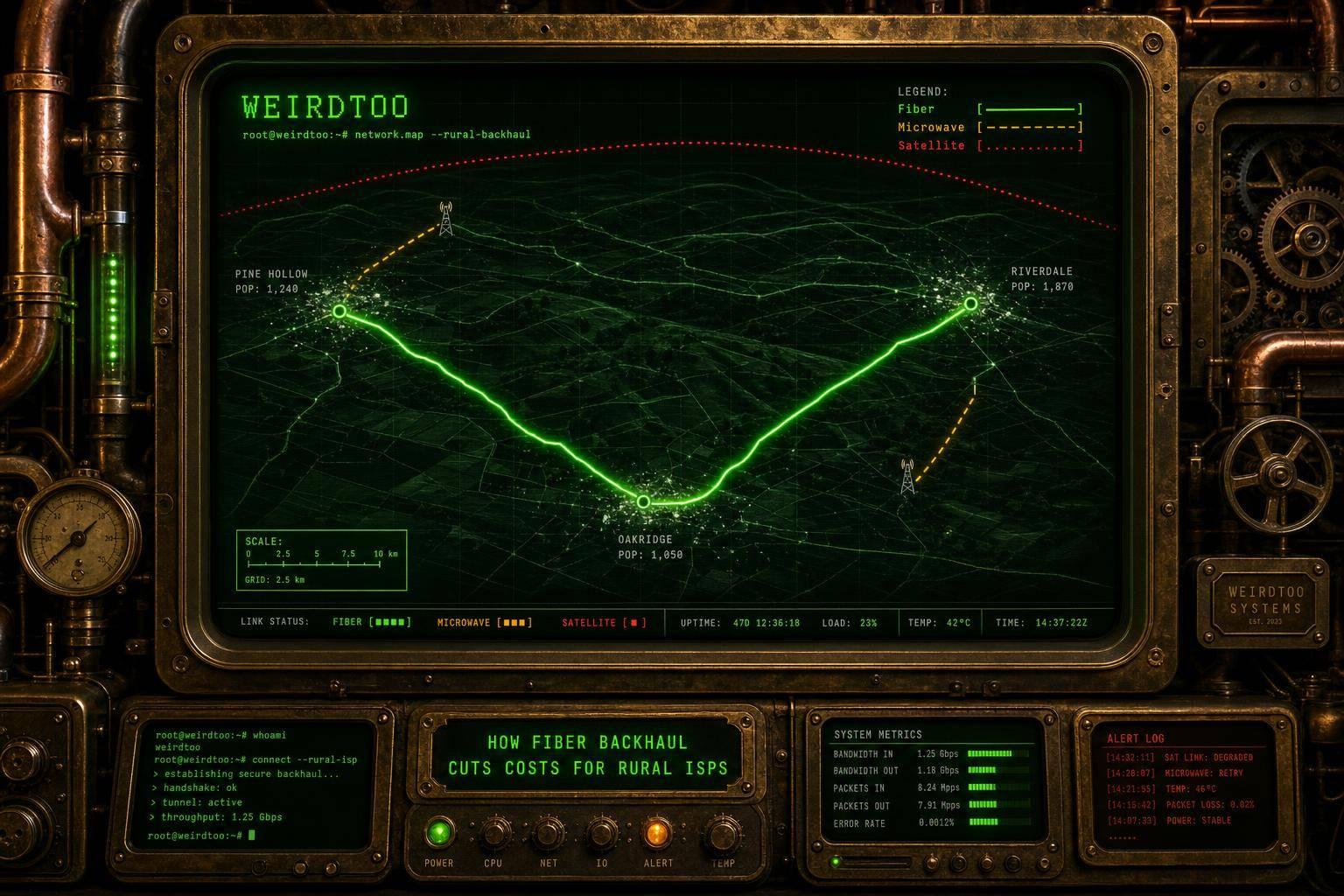
How Fiber Backhaul Cuts Costs for Rural ISPs
By weirdtoo·August 3, 2026·14 min read
Explains when building or leasing fiber backhaul cuts long-term costs for rural ISPs and compares microwave, satellite, and funding options.
How Fiber Backhaul Cuts Costs for Rural ISPs
If you run a rural ISP, backhaul is often the bill that keeps getting meaner as traffic grows. Fiber usually costs more at the start, but over time it can cut monthly transport costs, lower outage risk, and make upgrades a gear problem instead of a digging problem.
Here’s the plain version:
- Leased lit service is easier to start with, but monthly costs climb with usage. The article cites $1,200/month for 1 Gbps and $9,600/month for 10 Gbps on some Tier 2 middle-mile links.
- Microwave can get a route live fast, but tower leases, licensing, and capacity ceilings show up later. Tower costs alone can run $500 to $2,000/month per tower.
- Satellite works when nothing else does. It is still the “you had no sane road left” option.
- Self-built or dark fiber hurts up front, then gets cheaper per bit as traffic grows. In many cases, upgrades mean swapping optics, not rebuilding the route.
- Construction cost is the hard part. Underground fiber can run $22 to $45 per foot, and civil work can eat 60% to 80% of the total.
- Route planning matters more than people want to admit. Bad routing can add 20% to 40% more mileage. That is how a project gets expensive for no good reason.
- Public funding and utility partnerships can cut the damage. BEAD, NTIA Middle Mile, USDA ReConnect, pole access, and dig-once timing all matter.
The uncomfortable part: fiber is not the cheap option on day one. It is the option that can stop your backhaul bill from acting like a tax on growth.
Quick comparison
| Option | Upfront cost | Monthly cost | Capacity growth | Best fit |
|---|---|---|---|---|
| Leased lit fiber | Low to medium | High | Contract-driven | Early launch |
| Self-built fiber | High | Low | Optics swaps | Long-term trunk routes |
| Dark fiber / IRU | Medium to high | Low | ISP-controlled | High-traffic routes |
| Microwave | Medium | Medium | Limited by spectrum and towers | Gap crossing, short-term relief |
| Satellite | Low | High | Shared and limited | Hard-to-reach areas only |
If you are trying to decide between renting bandwidth forever or taking the build hit now, this is the whole argument: fixed infrastructure usually beats a rising monthly bill once usage gets big enough.
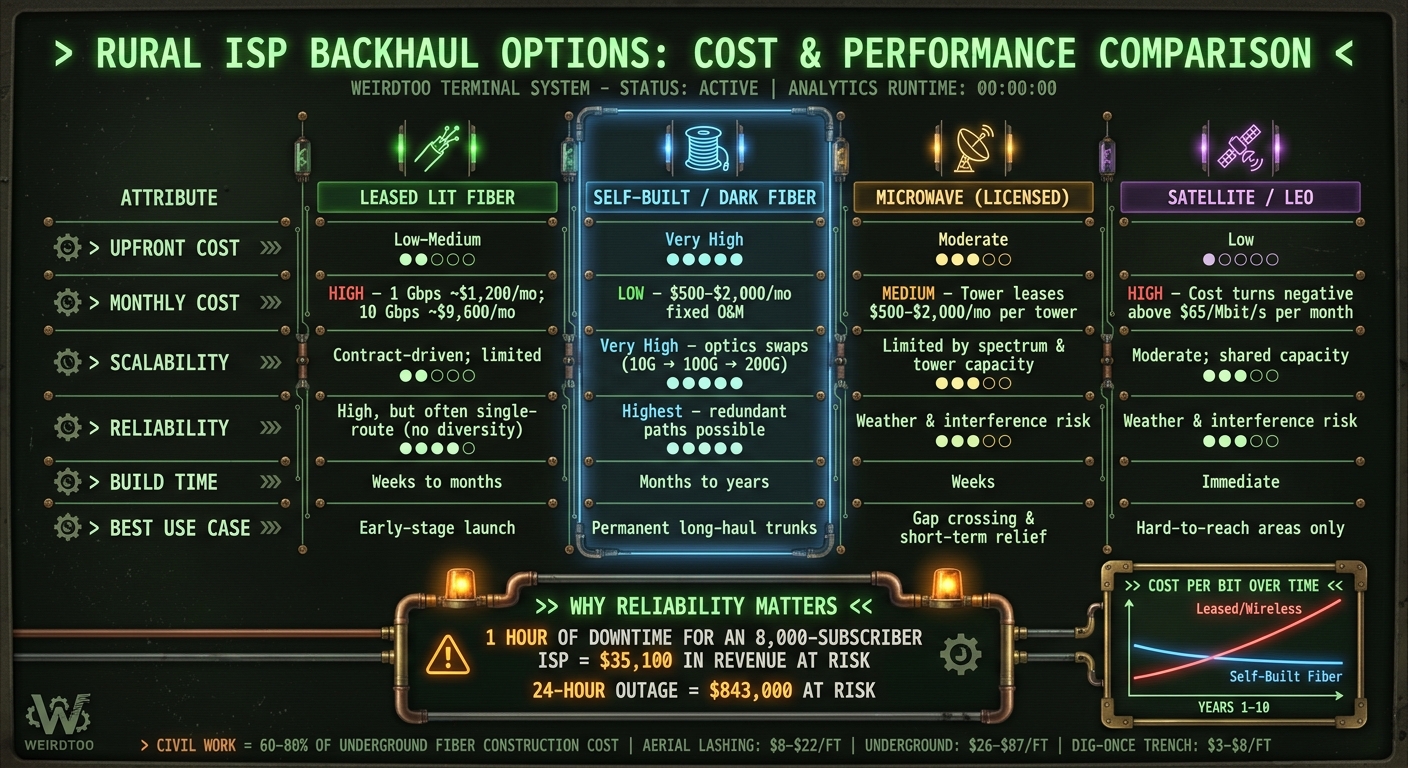
Rural ISP Backhaul Options: Cost & Performance Comparison
The problem: costly and unreliable backhaul options
How leased bandwidth drains cash as usage grows
Leased lit service is fine at the start. Then traffic goes up, you need more capacity, and the bill starts acting like it has a personal grudge.
On a Tier 2 middle-mile network, 1 Gbps of lit service runs about $1,200/month. Jump to 10 Gbps and you are at $9,600/month [4]. Tier 1 is worse: 1 Gbps can cost $7,000/month, though bulk deals at 20 Gbps may get down to about $14,000/month, or $700/Gbps [4]. Rural operators usually do not get those bulk rates. They get the small-buyer version of the deal, which is to say: pay more.
There is also the ugly part people skip in the sales pitch. A lot of rural leased lines are single-route links. No route diversity. One backhoe, one bad day, whole town offline.
For an ISP with 8,000 subscribers paying $65/month, one hour of downtime puts $35,100 in revenue at risk. A 24-hour outage pushes that to $843,000 [2]. So yes, the line with the lower monthly price can end up being the costliest choice on the network.
Where microwave and satellite work, and where they fall short
Microwave can save your skin early. It goes in within weeks instead of months, costs less up front if you can use towers or masts you already have, and it works well where trenching is either impractical or just absurdly expensive [1].
That said, microwave does not make the scaling problem go away. It just delays it.
Unlicensed spectrum like 5 GHz is shared. More operators show up, interference risk goes up [1]. Licensed bands like 6 GHz and 11 GHz fix some of that, but now you are paying for the privilege. Add licensing, site access, and tower lease costs that often run $500 to $2,000/month per tower [6]. Then add equipment refresh cycles, because radios do not live forever. At some point, usage grows and the wireless link hits a ceiling. Fiber does not have that same ceiling.
Satellite, including LEO, is for the places that are hard to reach by any sane method. Latency is better than it used to be with LEO constellations, but capacity is still shared and the per-Mbps cost stays high [5]. One analysis found that the net present value of satellite backhaul usually turns negative once bandwidth costs go past $65/Mbit/s per month [7].
That is not a small wrinkle. That is the whole problem.
Leased fiber, self-built fiber, microwave, and satellite: a side-by-side comparison
The tradeoff is easier to see when everything is on one table.
| Feature | Leased Lit Fiber | Self-Built Fiber | Microwave (Licensed) | Satellite (LEO) |
|---|---|---|---|---|
| Upfront Cost | Low to moderate | Very high | Moderate | Low |
| Monthly Cost | High; scales with usage | Low (O&M only) | Moderate (leases/fees) | High per Mbps |
| Scalability | Limited by contract | Very high | Limited by spectrum | Moderate |
| Latency | Low | Lowest | Low to moderate | High, though LEO is improving |
| Reliability | High, but often no route diversity | Highest | Weather and interference can disrupt it | Weather and interference can disrupt it |
| Build Time | Weeks to months | Months to years | Weeks | Immediate |
| Best Use Case | Early-stage capacity | Permanent trunks | Gaps and initial builds | Remote-only stopgap |
The pattern is not subtle.
- Lower upfront cost usually means higher monthly cost later.
- Leased lit service and satellite keep day-one spend lower, but the meter keeps running harder as demand climbs.
- Self-built fiber flips that deal: painful up front, cheap to run after.
- Microwave sits in the middle. Good for crossing ugly terrain or buying time. Bad as the forever plan if usage keeps growing.
That is why fiber backhaul ends up being the long-haul answer, while the other options tend to be either stopgaps, shortcuts, or expensive rent dressed up as strategy.
sbb-itb-342b8b2
Bring Broadband Home: Deploying rural fiber networks with GoNetspeed

The solution: how fiber backhaul lowers long-term costs
Fiber is expensive at the start. No point dressing that up. You pay more to build it, and sometimes a lot more.
But once it is in the ground, the math changes. Fiber gets cheaper over time because the route is already there. When you need more capacity, you usually change the optics on each end instead of digging again [2]. That is the whole play.
Lower cost per gigabit over the life of the network
After the fiber route exists, capacity growth usually comes from optics swaps, not more construction [2]. In plain terms, that can mean going from 10G to 100G or 200G optics [8][2].
That cost curve looks a lot better than leased lit service, where every bandwidth jump means a fatter monthly bill. Microwave is not much kinder. More capacity there often means more radios, more dishes, or both. None of that is cheap, and none of it is fun when the tower crew sends the invoice.
Fiber has a lifespan of 20 years or more, and monthly operating costs can stay in the $500 to $2,000 range no matter how much traffic crosses the link [8]. That is the part people care about once the trenching dust settles.
Owning fiber, leasing dark fiber, or using open-access routes
The next decision is not just fiber or no fiber. It is who controls it, who pays first, and who gets stuck with the bill later.
| Model | Upfront Cost | Recurring Cost | Control | Best For |
|---|---|---|---|---|
| Dark Fiber (IRU/Lease) | High (IRU) or moderate (lease) | Low; fixed annual O&M | Full ISP control | High-traffic backbones with confident growth |
| Open-Access / Carrier-Neutral | Moderate (shared) | Moderate lease/cross-connect | High; flexible carrier choice | Diversity, peering, avoiding full build costs |
Dark fiber is the cleanest version of the cost flip. You pay to light the fiber yourself. You handle optics. You handle capacity planning. That is more work up front, yes. But once the system is running, adding capacity is cheap until the optics are tapped out [9].
An Indefeasible Right of Use, or IRU, can lock access in for 20+ years and cannot be canceled [4]. That matters. Lit service contracts can look fine in year one and ugly by year five. An IRU is not glamorous, but it is a way to stop playing rate-hike roulette.
Open-access routes work differently. State-funded middle-mile networks and carrier-neutral routes let more than one ISP use the same physical plant [9][5]. That spreads the capital load and keeps your upstream options open from one termination point [9][5].
As more state broadband offices fund open-access middle-mile builds, lit transport pricing on those routes tends to drop after the infrastructure goes live [9]. So the ownership model is not some side detail. It changes the whole cost shape.
Backhaul costs before and after switching to fiber
Switching from leased or wireless backhaul to owned or dark fiber changes more than the monthly line item.
| Metric | Leased/Wireless Backhaul (Before) | Owned/Dark Fiber Backhaul (After) |
|---|---|---|
| Recurring Costs | High; scales up with every Mbps of usage | Low; fixed annual O&M regardless of traffic |
| Cost per Gigabit | Increases linearly as usage grows | Decreases as usage grows |
| Upgrade Path | New contracts or hardware swaps | Change optics only; no route rebuild |
| Latency/Jitter | Variable, especially with wireless or satellite | Consistently sub-millisecond and stable |
| Margin Impact | Margins compress as subscriber usage climbs | Margins expand as subscriber density increases |
That last row is the one that decides whether a rural ISP has a business or a headache.
With leased or wireless backhaul, each new subscriber adds load to a cost base that keeps climbing. More users, more pressure, more monthly pain. With owned or dark fiber, more subscribers spread a fixed cost across more accounts. That is how the model starts working in your favor instead of against you.
How to make fiber backhaul affordable to build
The math looks nice on paper. Long-term savings, lower lease bills, more control. Fine. None of that helps if you can't get the build paid for in the first place.
For a rural ISP, the fight is upfront cost. That usually comes down to three things: the route, who you build with, and whether you can pull in public money without getting buried in delays.
Start with lower-cost construction methods
The biggest cost lever is the route. Not the cable. Not the gear. The route.
If you just follow roads because that's how people have always done it, you can add 20% to 40% in extra mileage compared with GIS-optimized routing [10]. In a rural build, that waste gets expensive fast. One extra route mile can run $80,000 to $140,000 in construction cost [10].
A 2025 Midwest BEAD build is a clean example. The route dropped from 47.6 miles to 31.3 miles, which saved $2.1 million and 14 weeks [10]. That's not a rounding error. That's the whole job getting easier.
Once the route is locked, the next lever is placement method.
- Use existing poles when you can. Aerial lashing costs about $8 to $22 per foot.
- Underground conduit costs much more at $26 to $87 per foot.
- If you can trench during road work, that underground cost can drop to $3 to $8 per foot [2][10].
That last part is where people miss easy money. If the ground is already open, do more on the first dig. Digging twice is how budgets get stupid.
And if you're trenching, overbuild the fiber then, not later. The jump from 144F to 288F cable is about $0.35 per foot [2]. Re-trenching later costs far more. Save $0.35 now, spend a fortune later. Great plan.
Reduce capital costs through utility partnerships and shared routes
Most of the underground cost is not the fiber itself. It's the dirt work.
Civil work - trenching, boring, and restoration - makes up 60% to 80% of underground fiber construction costs [2]. So if you're hunting for savings, don't obsess over shaving tiny amounts off equipment while ignoring the part that eats the budget.
Electric cooperatives can help a lot here. Many already own poles across the same territory you need to reach. If you partner with them, you may avoid third-party pole attachment fees. You can also cut 4 to 6 months off the schedule by skipping joint-use application delays [3].
There is still a catch, because there is always a catch. You still need a pole-loading study before attachment [3].
Shared conduit and shared pole builds also spread civil cost across more than one project. That matters more than squeezing vendors for minor line-item cuts.
Use BEAD, NTIA Middle Mile, USDA ReConnect, and other U.S. funding programs
Federal funding is not magic. It is paperwork with money attached. Still worth doing.
BEAD can fund middle-mile segments when there is no reasonable nearby route. NTIA Middle Mile and USDA ReConnect can also support rural backhaul [2].
The timing matters. Start middle-mile engineering at the same time as last-mile planning. If you wait, revision delays can chew up your schedule [2]. Also watch state dig-once schedules. If you catch one of those windows, placement can get much cheaper [2].
Once the build is funded, the cost and service gains show up in operations.
Results: what fiber backhaul changes for costs, performance, and local service
What changes financially after the switch
When the route goes live, the money story changes fast. The big shift is simple: you stop paying a bill that grows with traffic and start paying a fixed network cost instead. Fiber turns backhaul from a usage-based bill into a fixed expense, so the cost per bit drops as traffic goes up. That matters if you're the person staring at invoices every month and watching customer usage climb without asking permission. A long-term IRU can lock in access and make budgeting less jumpy [4].
What improves technically for customers and operations
The cost side matters, but the network side is the part customers feel. Fiber gets rid of the hard cap that shows up with other backhaul options. A 288-fiber backbone can support roughly 18,000 to 25,000 GPON subscribers [2]. After that, upgrades can happen through optics swaps instead of digging again, which is a much better problem to have. Redundant fiber paths also mean one cut does not have to knock out the whole network. That is the kind of detail nobody notices until it fails.
Conclusion: fiber backhaul costs more upfront but less over time
Backhaul is where rural ISP economics either work or fall apart. Leased lit services are easy to start, then they punish you for growing. Microwave and satellite can plug holes, but they do not carry the load for the long haul. Fiber - owned, dark-leased, or secured through an IRU - changes the math by turning a monthly variable cost into a fixed infrastructure cost.
Fiber costs more upfront, but it lowers per-bit cost, improves uptime, and gives rural ISPs room to grow.
"Middle-mile capacity sets the ceiling for everything downstream." - Draftech International [2]
FAQs
When does fiber backhaul pay off?
Fiber backhaul makes sense when you plan to be around for a while and you know bandwidth demand is not staying small.
The upfront hit is the ugly part. Construction costs are higher, and there is no cute way to say that. You pay more now so you stop paying for someone else’s pipe later.
Over 15 to 20 years, fiber often ends up with a lower total cost of ownership. The reason is simple: it lasts, and it helps you dodge recurring monthly service fees that keep nibbling at your margin every month, forever.
It usually pencils out best when your steady capacity needs are above 1 to 2 Gbps. Same story if trenching and infrastructure costs can be spread across a large subscriber base that is still growing. If you have enough people sharing the build cost, the math gets a lot less painful.
Should a rural ISP build or lease fiber?
It comes down to three things: terrain, density, and how much cash you want to lock up for the long haul.
Fiber is the better long-term bet when you need high capacity and plan to keep the network in place for years. It performs better, and at scale it usually costs less to run than wireless. That part is not glamorous. It is just math.
Leasing fiber or buying existing capacity is often the cheapest place to start. You skip the giant upfront build cost and get moving sooner. Building fiber yourself costs a lot more on day one, but over a 20-year window it can make sense if you need control and expect steady demand.
The middle-ground option is usually the sane one: fiber on the main routes, wireless where the ground is ugly, the permits drag, or you need service up fast. That mix is often the most practical, even if it is less neat on a diagram.
How can rural ISPs cut fiber build costs?
Rural ISPs do not win by digging more trench. They win by building less line.
Fiber costs drop when you stop following roads by habit, share what is already there, and plan the network like money is real. Because it is. GIS-based route analysis can cut total route miles by 20% to 40% compared with just tracing the road and calling it a day.
That matters fast. Fewer miles means less fiber, less labor, fewer permits, fewer places for a build to go sideways.
A few moves do most of the work:
- Use aerial lashing on existing utility or co-op poles when you can. It is usually cheaper than underground trenching, and in rural builds that gap can be the whole ballgame.
- If you do need underground work, line it up through dig-once policies. Open the ground once. Do not pay twice because two crews showed up six months apart.
- For backhaul, use existing towers and rooftops before you start planning new structures. New steel is expensive. Old steel that already exists is less romantic and far more useful.
- Avoid railroad crossings unless there is no clean way around them. They add cost, delay, paperwork, and a special kind of misery.
- In low-density areas, use distributed splitter architectures to shorten drops. Long drops are where budgets go to bleed out slowly.
None of this is glamorous. It is route math, pole access, and saying no to dumb detours early. That is usually where the savings are.
Current contact path
Need Weird Network WiFi, custom apparel, or scoped help?
Use the contact form; removed product, checkout, research, and newsletter funnels stay offline.