Loading…
“Customizable Costumes: Add Your Name or Logo”
By weirdtoo·May 4, 2026·12 min read
Personalize costumes with names, logos, or graphics using printing, embroidery, and digital tools; includes pricing, materials, and ordering tips.
“Customizable Costumes: Add Your Name or Logo”
Customizable costumes allow you to personalize outfits with names, logos, dates, or graphics, making them unique to your needs. Whether for businesses, events, or community groups, these designs help create a sense of identity and leave a lasting impression. From screen printing to embroidery, various methods ensure your design fits the material and purpose. Popular uses include branded uniforms, event-themed costumes, and team apparel. Costs vary by type, with options like custom mascots starting at $1,499.00 and personalized jerseys around $49.96. Digital tools simplify the process, letting you design and order easily while ensuring professional results. Whether for marketing, team-building, or celebrations, personalized costumes combine functionality with style.
Types of Customizable Costumes
Customizable costumes bring a personal touch to events, businesses, and community groups, offering tailored solutions that stand out and make an impression.
Event-Themed Costumes
Event-themed costumes add flair to seasonal celebrations and festivals, blending creativity with personalization. For Halloween, designers craft high-end custom pieces starting at $500.00, with deposits beginning at $250.00[7]. For parades and festivals, organizers often turn to "Mas Making" techniques to create large, kinetic structures that deliver dramatic visual effects[4].
Inflatable designs are another popular choice for event visibility. Custom Air Dancers® - those eye-catching inflatable figures - start at $159.00 and can be personalized with specific text like "SALE"[5]. These battery-powered costumes rely on small fans (AA or AAA batteries) to keep their shape, making them ideal for outdoor promotions. Beyond holiday celebrations, these creative options are also effective for branding and promotional events.
Branded Business Costumes
Custom mascots and branded costumes have become a go-to marketing tool for businesses, acting as "walking billboards" that connect emotionally with audiences[6]. Since 1996, one manufacturer has produced over 6,200 mascots, with each costume designed to last 5 to 7 years when cared for properly[6]. Businesses can choose between foam mascots, starting at $1,895.00 for detailed character designs, or inflatable versions, starting at $1,499.00 for easy transport and larger-than-life appeal[5].
"Our custom corporate mascots and costume characters attract attention and drive revenue." - Costume Specialists[3]
For everyday branding, embroidered logos on workwear like polos, quarter-zips, and lab coats offer a functional yet personalized touch. This is especially useful for healthcare teams and multi-location businesses, where adding individual names and titles enhances a sense of professionalism and identity[8][1]. Some providers even offer direct-to-home shipping for remote employees, simplifying logistics while maintaining a strong connection to company culture[8].
Community and Group Designs
Community groups and performance teams also benefit from personalization, using custom designs to foster unity and spirit. Dance teams, cheer squads, and show choirs often opt for "semi-custom" designs, which combine pre-approved patterns with chosen fabrics and embellishments like sequins. This approach provides a custom look without the higher cost of fully bespoke designs[2]. Bulk orders of 12 or more pieces can qualify for discounts of up to 20%, and semi-custom catalog orders ship faster - within 2–8 weeks - compared to the 10–17 weeks required for fully custom designs[2].
Sports fans and community groups also love personalized jerseys, which cost around $49.96 and can feature custom names, numbers, and team colors. These jerseys help build a sense of camaraderie at stadium events or themed gatherings[9].
sbb-itb-342b8b2
Customization Options and Methods
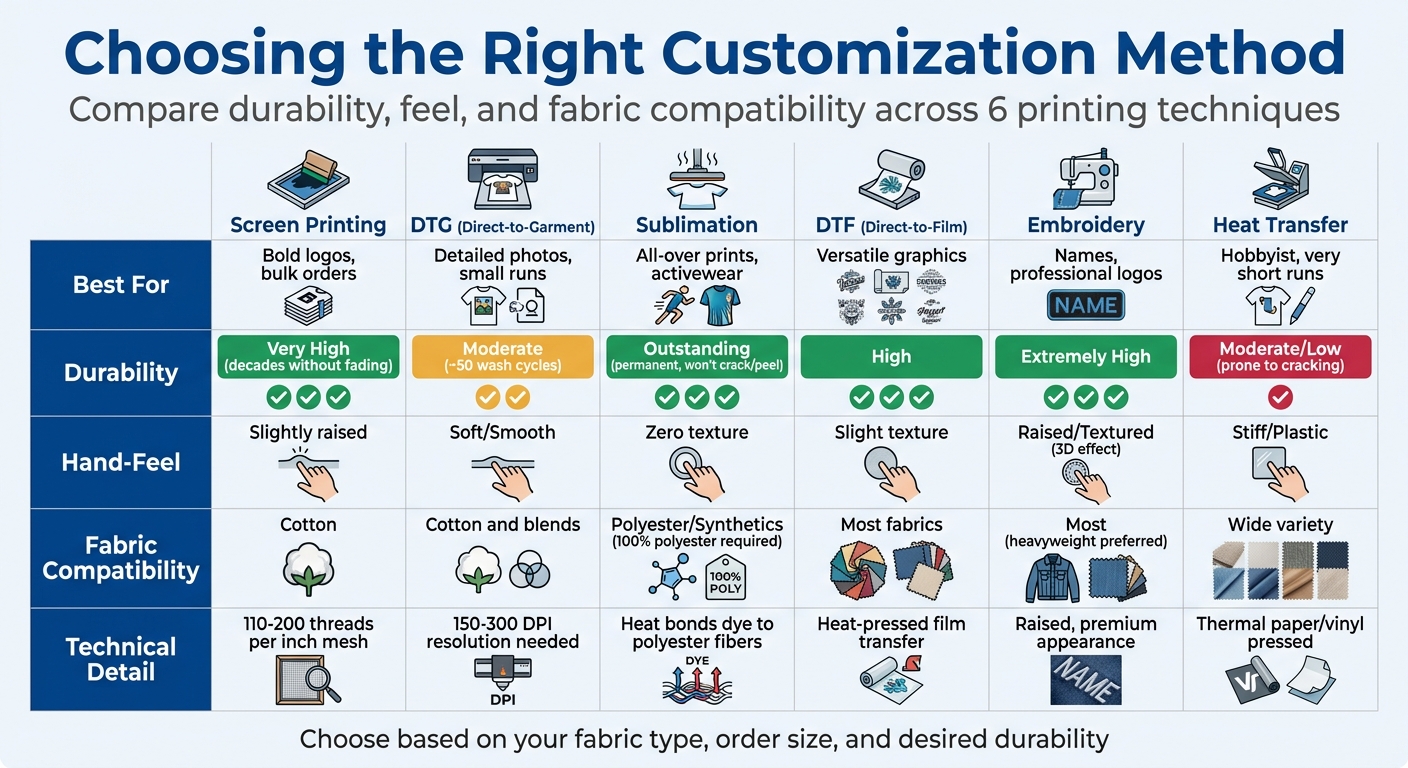
Costume Customization Methods Comparison Chart
When it comes to creating personalized costumes, the method you choose should align with the fabric type, design intricacy, and order size. Each technique offers a distinct look, feel, and level of durability.
Printing Methods
Screen printing is ideal for large orders with bold, uncomplicated logos. Thick ink is pressed through a mesh stencil onto the fabric, producing vibrant designs that can last for decades without fading. This method is particularly efficient for bulk runs, as the per-unit cost decreases significantly despite the higher initial setup expense due to screen creation. Mesh counts typically range from 110 to 200 threads per inch, allowing for fine detail capture [10].
Direct-to-garment (DTG) printing functions much like an inkjet printer but for clothing. It sprays ink directly onto cotton or cotton-blend fabrics, making it perfect for detailed, full-color images or intricate designs. The result is a soft, smooth finish that holds up for around 50 wash cycles with proper care. For the best output, use digital images with a resolution of 150–300 dots per inch [10].
Sublimation printing uses heat to turn dye into gas, which bonds directly with polyester fibers. This produces a permanent, texture-free design that won’t crack or peel - perfect for activewear or all-over designs. However, this technique only works with 100% polyester or high-polyester blends [10].
Direct-to-film (DTF) printing involves transferring designs onto a special film, which is then heat-pressed onto almost any fabric. It offers excellent durability with a slight texture and works well for various garment types.
Embroidery is the go-to method for professional logos or names on items like jackets and polos. It creates a raised, three-dimensional effect that’s extremely durable and gives a polished, premium appearance.
Heat transfer involves printing designs onto thermal paper or vinyl, which are then heat-pressed onto the fabric. While it’s an affordable choice for small runs, the designs are more prone to cracking over time.
| Method | Best For | Durability | Hand-Feel | Fabric Compatibility |
|---|---|---|---|---|
| Screen Printing | Bold logos, bulk orders | Very High | Slightly raised | Cotton |
| DTG | Detailed photos, small runs | Moderate | Soft/Smooth | Cotton and blends |
| Sublimation | All-over prints, activewear | Outstanding | Zero texture | Polyester/Synthetics |
| DTF | Versatile graphics | High | Slight texture | Most fabrics |
| Embroidery | Names, professional logos | Extremely High | Raised/Textured | Most (heavyweight preferred) |
| Heat Transfer | Hobbyist, very short runs | Moderate/Low | Stiff/Plastic | Wide variety |
Choosing the right technique for your fabric and design placement is key to achieving a polished result.
Material and Placement Options
The choice of material plays a huge role in determining the best customization method. Cotton pairs well with screen printing and embroidery, while polyester blends are better suited for heat transfers and sublimation [12]. For a professional touch, place logos or text on the left chest, about 3–4 inches below the collar. Full-front or back placements work best for bold, attention-grabbing designs.
For text clarity, use a 3/8″ font for up to 20 characters or a 5/8″ font for shorter text up to 10 characters [1]. Designs with intricate details are best placed on flat surfaces like the left chest or upper sleeve, while larger, bolder graphics look great across the full front or back [12]. Keep in mind, unique placements like pockets or hoods may increase setup costs [13].
For a subtle yet elegant look, consider "Tone-on-Tone" embroidery - matching the thread color to the garment color [1]. Uniforms often use emblems sized at 1 5/8″ x 3 5/8″ for displaying names and titles [1].
Digital Design Tools
Digital tools have made costume customization easier and more accessible than ever. These platforms allow individuals and businesses to create designs that reflect their unique vision.
Modern AI-based tools can generate costume concepts in seconds. For instance, entering a detailed description like "cyberpunk warrior, glowing blue armor, intricate circuitry" can produce a custom avatar in just 15 seconds [11]. For group orders, some platforms streamline the process by managing name and size lists in a single interface. Features like "location logic" ensure designs are appropriately scaled for their placement, avoiding disproportionate graphics on sleeves or backs [1].
Additional tools, such as image vectorizers, can convert creative ideas into scalable vector graphics, ensuring designs remain sharp and clear, whether printed on a sleeve or embroidered on a jacket [11]. Many platforms also support real-time collaboration, allowing teams to refine designs together. If uploading personal photos for AI-generated designs, ensure the platform adheres to strict data protection policies and uses images only for design purposes [11].
How to Order Customizable Costumes
Selecting a Base Design
Start by picking a base design that suits your needs. Options range from everyday wear, like tops and jackets, to specialized items such as flame-resistant or high-visibility safety gear [1]. For performance groups like dance teams, the choice often depends on the genre - Jazz, Hip Hop, Pom, or Lyrical - and the theme of the choreography [15][18]. Standard dance costume bases generally cost between $200 and $250, while simpler items, such as specialty pants, can start at around $38 [16][17]. If you're working on a high-budget film or unique project, you might need to create a custom design from scratch or collaborate with established brands [14].
Adding Personalization Details
Once you've chosen your base, it's time to customize. Add logos, text, or emblems to make it your own. You can upload pre-approved logos from your account or submit new artwork sized for the placement area [1]. For text, you can add up to three lines using fonts like Block or Brush Script. The number of characters depends on the font size: 3/8" allows up to 20 characters, 1/2" allows up to 16, and 5/8" accommodates up to 10 [1].
For branding, consider creating emblems. Standard name emblems are 1 5/8" x 3 5/8", while company emblems measure 2" x 4" [1]. Thread colors can match your brand’s palette or use a "Tone-on-Tone" option for a more subtle effect [1].
Reviewing and Placing Orders
Before finalizing, review your cart carefully to confirm all details. Most platforms let you edit customizations directly from the cart, so double-check spelling, sizes, and design placements [1]. For team orders, use tools like "manage list of items" to assign names and titles to specific garment sizes. Gathering this information beforehand (e.g., 5 Mediums, 10 Larges) can save time [1].
Take a close look at the digital mockup to ensure font alignment and color accuracy. Remember that quantities for custom items usually can't be changed after submission, and personalized products are typically non-returnable [1][17]. For group orders of 10 or more custom dance costumes, expect shipping to take about 3 to 4 weeks [15]. Once everything checks out, your order is ready to go!
Practical Uses for Customizable Costumes
Business Applications
Custom costumes play a big role in creating memorable customer experiences and promoting a professional team identity. For example, in marketing and public relations, custom mascots act as "walking billboards" for businesses. Since 1996, professional mascot makers have created over 6,200 mascots for various organizations [6].
In addition to mascots, industries like automotive, food and beverage, and service sectors often use personalized workwear. Embroidered uniforms featuring names, logos, and emblems help establish a polished, professional image [1]. These personalized details not only make employees easily identifiable but also strengthen the overall brand identity.
Event and Party Examples
Customizable costumes also add a unique flair to social events, making them unforgettable. Inflatable costumes powered by battery-operated fans are especially eye-catching and bring a playful energy to gatherings [5]. Their whimsical designs grab attention and leave a lasting impression.
For themed celebrations, customization options range from simple name additions to elaborate character designs. Seasonal events, for instance, can feature holiday-themed inflatables like "Elf" or "Santa Disguise" costumes [5]. Performance groups, such as marching bands and color guards, often wear custom-themed costumes to enhance their visual appeal and ensure team uniformity during shows [19].
Community and Team Uses
Custom costumes are also a great way for community groups to build unity and recognition. Schools and universities frequently use custom mascots during pep rallies and sporting events to boost school spirit and bring students together [6][20]. Non-profits often design mascots as cuddly animals or superheroes to engage with audiences - especially children - and draw attention to important causes [6].
Personalized group apparel, like shirts or jackets with names, titles, or departments, helps reinforce both individual identity and team cohesion [8]. This attention to detail not only strengthens community ties but also ensures every member feels valued and represented.
"One of the best things you can do for employee engagement is give them great gear with your brand or logo in it!" [8]
Tips for Best Results
Choosing the Right File Formats
For sharp, professional designs, always go with vector files. Formats like PDF, AI (Adobe Illustrator), EPS, and SVG can be resized without losing quality, ensuring your logo or design looks perfect no matter the size [21]. If you're using raster files, opt for PNG when you need transparent backgrounds - ideal for logos that sit directly on fabric without a background box [21][22]. Just make sure your PNG files are set at 300 DPI (dots per inch) at the final print size to avoid any blurriness [21][22].
Another key step? Convert all text to outlines in your design software before submitting. This ensures your chosen fonts won’t accidentally be replaced by default ones during printing [21]. Also, always design in CMYK color mode instead of RGB. CMYK is tailored for physical printing, while RGB is for digital screens - using RGB could result in unexpected color shifts when printed [21][22]. Following these guidelines is crucial, and T-Shirt Elephant notes a 99.7% satisfaction rate among over a million customers who adhere to these file standards [21].
Selecting Colors and Fabrics
The fabric you choose can make or break the look and longevity of your design. For business costumes, fabrics like wool and twill weaves are excellent choices - they’re durable and resist wrinkles. For all-day comfort, Air Layer fabric is a great option as it holds its shape while remaining breathable.
If your design is for photography or stage performances, consider bold materials like faux leather (PU) for a sleek, glossy finish or velvet for its rich texture and dramatic drape. When it comes to adding logos or names, embroidery is the most durable option, standing up to frequent washing better than most printing methods. For a refined look, try "Tone-on-Tone" customization, where the embroidery thread matches the fabric color, creating a subtle yet textured effect [1]. To ensure your colors are spot-on, use HEX color codes when placing your order. This guarantees your digital design will match the physical fabric or thread colors exactly.
Paying attention to fabric and color details ensures your design not only looks great but also holds up over time, especially when scaling up production.
Ordering in Bulk for Savings
Ordering in bulk isn’t just economical - it simplifies logistics. Bulk orders help cut down on shipping costs and streamline distribution, with vendors often handling sorting and packing by name and size [8]. This saves you time and effort [8].
For cost-effective personalization, consider digital transfers (DTF), which are durable and work well for outfitting large teams [8]. To further maximize savings, think about adding "no-size" items like custom backpacks to your order. These eliminate sizing concerns while still offering personalized options [8].
Conclusion
Custom costumes can help amplify your brand, bring teams closer together, and add a polished touch to events. Whether it’s incorporating a company logo into business wear, personalizing uniforms with employee names, or designing coordinated outfits for a group, customization transforms standard clothing into a professional statement.
Getting started requires some planning - gather names, sizes, and the right file formats for your designs. As mentioned earlier, choosing high-quality materials and using accurate design tools is crucial. Modern digital platforms make managing group orders easier by letting you assign individual details, review designs, and confirm everything in one session. From subtle embroidery to bold logos measuring 2" x 4", these tools offer a range of options to create consistent and visually appealing branding [1].
Some providers even handle packing and shipping for each individual order, saving you the hassle of sorting and distribution [8]. Whether you choose simple text customization, multiple logo placements, or a mix of both, today’s tools give you full control over the final product. Plus, satisfaction guarantees and professional reviews let you place your order with confidence [8].
With a smooth design process and efficient production, your finished product will reflect your brand’s identity perfectly. Now’s the time to explore personalization options that fit your goals and budget - your custom costumes are just a few clicks away.
FAQs
What’s the best customization method for my fabric?
Digital printing methods, such as reactive dye or dye sublimation, are great choices if you're working with detailed designs, photographs, or smaller quantities. These techniques offer vibrant colors, flexibility, and don’t require a minimum yardage, making them perfect for personalized projects. On the other hand, if you’re focusing on simpler, logo-based designs, printing fabric by the yard might be a better fit. Compared to traditional screen printing, digital methods also tend to be more environmentally friendly.
What file type should I upload for the sharpest logo?
For the clearest and most professional-looking logo, use an SVG (Scalable Vector Graphic) file. SVGs keep your logo sharp and scalable, so it looks perfect at any size without sacrificing quality.
How far in advance should I order custom costumes?
If you're considering custom costumes, it's smart to place your order as early as you can. While there isn't a specific deadline, giving yourself plenty of time helps prevent delays and ensures your costume is ready exactly when you need it.
Current contact path
Need Weird Network WiFi, custom apparel, or scoped help?
Use the contact form; removed product, checkout, research, and newsletter funnels stay offline.