Loading…
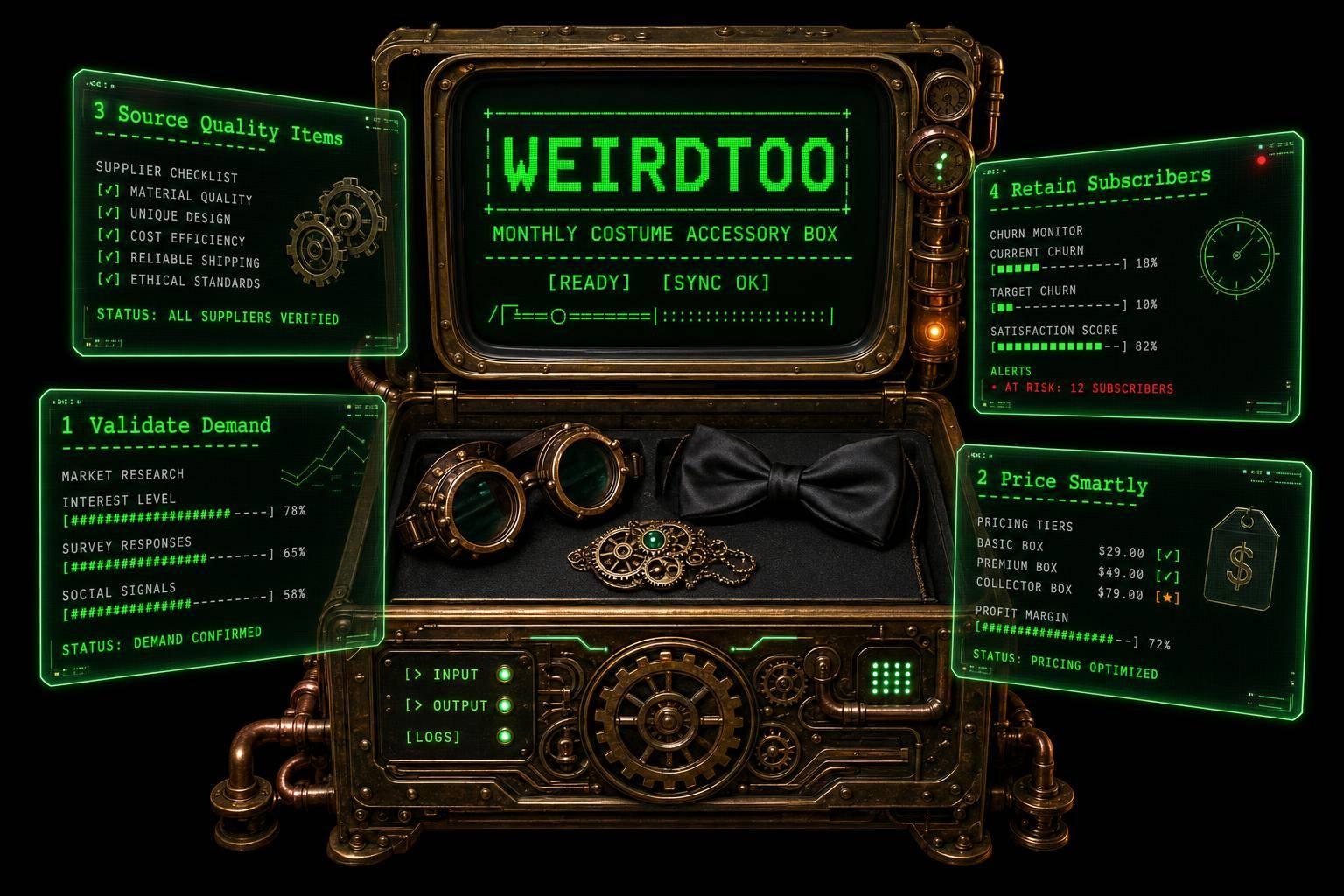
Create a subscription box for monthly costume accessories
By weirdtoo·June 12, 2026·16 min read
How to launch a niche costume-accessory subscription box: validate demand, set profitable pricing, source quality items, and retain subscribers.
Create a subscription box for monthly costume accessories
Want to start a subscription box for costume accessories? Here's the gist:
- Why it works: The U.S. subscription box market generates over $30 billion annually, and niche boxes like costume accessories cater to cosplayers, theater fans, and themed event enthusiasts. Subscribers spend 2.5x more than traditional shoppers and stick around longer.
-
How to start:
- Find your niche: Focus on specific themes like "dark academia" or "90s cosplay."
- Validate demand: Use pre-launch campaigns or waitlists (aim for 200+ signups in 30 days).
- Create value: Offer curated, exclusive items - at least 3-4x the perceived value of the cost.
-
Key steps to launch:
- Build a prototype box with standout "hero items."
- Price boxes to maintain a 40-60% profit margin (e.g., $30-$50 per box).
- Start with in-house fulfillment; scale to third-party logistics (3PL) when you hit 300+ subscribers.
- Retention strategies: Use monthly themes, milestone rewards, and community-building tools to keep subscribers engaged. Address payment failures to recover 20-40% of cancellations.
This model thrives on recurring revenue and loyal subscribers. Start small, plan ahead, and focus on delivering a curated experience.
How the Costume Accessory Subscription Model Works
Defining Your Niche and Target Audience
Focusing on a specific niche is key to standing out. A box themed around "dark academia" or "1990s retro cosplay" will naturally draw more dedicated subscribers than a generic "costume accessories" offering.
"The most common fatal mistake is being too broad. 'Accessories for women' is not a niche. Success lies in specificity." - AceAccessory [1]
Start by identifying existing communities that align with your theme - look for active subreddits, Discord groups, or trending TikTok hashtags. These spaces not only provide a built-in audience but also offer valuable insights into preferences and trends. Once you've found your niche, build a detailed subscriber profile. Consider factors like age, income, preferred platforms, and spending habits. For example, millennial cosplayers may prioritize exclusive, Instagrammable unboxing experiences and items they can't easily find elsewhere.
Before fully committing, test the waters by validating your niche with market demand assessments.
Checking Market Demand Before You Launch
A great way to gauge interest is through a pre-launch landing page where potential subscribers can sign up with their email. If you can gather 200+ signups within 30 days, you’re likely onto something [8].
Another option is to launch a short crowdfunding campaign on platforms like Kickstarter. This approach not only helps you secure funding for the first three to six months of inventory but also confirms interest through actual purchases [11]. Keep the pre-launch period between 15 and 60 days - any longer, and you risk losing the initial buzz [2].
| Validation Method | Timeline | Target Metric |
|---|---|---|
| Pre-launch waitlist | 30 days | 200+ email signups [8] |
| Pre-launch campaign | 15–60 days | 10–20% conversion rate [2] |
| Pilot program | 3 months | Test sourcing and theme response [5] |
| Crowdfunding | 30–60 days | Fund first 3–6 months of inventory [11] |
Once you've validated demand, it’s time to define what makes your subscription box irresistible.
Building a Clear Value Proposition
Your value proposition should answer one critical question: why should someone subscribe to your box instead of buying items individually? The answer often lies in curation, exclusivity, and a sense of community.
One effective method is the "hero item" strategy - each box features a standout, high-value piece (like a custom-designed prop or limited-edition mask) that’s unavailable elsewhere [1]. This exclusive item becomes the centerpiece, supported by a cohesive monthly theme that turns your box into a curated experience. To ensure your box feels like a great deal, its perceived retail value should be around 3 to 4 times your cost of goods sold.
"The box itself is merely the physical touchpoint for a recurring experience... it's a membership club centered around a shared identity or passion." - AceAccessory [1]
Position your subscription as more than just a product - it’s a community. When subscribers feel like they’re part of something bigger, canceling becomes less about stopping a payment and more about leaving a shared identity behind. That emotional connection can make all the difference in retention.
sbb-itb-342b8b2
Planning Themes, Item Selection, and the Customer Experience
Once you've nailed down your value proposition, the next step is to focus on thoughtful theme planning and carefully curated item selection to deliver an engaging experience for your subscribers.
Designing Monthly Box Themes
Think of your monthly themes as chapters in an ongoing story. Creating a 3-to-6-month narrative arc where each box builds on the previous one can build excitement and keep subscribers hooked. For example, a box titled "Mystic Cabinet" that transitions seamlessly into "Found Object Folklore" the following month feels intentional and keeps the experience cohesive.
Tying themes to the U.S. event calendar ensures your content feels timely. Events like Comic-Con (July), Halloween (October), and school theater seasons (spring and fall) provide natural opportunities to align your boxes. Planning these at least six months in advance gives you the lead time needed to source high-quality items without rushing [2].
To keep things interesting, alternate between bold and subtle themes. For instance, a dramatic "Villain Era" box in October could be followed by a softer "Cottagecore Disguise" theme in November. This approach keeps the experience fresh and prevents predictability.
Selecting High-Quality Accessories
Every item in your box should feel intentional. Use the 50/30/20 rule when choosing products:
- 50% functional items that can be used in costumes or everyday life
- 30% novelty items that deliver a "wow" factor
- 20% collectibles or display-worthy pieces
Organize your inventory into three tiers: dependable "A-items" that can be reordered easily, semi-limited "B-items", and rare "C-items" that generate buzz due to their exclusivity [5]. This mix ensures consistent quality while avoiding filler items.
Each box should revolve around one standout hero item, supported by two or three smaller accessories that complement the theme. Maintaining high standards for these items is essential to keeping your subscribers' trust [7].
"A genuinely great novelty item usually has an obvious point of entry. It may be funny, but it still performs a function, sparks a memory, or creates a display moment." - Eccentric.store [5]
Once you've finalized your selection, the focus shifts to presentation.
Packaging and the Unboxing Experience
The unboxing moment is where all your planning comes to life. Place the hero item on top so it’s the first thing subscribers see. Instead of bubble wrap, use crinkle paper - it not only protects fragile items like wigs and props but also looks great in photos [2]. For costume accessories, use branded boxes that are the right size to prevent shifting during transit and to show care in packaging.
"A box that arrives looking polished also signals that the contents are intentional, even when the items are strange." - Evelyn Hart, Senior SEO Content Strategist [5]
Add a thematic insert card to every box. This card can explain the inspiration behind the theme, provide styling tips, or include assembly instructions for props [1] [5]. These small details transform a collection of items into a curated experience. For loyal subscribers, consider adding milestone gifts - like exclusive pins or numbered prints - at the 3rd, 6th, or 12th box. These gestures foster a sense of community and encourage long-term retention [7].
Sourcing, Pricing, and Shipping Basics
Finding Reliable Suppliers
Your sourcing strategy is the backbone of your subscription box's success. It’s what determines whether your box feels thoughtfully curated or haphazard. A solid approach is to divide your inventory into two categories: anchor inventory (reliable, reorderable staples like enamel pins or scarves) and discovery inventory (unique, limited-edition items that create excitement). This mix ensures consistency while keeping your offerings fresh.
For discovery items, platforms like Faire and Abound connect you with independent brands and small artisans across the U.S. [8]. If you need a broader range, RangeMe is a great resource for domestic wholesalers. Once you're ready to scale, trade shows like JCK Las Vegas allow you to inspect products in person and negotiate deals directly [10]. U.S.-based wholesalers typically offer lead times of 5–10 business days, making it easier to maintain a 2-month product pipeline [10].
Before committing to any supplier, always request samples and start with a small pilot order to test reliability. Look for at least 98% on-time delivery and a defect rate below 1% [7]. To safeguard your supply chain, have at least two approved suppliers for your most important items - this way, disruptions won’t derail your shipping schedule.
"Your manufacturer is not just a vendor; they are a co-pilot for your most important asset - the products." - AceAccessory [13]
Building a Cost Model and Setting Your Price
Pricing your subscription box involves more than just the cost of the products. You’ll also need to factor in packaging, shipping, fulfillment labor, and payment processing fees. Packaging typically costs $3–$8 per unit at scale, domestic shipping ranges from $5–$12 per box, and fulfillment labor adds $2–$5 per box. Payment processing fees are usually 2.9% + $0.30 per transaction [8][12].
A simple formula to calculate your price is:
Box Price = (Product Cost + Packaging + Shipping + Fees) ÷ 0.55
This formula targets a 45% profit margin, which is the minimum you should aim for before accounting for marketing costs [8]. For most costume accessory boxes, pricing typically falls between $30 and $50 per month, with product costs ideally making up 30–40% of the retail price [12]. Here’s how this breaks down by tier:
| Subscription Tier | Target Price | Target Product Cost (30–40%) |
|---|---|---|
| Budget | $30.00 | $9.00 – $12.00 |
| Mid-Range | $45.00 | $15.00 – $18.00 |
| Premium | $70.00 | $25.00 – $30.00 |
One effective pricing strategy is to bundle shipping into the subscription price rather than adding it at checkout. Customers prefer seeing a single, all-inclusive number instead of surprise charges at the end [12]. Additionally, offering a 15–20% discount for annual subscriptions can improve cash flow and secure long-term subscribers, especially before the holiday season [12].
"As a rule of thumb, Cratejoy recommends pricing your box with at least a 40% profit margin to be considered sustainable." - Cratejoy [2]
Once your pricing is in place, the next step is to streamline your shipping process.
Managing Shipping and Returns
Efficient shipping is critical to keeping costs under control and meeting customer expectations. Subscription boxes typically operate on a batch fulfillment model: you bill customers on a set date (often the 1st of the month) and ship everything within 5–10 days [4]. Shipping between the 1st and 5th each month helps set clear, reliable expectations [8].
For domestic shipping, USPS, UPS, and FedEx are the go-to carriers. If you’re handling fulfillment in-house, tools like Pirate Ship can help you access discounted USPS rates without requiring a high volume [11]. Once your subscriber base grows to 300–500 members, it’s worth considering a third-party logistics (3PL) provider like ShipBob, Shipmonk, or Fulfillrite. These services offer volume discounts and free up your time [8][12]. Standardizing your box dimensions can also help reduce labor and avoid charges for dimensional (DIM) weight [5][7].
Returns are less common for costume accessories, but issues like damaged items or shipping errors can arise. A clear return policy - detailing what qualifies for a replacement and the reporting timeframe - helps minimize customer service headaches. More importantly, offering a pause or skip option instead of immediate cancellation can recover 15–30% of potential cancellations [3].
"Subscribers forgive oddity; they do not forgive surprises about shipping." - Evelyn Hart, Senior SEO Content Strategist [5]
Setting Up Operations and Subscription Logistics
Subscription and Billing Systems
Once your shipping plan is set, the next step is to establish a system for managing recurring payments and customer accounts. Shopify, combined with subscription management apps like Appstle or PayWhirl, provides a solid foundation for early-stage subscription boxes [8][12].
"Shopify is the strongest platform for subscription box businesses because of its app ecosystem, built-in payment processing, and scalable infrastructure." - Talk Shop [8]
As your subscriber base grows beyond a few hundred, consider upgrading to Recharge (around $99/month). Recharge is a popular choice in the industry, offering features like integration with email automation tools such as Klaviyo and robust dunning management. Dunning, the automated process of retrying failed payments and reminding customers about expired cards, is crucial - failed payments can cause 20–40% of subscription cancellations [6].
Whatever tool you choose, make sure it includes a self-service portal. This allows customers to update payment methods, change shipping addresses, or skip a month without needing to contact support, which can significantly improve the user experience.
A predictable billing cycle aligns with your operational workflow, ensuring your processes run smoothly and stay in sync with your shipping schedule.
Monthly Order Management and Workflow
Subscription boxes thrive on a predictable monthly timeline. Sticking to a structured five-phase workflow can help you avoid last-minute surprises and keep operations running smoothly:
| Phase | Timing | Key Activities |
|---|---|---|
| Sourcing & Theme Lock | Weeks –12 to –8 | Finalize themes, negotiate wholesale deals, and request product samples |
| Procurement & Forecasting | Weeks –8 to –4 | Place purchase orders based on subscriber forecasts |
| Receiving & QC | Weeks –4 to –2 | Receive inventory and conduct quality checks early |
| Billing & Kitting | Weeks –2 to 0 | Process payments and assemble boxes, including inserts |
| Ship Week | Week 0 | Ship boxes and send automated tracking emails |
Conducting quality checks 2–4 weeks before shipping is critical. Discovering issues like damaged or incorrect products during the kitting phase can disrupt your timeline. Addressing these problems earlier ensures smoother operations. Tools like Shopify Flow can automate tracking notifications as soon as labels are created, reducing customer inquiries about shipment status.
By streamlining your order management, you'll be in a better position to decide whether to stick with in-house fulfillment or transition to third-party fulfillment.
In-House Fulfillment vs. Third-Party Fulfillment
In the beginning, handling fulfillment yourself is usually the most cost-effective option. It also gives you complete control over the unboxing experience, allowing for personal touches like custom tissue paper, handwritten notes, or carefully arranged items.
However, as your subscriber count grows beyond 500, outsourcing to a third-party logistics (3PL) provider often becomes more efficient. This shift can help you manage larger volumes while maintaining the quality of your curated unboxing experience.
"When we first started out and had smaller numbers, we could get away with boxes being staged here and there. But as we added more people to the fulfillment process, our inefficiencies became glaring." - Retro Pop Box [14]
Before making the switch to 3PL, ensure the provider integrates seamlessly with your ecommerce and subscription platforms. Document your assembly process thoroughly and create detailed packing checklists early on. These steps will make the transition smoother when the time comes to hand off fulfillment tasks.
Getting and Keeping Subscribers
Writing Clear Marketing Messages
Your marketing copy should instantly communicate to your audience that the subscription box is designed specifically for them. Be clear about what’s inside and who it’s for. For instance, instead of saying something vague like "monthly costume accessories", go for something more descriptive like "a curated box of dark academia accessories delivered to your door every month." This kind of niche-focused messaging resonates far better than a broad, generic appeal.
Make sure to emphasize the savings and exclusive value your box offers. Highlight the retail value compared to the subscription price - showing a perceived savings of 25–40% can be a powerful motivator for potential subscribers [13]. Additionally, feature a "hero item" in your marketing - a standout, high-value piece that anchors the box’s appeal. Prominently showcase this item in your ads and emails. Pre-launch strategies like waitlists and validation campaigns (discussed earlier in this guide) can also help build anticipation.
This clear, targeted messaging lays the groundwork for the partnerships and campaigns outlined below.
Channels and Partnerships That Work
With your messaging in place, focus on the right channels to reach your audience. A great starting point is micro-influencer seeding. Send free prototype boxes to 10–20 creators with 10,000–50,000 followers in niches like cosplay, costume design, or aesthetics such as dark academia or cottagecore. Begin this outreach 6–8 weeks before launch [9][8]. These influencers often have highly engaged audiences and may agree to promote your product in exchange for the box itself, which is especially helpful during the early stages.
Cross-promotions with non-competing brands can also expand your reach. For example, team up with companies like makeup or wig shops to share audiences without overlapping products. Listing your subscription box on a marketplace for subscriptions is another option - it connects you to an established audience, though it typically includes a small transaction fee (e.g., 1.25% + $0.10 per order) [14]. Finally, in-person events like cosplay conventions or local craft fairs provide a more personal way to connect with potential subscribers [9].
Keeping Subscribers Engaged Over Time
To keep subscribers engaged, deliver on the personalized experience you promised in your marketing. Retention is key - especially since monthly churn rates in the subscription box industry average between 10% and 12% [8]. Interestingly, 20–40% of cancellations are due to payment failures rather than dissatisfaction [6], so having a strong dunning process to recover these payments is critical.
For voluntary cancellations, offering flexible options like "skip a month" or "pause" instead of a hard cancel can make a big difference [12][8]. A well-designed offboarding flow can even recover 15–30% of potential cancellations [3]. Another way to maintain excitement is through narrative theme sequencing. By planning boxes in 3-to-6-month arcs, each delivery feels like the next chapter in an ongoing story, reinforcing the sense of community and curation [5].
"The goal is to make canceling feel like leaving a club, not just stopping a purchase." - AceAccessory [13]
Community-building tools can also strengthen subscriber loyalty. Create a private Discord or Facebook group for members, offer milestone rewards at 3, 6, and 12 months, and introduce a member-only add-on shop. These shops can generate 20–40% of your total revenue [6]. Additionally, a referral program - structured as "give a box, get a box" or "3 referrals = 1 free box" - can turn your most loyal subscribers into advocates, driving 15–35% of new sign-ups with minimal acquisition costs [6][8].
Conclusion: Steps to Launch Your Subscription Box
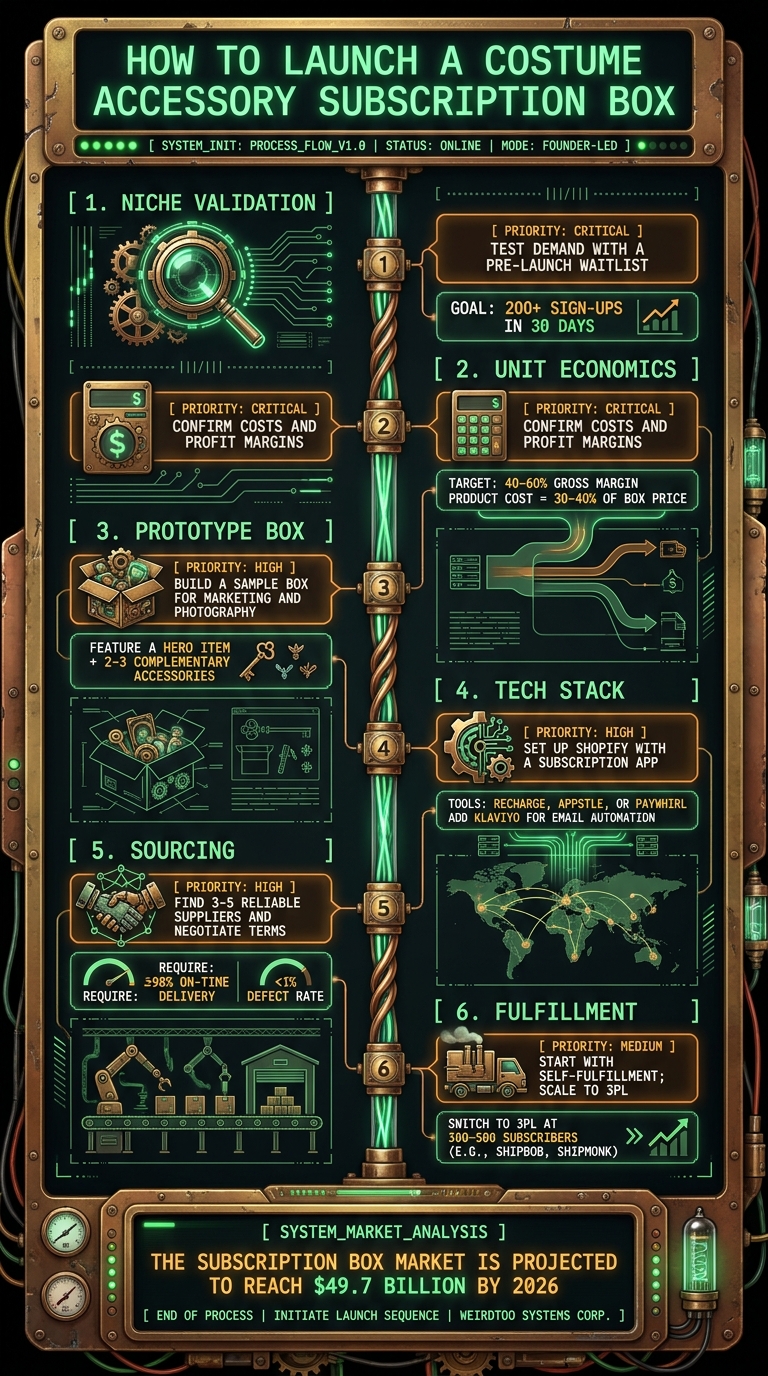
How to Launch a Costume Accessory Subscription Box: 6 Key Steps
Turn your subscription box idea into a thriving business with these actionable steps. Start by validating your niche with a simple landing page and waitlist. Aim for 200+ sign-ups within 30 days - this is a strong indicator of demand [7][8]. Before committing to inventory, double-check your unit economics. For a sustainable business, ensure your landed product costs are 35–45% of your box price and target a gross margin of 40–60% [6][8].
Once your numbers align, create a product sample. Use locally sourced items to develop a prototype and capture high-quality images. Engage 10–20 micro-influencers to build buzz before your official launch [8]. Set up Shopify with a subscription app to handle billing, dunning, and subscriber management. For fulfillment, stick to in-house operations for your first 300 subscribers, then evaluate if outsourcing to a third-party logistics provider makes sense [8].
The table below outlines the six key steps to prioritize during your launch:
| Step | Priority | Key Action |
|---|---|---|
| 1. Niche Validation | Critical | Test demand with a waitlist of 200+ sign-ups [7][8] |
| 2. Unit Economics | Critical | Confirm costs and margins: aim for a 40–60% margin [8][14] |
| 3. Prototype Box | High | Create a sample for marketing and photography [14] |
| 4. Tech Stack | High | Use Shopify with subscription apps like Recharge or Loop [8][6] |
| 5. Sourcing | High | Find 3–5 reliable suppliers and negotiate terms [8] |
| 6. Fulfillment | Medium | Start with self-fulfillment; scale to 3PL at 300+ subscribers [8] |
Remember, growth comes from listening to your subscribers. Use post-box surveys to pinpoint what they loved and what fell short. This feedback can guide your next theme and product selection. A loyal, engaged subscriber base that renews month after month is far more valuable than a large audience with high churn.
The subscription box industry is on the rise, with projections showing it will hit $49.7 billion by 2026 [8]. There’s plenty of opportunity for a well-curated, niche-focused box - like costume accessories. Start small, deliver consistently, and let your subscribers guide your growth.
FAQs
How do I pick a niche that’s specific enough to sell?
To find a niche that works, aim for a market that's overlooked but has strong passions, challenges, or lifestyles you can address in a way that stands out. Start by examining your products, your audience, or even your own interests to pinpoint unmet needs. Check out your competition to spot areas they may be missing, and use tools like Google Trends or social media platforms to measure interest and demand. Clearly define your ideal customer - what they care about, the problems they face, and how your product provides a solution tailored just for them.
What should I include in my first box to wow subscribers?
To wow your subscribers with your first costume accessory box, make sure to include a standout hero item - something custom-designed or exclusive that ties perfectly into your theme. Pair it with 2-3 smaller, themed items like jewelry, hair accessories, or props to create a cohesive look. Don’t overlook the importance of presentation - use eye-catching, branded packaging and add thoughtful details like a personalized note or thematic graphics to make the unboxing experience unforgettable.
When should I switch from self-fulfillment to a 3PL?
When your subscription box business reaches around 300–500 subscribers, it's a good time to consider partnering with a 3PL (third-party logistics) provider. At this stage, managing logistics on your own often becomes too time-consuming and inefficient. A 3PL can streamline your operations, enhance shipping reliability, and lighten your workload.
For businesses with fewer than 300 subscribers, self-fulfillment is typically manageable. However, once you surpass the 500-subscriber mark, the volume can become overwhelming, making professional logistics support almost a necessity to keep things running smoothly.
Current contact path
Need custom apparel or scoped help?
Use the contact form; removed product, checkout, research, and newsletter funnels stay offline.