Loading…

Co-op Ownership Models for ISPs
By weirdtoo·January 18, 2026·16 min read
Community-owned ISPs reinvest revenue, use democratic governance, and deploy fiber to bring affordable, high-speed internet to underserved rural areas.
Co-op Ownership Models for ISPs
Co-op Internet Service Providers (ISPs) are member-owned organizations that prioritize community needs over profits. Unlike traditional ISPs, co-ops reinvest earnings into improving network infrastructure, expanding access, and lowering costs for members. They focus on underserved areas, especially rural communities, where corporate ISPs often find service unprofitable. Co-ops operate democratically, giving each member a vote in decisions about pricing, services, and upgrades.
Key takeaways:
- Community-first approach: Co-ops serve entire regions, ensuring equitable access.
- Reinvestment: Profits go back into the network, not to shareholders.
- Rural focus: Co-ops provide 31.3% of fiber-to-the-home services in rural U.S. areas.
- Funding options: Federal/state grants and partnerships with utility companies help reduce costs.
- Examples: Valley Electric Association in Nevada and RS Fiber in Minnesota showcase successful co-op models.
Co-op ISPs are a practical solution for bridging the digital divide, offering reliable, high-speed internet to underserved areas while empowering communities through local ownership and decision-making.
Benefits of Co-op ISP Models
Community Ownership and Control
Co-op ISPs put the power in the hands of their members, offering direct control through a democratic governance structure. Each member has an equal vote and can even serve on the board, ensuring decisions are made by the very people who use the network every day [6]. This setup promotes accountability and encourages members to take an active role in maintaining and improving the service [2]. Beyond governance, members also have a say in how their data is handled, allowing them to establish privacy and security measures that guard against external threats like surveillance or data mining [2]. What’s more, profits stay within the community, going toward long-term improvements rather than external shareholders.
Profit Reinvestment for Long-Term Growth
Co-ops don’t operate to generate profits for investors. Instead, every dollar earned is reinvested to upgrade infrastructure, extend service coverage, and lower costs for members [3]. This approach means the benefits flow right back into the community.
A great example is the Valley Electric Association (VEA) in Pahrump, Nevada. In December 2019, VEA completed a Fiber-to-the-Home project that brought high-speed internet to underserved areas. This initiative didn’t just improve connectivity; it also created 31 local jobs and boosted the regional economy [6]. By focusing on reinvestment, co-ops prioritize long-term community value over quarterly profit margins.
Addressing Rural Connectivity Challenges
Unlike corporate ISPs that often skip rural areas due to high costs and low population density, co-ops are committed to providing service to everyone in their coverage area. Their mission goes beyond profitability, aiming to connect entire regions, including the most remote communities.
"Unlike private-sector networks, municipal, tribal, and other community- and member-owned broadband networks are focused on ensuring universal, robust connectivity at affordable prices."
This commitment isn’t new. Many broadband co-ops build on the legacy of electric and telephone cooperatives that brought essential services to rural America in the 1930s and 1950s [6]. Their deep local roots and understanding of community needs make them uniquely equipped to tackle the geographic and economic hurdles that often come with rural connectivity [2].
Co-op ISP Structures and Governance
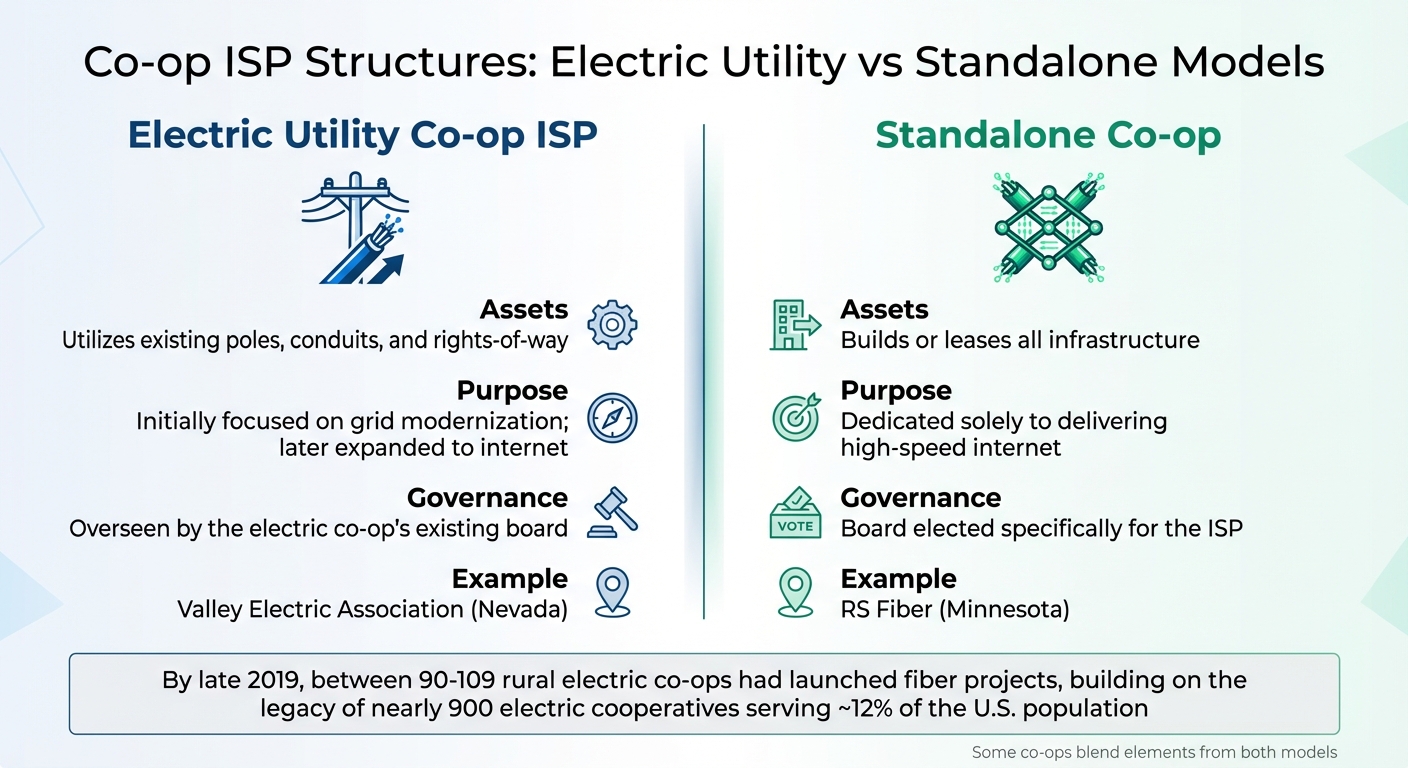
Electric Utility vs Standalone Co-op ISP Models Comparison
Co-op Structures: Electric Utility and Standalone Models
Co-op ISPs usually follow one of two paths: electric utility co-ops or standalone co-ops. Electric utility co-ops take advantage of existing infrastructure, such as poles, easements, and rights-of-way, which helps cut down costs. Many of these co-ops initially laid fiber to substations for grid monitoring - part of their "smart grid" initiatives - and later expanded the network to serve homes and businesses. For instance, by late 2019, between 90 and 109 rural electric co-ops had launched fiber projects, building on the legacy of nearly 900 electric cooperatives that already served about 12% of the U.S. population [6].
Standalone co-ops, on the other hand, start from scratch. A notable example is RS Fiber in Minnesota, the first cooperative in the U.S. created solely to provide high-speed internet. These co-ops often emerge in areas where traditional providers refuse to invest. Unlike electric utility co-ops, standalone co-ops must build or lease all infrastructure and typically rely on community funding, local banks, and grants specifically for broadband projects [6].
| Feature | Electric Utility Co-op ISP | Standalone Co-op |
|---|---|---|
| Assets | Utilizes existing poles, conduits, and rights-of-way | Builds or leases all infrastructure |
| Purpose | Initially focused on grid modernization; later expanded to internet | Dedicated solely to delivering high-speed internet |
| Governance | Overseen by the electric co-op's existing board | Board elected specifically for the ISP |
| Example | Valley Electric Association (Nevada) | RS Fiber (Minnesota) |
Some co-ops blend elements from both models. For example, Ouachita Electric in Arkansas partnered with a local telephone company to deploy fiber-optic service across southern Arkansas, pooling resources for a broader reach [6].
These structural models not only define how co-op ISPs operate but also emphasize their commitment to democratic governance.
Democratic Governance in Co-ops
Co-op ISPs aren't just about infrastructure - they're built on a foundation of democratic principles. A key feature of this governance is the one-member–one-vote system. Every service recipient becomes a member-owner, with equal voting rights and the ability to run for the board [6].
"The member owners control the cooperative: each person receiving service is a member of the cooperative and can directly vote in elections for the Board of Directors or even become a member of the Board."
– Institute for Local Self-Reliance [6]
Today, around 260 telephone cooperatives operate across the country. Impressively, in areas served by these co-ops, 56% of residents have access to fiber internet [4].
This governance model ensures decisions align with what the community needs, rather than focusing on profit margins. Member-owners are actively involved in shaping both the technical and administrative aspects of the network, creating a sense of shared responsibility rather than treating users as passive consumers [2].
Revenue Sharing and Patronage Capital Credits
Co-op ISPs prioritize reinvesting in their communities over chasing profits for external shareholders. Revenue generated by these co-ops stays local, either reinvested in infrastructure improvements or returned to members as patronage capital credits. This approach ensures that long-term community benefits take precedence over short-term financial gains.
The emphasis on community ownership means decisions reflect local priorities rather than corporate interests. For example, in North Dakota, co-ops provide fiber connectivity to 70.8% of the state’s landmass, delivering some of the fastest internet speeds in the country [1].
"In contrast to what happens with for-profit models like corporate services, users of communal infrastructure should play a part in caring for the infrastructure... This is a significant step away from the extractivist mindset towards one of co-responsibility and care."
– Association for Progressive Communications (APC) [2]
Transparency is a cornerstone of co-op governance. Clear documentation of co-management agreements and open fund allocation policies ensures that members know exactly how their contributions are being used. This level of openness fosters trust and strengthens the cooperative’s accountability to its members.
Funding and Deployment Strategies for Co-op ISPs
Federal and State Grants for Broadband Expansion
The Broadband Equity, Access, and Deployment (BEAD) Program allocates a massive $42.45 billion to states for the expansion of high-speed internet access. Co-ops can tap into this funding by applying as subgrantees through their state broadband offices. Application processes are set to kick off in late 2024, with a four-year timeline for implementation [7].
At the state level, progress is accelerating. States like Georgia and Mississippi have recently overturned laws that previously blocked cooperatives from providing internet services. Meanwhile, Colorado, North Carolina, and Texas have introduced legislation to make it easier for co-ops to invest in broadband infrastructure [1].
To make the most of these opportunities, co-ops are encouraged to work closely with state broadband offices. Community consultations play a key role in identifying local challenges and ensuring funds are directed to areas that truly lack service. As Kevin Hughes, Administrator of D.C.'s State Broadband and Digital Equity Office, emphasized:
"Once the grants are over, we want to make sure that these projects continue the good work that they're doing. We are looking to create smart partnerships with nonprofits, government agencies, and, obviously, internet service providers" [7].
By combining grant funding with strategic partnerships, co-ops can significantly cut costs and build more sustainable networks.
Partnerships and Resource Sharing
Collaborating with local governments and utility companies can help co-ops lower deployment costs. Many electric and telephone cooperatives already own valuable resources, such as utility poles, rights-of-way, and easements, which can be repurposed to support fiber network rollouts.
For technical operations, co-ops can host servers in existing data centers or collaborate with other ISPs. This allows them to share expenses for electricity, connectivity, and security while retaining control over their systems [2]. Some communities even manage the "last mile" infrastructure themselves, while relying on larger data centers or regional networks for backhaul.
New co-ops often gain a competitive edge by partnering with established organizations like the American Association for Public Broadband (AAPB). These partnerships provide access to mentorship programs and detailed handbooks that outline the steps for creating successful networks. Formal agreements in these partnerships ensure transparency and accountability, especially when managing shared infrastructure [2][3].
Scalable Deployment Models
After securing grants and forming partnerships, many co-ops adopt phased deployment strategies. This often means starting in areas with high demand and gradually expanding to underserved regions.
In states with complex geography or large swaths of public land, early permitting is critical to avoid delays that could jeopardize BEAD deadlines. Eric Frederick, Michigan’s Chief Connectivity Officer, highlighted the importance of proactive planning:
"The priority is making sure that once those projects are set, there is nothing standing in our way that doesn't need to be, and making sure that our grantees can be successful - because their success is our success" [7].
To ensure long-term success, co-ops should invest grant funds into workforce training. This not only supports the network’s ongoing maintenance but also empowers the community to manage the infrastructure after the project is completed. These incremental, community-driven approaches reinforce the cooperative’s mission to provide reliable connectivity for the long haul [7].
Examples of Co-op ISPs
Arkansas Diamond State Networks
Over the last decade, rural electric cooperatives have made significant strides in expanding fiber broadband access [4]. One standout example is Arkansas Diamond State Networks, a partnership among multiple cooperatives. By joining forces, these co-ops have been able to extend fiber broadband to rural areas that traditional providers often ignore. This collaborative model enables smaller cooperatives to pool resources, share technical know-how, and secure better deals on equipment and construction costs. It’s a clear example of how rural communities can take charge of their connectivity instead of waiting for large corporate ISPs to deem them profitable enough to serve.
Another example, O-NET, highlights how member-driven networks operate differently from conventional ISPs.
O-NET Community ISP Model
O-NET showcases the strength of cooperative structures by prioritizing the needs of the community rather than focusing on corporate profits. Unlike traditional ISPs, O-NET operates under a democratic governance system where members have a say in network decisions. Instead of funneling profits to distant shareholders, O-NET reinvests earnings into improving infrastructure, expanding the network, and enhancing service quality.
This model is built on transparency and local accountability. Members know exactly how their monthly payments are used - whether it’s maintaining reliable service, upgrading equipment, or expanding access. This approach fosters trust in communities that have often been neglected by mainstream providers.
Wyoming Perspectives: Potential for Co-ops
With its vast rural areas and scattered population, Wyoming is an ideal candidate for cooperative broadband solutions. Neighboring states provide a roadmap for success: cooperatives cover 70.8% of North Dakota’s landmass with fiber and reach 47.7% of South Dakota [1]. As legislative hurdles diminish, Wyoming is poised to follow their lead.
The state’s unique challenges make community-focused co-ops particularly effective. For example, WEIRDTOO LLC demonstrates how tailored services can meet the needs of areas that mainstream providers often overlook. Across the U.S., more than 140 cooperatives now offer gigabit internet to over 300 communities [1]. This proven framework gives Wyoming residents a viable path to take control of their digital futures. The real question isn’t whether co-ops can succeed in Wyoming - it’s when local communities will take the initiative to build them.
These examples highlight adaptable models that communities can use to establish their own co-op ISPs, empowering them to bridge the digital divide on their own terms.
sbb-itb-342b8b2
How to Establish a Co-op ISP
Assess Community Demand and Feasibility
The first step in setting up a co-op ISP is understanding the specific needs of your community. This isn't just about asking, "Do you want faster internet?" Instead, dig deeper to identify which services matter most. Is it basic broadband access? Secure email hosting? Online conferencing? Or perhaps website hosting for local initiatives? Use surveys and community meetings to gather insights and gauge the demand. At the same time, evaluate the community's capacity to support the project. Do you have access to network engineers, system administrators, or other IT professionals? Their expertise will help determine if you can handle physical servers or if starting with virtual machines is a better option for your group [2].
Resources like the American Association for Public Broadband's "Own Your Internet" handbook can guide you through this process with decision-making frameworks and mentorship opportunities [3].
Forming a Legal Co-op Entity
Once you've confirmed the feasibility of the project, the next step is to establish a formal legal structure for your co-op. Work with legal experts to draft bylaws that outline democratic decision-making, rules for reinvestment, and data privacy policies. Some states, including Georgia, Mississippi, Colorado, Maryland, North Carolina, and Texas, have recently updated laws to make co-op investments simpler [1].
It's also important to create written agreements that address data storage, user privacy, and overall management. These documents should be flexible enough to adapt as your community's needs evolve. Additionally, consider the physical location of your servers, as this will determine which jurisdiction's data privacy and government access laws apply [2].
With your legal framework in place, you're ready to move on to the technical side of things.
Infrastructure Development and Launch
Now it's time to build the network. Your hardware setup will depend on the technical expertise available within your community. If you have a skilled IT team, you might choose bare metal servers for maximum control. If resources are more limited, virtual machines may be a better fit - they offer a good balance of control and lower maintenance demands [2].
| Infrastructure Component | Bare Metal Model | Virtual Machine Model |
|---|---|---|
| Hardware Maintenance | Fully self-managed | Managed by service provider |
| Operating System | Fully self-managed | Self-managed |
| Security Patches | Self-managed | Co-managed |
| Software Choice | Full control | High control (with some limits) |
Building a solid team is crucial. You'll need system administrators to handle hardware and OS maintenance, network engineers, security specialists, database administrators, and support staff for troubleshooting and training. Funding is another key piece of the puzzle. Look into federal and state broadband grants, and consider partnering with existing electric or telephone cooperatives to share resources and expertise.
To ensure smooth operations, implement Operational and Business Support Systems (OSS/BSS). These tools will help you manage billing, monitor network performance, and maintain security. Make sure all software is regularly updated with security patches, and enforce strict access controls to protect community data.
Community-owned ISPs have already proven they can succeed. Over 140 cooperatives in the U.S. have built fiber-to-the-home networks that deliver speeds exceeding 1,000 Mbps. These projects show that locally owned infrastructure can compete with major corporate ISPs [1].
Challenges and Solutions for Co-op ISPs
Overcoming Initial Capital Hurdles
Securing funding for building a network is one of the biggest challenges community providers face. Infrastructure costs can skyrocket quickly. However, co-ops have several ways to tackle this issue. Federal and state grants often serve as a primary funding source, though applying for these grants can be a complicated process. For example, the New Hampshire Electric Cooperative successfully obtained a $50 million grant through the American Rescue Plan Act to expand fiber access in rural areas that have historically been underserved[8].
In addition to grants, co-ops can keep initial costs manageable by adopting virtual machine (VM) infrastructure, which strikes a balance between affordability and control. Partnering with local governments or utilities to share resources is another cost-efficient strategy. To ensure ongoing financial stability, co-ops can also establish paid service tiers, creating a revenue stream to cover operating costs and fund future growth.
By addressing these financial challenges, co-ops can move on to tackle the next big obstacle: regulatory barriers.
Navigating Regulatory Barriers
Regulatory issues have historically slowed the progress of co-op ISPs. In some states, cooperatives were outright banned from providing internet services. Advocacy efforts, however, have led to significant changes. States like Georgia and Mississippi have overturned such bans, and new laws in places like Colorado, Maryland, North Carolina, and Texas now encourage co-op broadband investments[1].
"Cooperatives should be the foundation for bringing high-quality Internet service to rural America… Small towns and farming communities need robust Internet service to support their local economies, educate themselves, and generally improve their quality of life."
- Institute for Local Self-Reliance[1]
To navigate these regulatory hurdles effectively, co-ops often rely on experienced advisors. Many successful co-ops work with law firms, financial consultants, and public relations experts who specialize in community-owned broadband. Programs like the mentorship offered by the American Association for Public Broadband, along with resources such as their "Public Broadband Handbook", provide actionable steps and connect newer co-ops with seasoned operators for guidance[3].
Once regulatory challenges are addressed, the focus shifts to building scalable and sustainable operations.
Ensuring Scalability and Long-Term Viability
With funding secured and regulatory obstacles cleared, co-ops must turn their attention to ensuring long-term success. As they grow, maintaining high-quality service and adhering to community-driven governance can become increasingly complex. Currently, more than 140 cooperatives in the U.S. provide residential gigabit internet to over 300 communities. In states like North Dakota and South Dakota, cooperatives have connected 70.8% and 47.7% of their land areas to fiber networks, respectively[1].
To manage growth effectively, co-ops should implement written agreements and transparent policies that uphold their democratic principles. Reinvesting revenue into network upgrades instead of distributing profits helps maintain service quality and ensures sustainability. Exploring diverse funding options, such as innovative financing models tailored to locally owned infrastructure, can also strengthen financial stability. Additionally, partnering with specialized firms for network design and construction allows co-ops to focus on their core mission: engaging with and serving their communities[3][5].
Conclusion: The Future of Co-op ISPs
Co-op ISPs have stepped up to tackle rural connectivity issues across the country, consistently delivering high-speed, dependable internet where traditional providers often fall short. What sets this model apart is its focus on community needs rather than corporate profits. By reinvesting revenue locally, co-ops keep services affordable and aligned with the unique economic and educational demands of their communities.
"Cooperatives should be the foundation for bringing high-quality Internet service to rural America… Small towns and farming communities need robust Internet service to support their local economies, educate themselves, and generally improve their quality of life." - Institute for Local Self-Reliance [1]
Recent changes in regulations are paving the way for co-ops to expand even further. States like Georgia and Mississippi have lifted bans on cooperative internet services, while others, including Colorado, Maryland, North Carolina, and Texas, have introduced laws to support these initiatives [1]. Combined with federal funding opportunities and creative financing solutions, these changes position co-ops to grow and serve even more communities.
This approach, built on prioritizing people over profits, is inspiring innovative local efforts. For example, WEIRDTOO LLC focuses on providing affordable Wi-Fi hotspot management and guest network solutions in underserved Wyoming communities. Their mission underscores the importance of accessibility and local control, showing how community-first models can thrive.
Looking ahead, co-op ISPs are charting a clear path forward. Their democratic structure and commitment to reinvesting in their communities make them a powerful force for change. As more co-ops demonstrate their ability to deliver sustainable, high-quality internet, they’re creating a roadmap for universal connectivity that puts people - not shareholders - at the center.
FAQs
How do cooperative ISPs involve the community in decision-making?
Cooperative ISPs operate under a model where the members - essentially the subscribers - own the organization. Each member gets an equal say in how things are run through a one-member, one-vote system. This democratic structure ensures decisions reflect the community's needs rather than catering to external shareholders. Members actively participate in board elections, approve major policies, and weigh in on key decisions during regular meetings, typically held annually or semi-annually.
To keep everyone informed and engaged, co-ops often rely on tools like community surveys, advisory committees, and transparent financial reports. These measures help align priorities such as pricing, service quality, and network expansion with what the community truly needs. By involving members directly in the decision-making process, cooperative ISPs provide broadband solutions that are uniquely tailored to their communities while maintaining strong local accountability.
What are the common ways to fund a cooperative ISP?
Funding a cooperative ISP typically combines member contributions with external financing designed to align with community ownership principles. A common approach is through member equity, where future subscribers buy shares to help fund the network's development. Additionally, co-ops often seek grants from federal or state initiatives focused on expanding broadband access in rural areas, as well as low-interest loans from sources like USDA Rural Development or community-oriented lenders.
Other funding avenues include community bonds or tax-increment financing, which allow local investors to contribute financially while earning modest returns. Another option is public-private partnerships, where municipalities or utilities provide financial backing or guarantees, leaving the co-op to handle operations. These methods help ensure the project grows sustainably while staying centered on the community's needs.
How do cooperative ISPs address the challenges of providing internet in rural areas?
Cooperative ISPs are stepping up to address rural connectivity issues by combining community ownership, creative financing, and smart partnerships. In this model, the members are also the owners, which opens the door to funding through low-interest government loans, grants, and member contributions. This setup makes it possible to build infrastructure like fiber networks, even in areas with sparse populations or tough terrain, while keeping expenses under control.
Support from state and federal programs has been a game-changer. Many states have removed restrictions that previously limited co-ops from offering broadband services and have simplified permitting processes. Programs like the Rural Digital Opportunity Fund further empower these co-ops to deliver high-speed internet to underserved communities across the country.
By focusing on scalable fiber-to-the-home systems and sharing operational duties, co-ops manage to keep costs affordable for their members while maintaining steady growth. This collaborative approach helps them tackle the geographic and financial challenges that often discourage traditional providers from serving rural areas.
Current contact path
Need Weird Network WiFi, custom apparel, or scoped help?
Use the contact form; removed product, checkout, research, and newsletter funnels stay offline.