Loading…
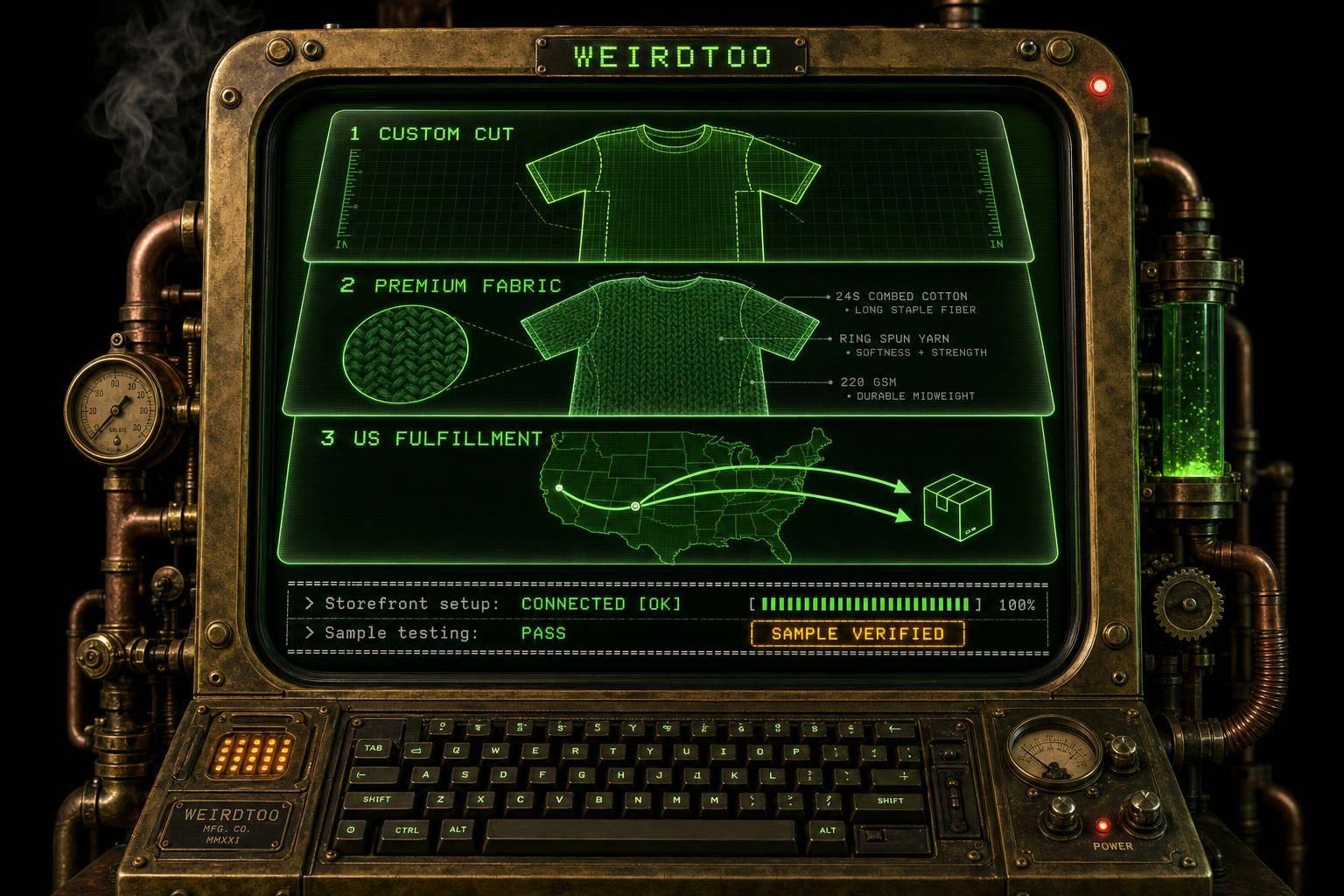
How to Build a Premium Print-on-Demand Brand
By weirdtoo·August 24, 2026·12 min read
Learn 3 print-on-demand models for building a premium apparel brand, including custom cuts, fabrics, US fulfillment, Shopify setup, and sample testing.
How to Build a Premium Print-on-Demand Brand
For years, print-on-demand has had a branding problem.
If you asked most small apparel operators what POD meant, the answer was usually some version of: easy to start, low risk, and visibly generic. The standard formula was simple - pick a blank that thousands of other sellers also use, place a graphic on the chest, and hope customers care more about the design than the garment itself.
This video argues that the old tradeoff is starting to break. The creator’s core point is that there’s now a third lane for POD: not just marketplace royalties, and not just running your own store with commodity blanks, but using on-demand production to build something that actually looks and feels like a brand.
That distinction matters if you sell to customers who can tell the difference between merch and clothing.
The real value in the video is not "here’s another POD supplier." It’s the bigger idea: if your product looks custom, you can stop competing like a commodity seller.
Key Takeaways
- There are three distinct POD models, not two: passive marketplace selling, managed store-based POD, and a newer brand-building model focused on differentiated garments.
- Premium POD works when the garment itself is part of the product, not just the printed graphic.
- Unique cuts, fabrics, silhouettes, and oversized print areas can create a stronger brand position than standard blanks.
- US fulfillment is faster but costs more; the video cites roughly 3–7 day turnaround from US stock versus much longer overseas fulfillment.
- Sample testing is non-negotiable if you care about repeat customers. The creator tested shrinkage, print quality, color consistency, and wash durability.
- The biggest strategic advantage is escaping price competition. If everyone uses the same blanks, the only obvious lever is price.
- Not every item supports every print option, so product selection and design placement need to happen together.
- Action step: Before launching, order samples across multiple fabrics and compare fit, print consistency, and post-wash condition.
- Action step: Build your first collection around one audience and one use case - streetwear, gym wear, or kidswear - not a random catalog.
sbb-itb-342b8b2
The Real Shift: From "Printed Merch" to "Actual Product"
The video centers on a simple but important change in thinking.
Traditional POD is often graphic-first. You start with art, then drop it onto whatever blanks are available. That approach can work, especially for testing ideas cheaply. But it has limits. If the garment feels ordinary, your customer sees an ordinary product with a logo on it.
The "brand-building" model flips that. It treats the blank as a strategic choice.
Instead of asking, "What can I print on?" the better question becomes: "What kind of product would my customer actually want to wear, even before the graphic goes on?"
That is a much stronger place to build from.
For indie clothing brands and creators, this matters because apparel buyers increasingly notice things like:
- Fabric weight
- Drape
- Sleeve shape
- Collar construction
- Overall silhouette
- Print size and placement
- Whether the garment feels retail-quality or promo-quality
The video’s strongest claim is that on-demand production can now reach closer to boutique or small-batch brand standards than many sellers assume.
The Three Print-on-Demand Models, Clearly Defined
One of the most useful parts of the video is the distinction between three business models that often get lumped together.
1. Passive POD
This is the marketplace route: upload designs to platforms that already have traffic, and earn a royalty when something sells.
It’s simple, but you own less.
You usually don’t control:
- The customer relationship
- The store experience
- The product story
- The long-term brand asset
For creators who want side income, this can be fine. For people trying to build a recognizable apparel brand, it’s limiting.
2. Managed POD
This is the standard "run your own Shopify store" version.
You control:
- Listings
- Branding
- Customer service
- Traffic acquisition
- Store design
But in many cases, you’re still selling from a shared catalog used by countless other brands. That means your storefront may be custom, while your actual product remains interchangeable.
3. Brand-Building POD
This is the model the video is really about.
Here, POD becomes a way to access garments that feel more specialized - different fabrics, distinct cuts, larger print zones, and more elevated silhouettes - without placing a traditional bulk order overseas.
That’s the meaningful shift.
It doesn’t remove the hard part of branding. You still need good design, positioning, product-market fit, and traffic. But it does remove one major barrier: having to buy inventory upfront just to offer something that doesn’t look generic.
Why This Matters for Small Brands With No Room for Dead Inventory
For a small operator, bulk production creates two risks at once:
- You tie up cash in inventory.
- You may be wrong about what customers actually want.
That is where standard POD earned its reputation - it was a cheap way to test demand. But the tradeoff was usually product quality or distinctiveness.
The model shown in the video tries to split the difference:
- No large minimum order
- More distinctive product options
- Better-looking garments than entry-level POD
- More room to build a real visual identity
That can be especially useful for:
- Indie fashion labels testing their first drop
- Artists who want apparel that feels collectible rather than promotional
- Niche fitness brands that need better garment-performance alignment
- Small creators who want to validate a concept before committing to factory production
In plain English: it lowers the cost of looking legitimate.
What the Video Gets Right About Differentiation
The creator repeatedly returns to one point: if your catalog matches everyone else’s, you compete on price and maybe speed.
That’s true.
When ten stores are all selling similar heavyweight tees from the same mainstream POD catalog, the customer’s decision often comes down to:
- Whose design they like slightly more
- Who looks more trustworthy
- Who is cheaper
- Who ships faster
That’s a hard business to win consistently.
Differentiated garments change the conversation. A waffle tee, French terry gym top, cropped silhouette, oversized print treatment, or uncommon sleeve placement gives the product a more specific identity. Even before the customer reads the product description, they can see it’s not the default.
That doesn’t guarantee sales. But it does improve your odds of avoiding the worst kind of race: competing with sellers who are all using the same tools, same blanks, and same tactics.
Premium Product Strategy Starts With Audience, Not Catalog Size
A trap in any POD platform is getting excited by the number of SKUs.
The video mentions a large catalog, but the smarter takeaway is not "more products." It’s better alignment between garment and audience.
A premium POD brand should not launch by offering everything.
Instead, pick one lane and make the products coherent:
If your audience is streetwear-focused:
Prioritize:
- Heavier fabrics
- Boxy or oversized fits
- Larger print areas
- Distinct sleeve or back placements
If your audience is gym or movement-based:
Prioritize:
- Lightweight or technical-feel fabrics
- Mobility-friendly cuts
- Breathable materials
- Fit consistency after washing
If your audience buys for kids:
Prioritize:
- Comfort
- Wash durability
- Fabric feel
- Shrink behavior
This is where many beginner brands go wrong. They think branding is mostly logo and color palette. In apparel, branding also lives in product selection.
Fulfillment Reality: Faster US Shipping Costs More
The video makes a practical point small operators should pay attention to: fulfillment location matters.
According to the creator’s walkthrough:
- Overseas production gives access to a larger catalog
- US-based fulfillment cuts shipping time significantly
- US production carries a higher cost
The video cites an example where the cost difference was roughly $16 versus $21, depending on fulfillment location, and suggests US turnaround in the 3–7 day range compared with much longer international delivery windows.
That tradeoff is familiar in small business:
- Lower cost usually means slower delivery
- Faster delivery usually means tighter margins
There is no universal right answer. It depends on your customer promise.
If your brand positioning is premium and giftable, slower fulfillment may create friction. If your audience is niche and highly design-driven, they may tolerate a longer wait for a more distinctive item.
The important point is to decide this deliberately. Don’t discover after launch that your "premium" product arrives on a timeline more typical of low-cost imports.
The Most Credible Part of the Video: Sample Testing
The strongest section in the video is the hands-on review.
Instead of stopping at mockups and platform screenshots, the creator ordered samples across multiple garment types and then washed them to test how they held up. That matters because mockups sell the dream; post-wash condition reveals the truth.
The checks described in the video included:
- General feel of the blank
- Whether the garments smelled chemically treated
- Fabric comfort
- Shrinkage after washing
- Print durability
- Color consistency across fabrics
- Visible pre-treatment marks or staining
That is exactly the right process.
A small brand does not need lab-grade testing. But it does need a basic quality-control routine before asking customers to pay premium prices.
What to Look For When You Order Your Own Samples
If you’re building a print-on-demand apparel brand, don’t just ask, "Does this look good out of the bag?"
Ask:
1. Does it still look good after one wash?
Many garments pass the unboxing test and fail the ownership test.
2. Does the print sit well on the fabric?
Some materials take ink differently. A design that looks sharp on one blank may look duller or softer on another.
3. Is shrinkage acceptable for your sizing promise?
A little shrinkage is normal. A lot of shrinkage becomes returns, complaints, and distrust.
4. Does the garment feel like your price point?
A $38 shirt that feels like a $12 promo tee is a brand killer.
5. Is the fit doing any work for you?
Fit is one of the easiest ways to look more premium without inventing anything flashy.
The video’s conclusion from these tests was broadly positive, especially on print hold and overall garment quality. The useful lesson for readers is not that every result will match theirs. It’s that you should not skip this step.
Print Quality Across Different Fabrics: Why "Close Enough" May Be the Right Standard
One subtle but useful point in the video is that the same artwork printed on different fabrics did not produce perfectly identical color.
That is normal.
Fabric texture, absorbency, dye interaction, and surface finish all affect the final appearance. If you print the same design on a waffle knit, French terry, and sweatshirt fabric, some visual variation is expected.
What matters is whether those differences stay within an acceptable range for your brand.
For small operators, this is an important mindset shift:
- Don’t expect mathematical sameness
- Do expect consistency within reasonable production standards
If a seller promises exact color matching across every fabric type, they may be setting themselves up for frustration. Better to design with production reality in mind and choose graphics that survive minor variation.
Oversized Prints and Multiple Print Zones Are More Than Cosmetic
The video highlights larger print areas and more placement options as a major advantage. That’s not just a design gimmick.
Those features can materially improve brand perception because they let you build garments that feel intentionally designed rather than merely decorated.
Examples of what that changes:
- A sleeve print can make a simple top feel more developed
- An oversized front graphic can shift the product from "merch table" to "fashion drop"
- Back prints create more visual value without requiring a new garment
- Placement variety helps you avoid the copied-and-pasted look common in low-effort POD stores
This matters because apparel customers often judge quality visually before they ever touch the fabric. Better composition and placement can make a product feel more complete.
That said, more print zones also increase the chance of bad design decisions. Bigger canvas does not automatically mean better taste.
What the Video Doesn’t Solve
The creator is careful to address one obvious question: this still doesn’t solve traffic.
That’s important because a lot of POD content quietly implies that better products are enough. They aren’t.
Even if your garments are more distinctive, you still need:
- Clear audience targeting
- Strong creative direction
- Product photos or believable mockups
- Offer positioning
- Conversion-friendly pages
- A way to get people to your store
Premium product can improve conversion and retention. It does not create demand by itself.
This is where many small brands overspend on sourcing and underspend on clarity. A better blank helps only if the customer immediately understands why it’s for them.
A More Useful Way to Judge "Premium" POD
If you’re evaluating a supplier in this category, don’t focus only on whether the catalog looks impressive.
Judge it on five practical questions:
1. Can the product support your price point?
If your all-in cost forces retail pricing your audience won’t accept, "premium" becomes irrelevant.
2. Are the distinctive garments actually available with acceptable shipping times?
A beautiful catalog doesn’t help if the best items take too long or can’t be fulfilled reliably.
3. Can you get repeatable quality?
One good sample is encouraging. Repeatability is what matters in a business.
4. Does the garment make your brand more memorable?
If customers still see "just another printed tee", the differentiation may be too subtle.
5. Is this helping you validate a future bulk product line?
For some operators, premium POD is not the end state. It’s a low-risk bridge into eventual cut-and-sew or factory production.
That last point is especially valuable. Small brands can use premium POD to learn what customers actually reorder before committing cash to inventory.
Who This Model Fits Best
Based on the video, this approach makes the most sense for sellers who want a brand, not just designs for sale.
It is likely a strong fit for:
- Indie clothing labels testing a first collection
- Artists building limited apparel drops
- Fitness creators who need better category-specific garments
- Small lifestyle brands trying to avoid generic merch aesthetics
It may be a weaker fit for:
- Sellers whose audience only cares about the graphic
- Operators competing primarily on low price
- High-volume stores optimized around marketplace simplicity
- Anyone unwilling to order and inspect samples
In other words, this model rewards intent. If you care about garment identity, it gives you more room. If you just want the cheapest way to print a design, standard POD may still be enough.
The Bigger Business Lesson
The video is nominally about one platform category, but the broader lesson applies well beyond apparel.
When a market gets crowded, the winners usually stop fighting on the most obvious dimension.
In generic POD, that obvious dimension is price. In a lot of service businesses, it’s hourly rate. In local retail, it’s discounting. In online tools, it’s feature lists.
The smarter move is usually to make the offer harder to compare.
That’s what differentiated garments do here. They make the product less interchangeable. And once a product is less interchangeable, the brand has room to matter more.
Conclusion
The most valuable idea in this video is not that premium print-on-demand exists. It’s that product selection can become a competitive moat even inside an on-demand model.
Standard POD made it easy to start, but also easy to blend in. The newer brand-building approach described here tries to solve that by giving small operators access to garments that feel closer to real retail products - without forcing a bulk inventory bet upfront.
That won’t eliminate the hard parts of building a brand. You still need audience fit, design judgment, pricing discipline, and traffic. But it does remove one of the biggest constraints: the assumption that on-demand apparel has to look generic.
For small brands, that’s the real opportunity.
Not "premium" as a buzzword. Premium as a reason someone buys from you instead of the ten stores next door.
Source: "Print On Demand Brands Were Never Supposed To Look Like This" - John Santos, YouTube, Jul 31, 2026 - https://www.youtube.com/watch?v=YZjXX8KhsX0
Current contact path
Need Weird Network WiFi, custom apparel, or scoped help?
Use the contact form; removed product, checkout, research, and newsletter funnels stay offline.