Loading…
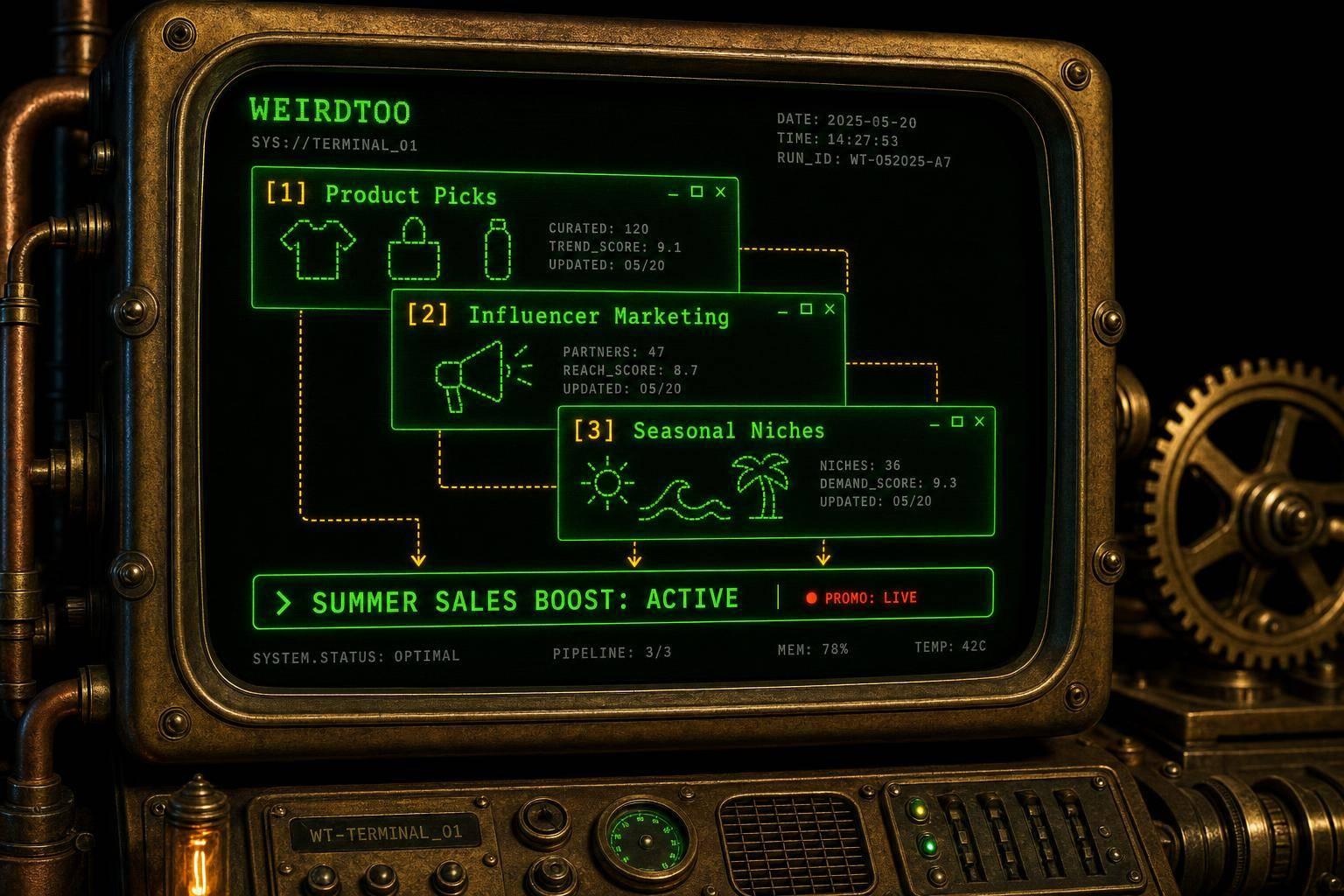
How to Boost Summer Print-on-Demand Sales
By weirdtoo·August 29, 2026·11 min read
Learn 3 ways to grow summer print-on-demand sales with product picks, influencer marketing, and seasonal niche ideas for your POD store.
How to Boost Summer Print-on-Demand Sales
For a lot of small print-on-demand sellers, summer feels like dead air.
Traffic gets flaky. Ad performance softens. People are traveling, spending on experiences, and paying less attention to online shopping. That often leads newer sellers to make the wrong conclusion: summer is a bad time to sell, so the best move is to wait it out.
The video argues the opposite. Its core point is simple: summer is harder, but not hopeless. In fact, the seller behind the video says his biggest print-on-demand month ever happened in July, with nearly $30,000 in sales.
That claim matters less as a brag and more as a clue. It suggests that summer success in print on demand does not come from pushing harder on the same tired products and same ad style. It comes from changing the offer, changing the presentation, and matching what people are actually doing this time of year.
This article breaks down those ideas, adds context, and turns them into practical steps for small operators who want better summer sales without wasting time.
Why Summer Sales Get Tough in the First Place
Before fixing a seasonal slump, it helps to understand what changes in buyer behavior.
According to the video, three things work against print-on-demand sellers in summer:
- People are busy
- People are spending elsewhere
- People tune out anything that feels overly commercial
Those three points line up with how impulse buying usually works.
During colder months, people are home more, scrolling more, and often more willing to buy novelty or identity-based products. Summer changes that rhythm. Attention gets fragmented. Budgets shift toward trips, events, kids’ activities, outdoor plans, and eating out. Even when people are online, they are less patient with obvious ads.
That means the usual playbook can weaken fast:
- generic t-shirts
- standard mugs
- clean but obvious mockup ads
- broad "funny gift" positioning
- passive store management
The video’s advice is useful because it doesn’t pretend demand disappears. It suggests that demand changes shape.
sbb-itb-342b8b2
Key Takeaways
- Don’t assume summer is dead. Buyer attention drops, but targeted seasonal offers can still sell well.
- Sell against expectations. Products like hoodies and blankets may still move in summer because people use them at night, indoors, or while traveling.
- Generic items are easier to ignore. If your store leans heavily on basic tees and mugs, summer is a good time to test less obvious products.
- Reduce the "ad look." Content that feels native to a feed often performs better than polished mockup-only promotions.
- Use smaller creators, not celebrity influencers. The video recommends niche creators with roughly 10,000 to 100,000 followers, especially those who post consistently.
- Commission-based partnerships can lower risk. Paying per sale instead of paying upfront can help small sellers test creator marketing without a large budget.
- Build products around real summer behavior. Camping, sports, cookouts, patios, RV travel, and family hosting are stronger starting points than vague seasonal branding.
- Personalization can increase relevance. Names, roles, teams, and family settings can make a product feel useful rather than decorative.
- Track profitability closely in slow periods. Summer is a bad time to let ad spend, shipping costs, and fees drift without review.
- Use summer to prepare for Q4. Even if margins are tighter, this season can be used to test products, creatives, and audiences before holiday demand returns.
The Best Summer Strategy: Stop Selling the "Default" Catalog
One of the strongest points in the video is also the easiest to overlook: what sells in summer is not always what sellers expect.
The creator says his best July product was a print-on-demand blanket. He also mentions strong summer performance from hoodies. On paper, both sound off-season. In practice, they make sense.
People still buy "cold weather" items in summer for reasons like:
- heavy air conditioning indoors
- late-night outdoor events
- camping trips
- beach nights
- RV travel
- gift buying that is not weather-dependent
This matters because many sellers narrow their catalog too aggressively based on calendar logic. They assume hot weather means tanks, beach towels, and nothing else. That can create an opening for sellers willing to test products that feel slightly unexpected.
Why "unexpected" can outperform "obvious"
Products that don’t fit the standard summer ad stream can win attention simply because they break pattern.
If every seller is pushing:
- bright summer tees
- patriotic graphics
- generic vacation slogans
then a cozy product with a clear use case may stand out more. Not because it is magical, but because it is less ignorable.
That is the deeper lesson here: summer buyers are distracted. Pattern interruption matters.
What to test besides basic shirts and mugs
The video specifically mentions:
- blankets
- hoodies
- performance products
- personalized tote bags
- personalized doormats
- patio or pool-themed wall art
The exact winning product will depend on niche, which is not specified in the video, but the pattern is clear. Better summer products often have at least one of these traits:
- they fit a seasonal activity
- they feel practical or giftable
- they carry a stronger emotional or identity angle
- they support personalization
- they are not the most saturated product in the catalog
For small sellers, that means a useful test question is:
"Would someone use this during something they’re already doing in summer?"
That question is stronger than "Does this look summery?"
Summer Buyers Scroll Past Obvious Ads Faster
The video’s second major point is about presentation. In summer, buyers are more likely to ignore anything that screams "advertisement."
That’s a familiar problem in print on demand because many stores rely on:
- supplier mockups
- product-on-white-background images
- polished but generic promo layouts
- repetitive direct-response copy
There is nothing inherently wrong with mockups. But in a crowded feed, especially when attention is low, mockups alone often don’t create enough trust or curiosity.
The creator’s solution is to make the promotion feel less commercial and more native to social platforms.
Why Small Influencers Can Outperform Paid Ads in Summer
The most concrete recommendation in the video is to use niche creators to promote products, especially on a commission basis.
This is one of the more practical ideas for smaller operators because it addresses two summer problems at once:
- People trust creators more than obvious ads
- Commission-based deals reduce upfront risk
The video argues that smaller creators often work better than huge ones. Specifically, it points toward people with roughly 10,000 to 100,000 followers, with the sweet spot often closer to the lower end.
That makes sense.
Creators in that range are often:
- closer to their audience
- more affordable
- more open to performance-based deals
- less polished in a way that actually helps content feel real
- more niche-specific
For print-on-demand sellers, that can be a better fit than chasing large accounts that are expensive, broad, and unlikely to work on commission.
What the creator partnership model looks like
The video describes a simple structure:
- find a creator in your niche
- offer to send a sample
- pay a commission only when sales happen
That is attractive for small businesses because it avoids one of the biggest mistakes in creator marketing: paying upfront for posts without any realistic expectation of return.
Still, there are limits worth noting.
What the video gets right - and what sellers should watch out for
The advice is strong, but small sellers should add a few guardrails.
1. Follower count is not enough
A creator with 20,000 followers can still be a poor fit if the audience is disengaged or mismatched. Look for:
- regular posting
- real comments, not just likes
- content clearly tied to your niche
- a style that makes product recommendations feel natural
2. Commission-only deals may not always be accepted
The video presents commission partnerships as accessible, and often they are. But not every creator will agree, especially if they already have brand experience. Some may ask for:
- free product only
- flat fee plus commission
- store credit
- custom discount code tracking
That doesn’t invalidate the strategy. It just means sellers should approach it like testing, not like a guaranteed script.
3. Product fit matters more than outreach volume
Sending a hundred messages for a weak product usually won’t save the campaign. The creator can only amplify something that already makes sense for their audience.
Meet People Where They Already Are
The video’s third big idea is the most strategically useful: align products with summer behavior.
This is more than "make seasonal designs." It means thinking in terms of actual use cases.
The examples in the video include:
- a personalized campsite doormat
- a sports mom tote bag
- pool and patio wall decor
These work because they attach to real-life moments. They are not abstract seasonal graphics. They are products tied to a setting, identity, or routine.
That distinction matters.
A weak summer listing says:
- "Hello summer"
A stronger summer listing says:
- "Family campsite welcome mat"
- "Baseball mom sideline tote"
- "Patio sign for the backyard bar"
- "RV couple personalized blanket"
The second group has context. Context increases conversion.
A simple framework for building summer offers
If you run a small print-on-demand store, start with summer situations instead of products.
Ask:
- Where is the buyer going?
- Who are they with?
- What are they hosting?
- What role are they playing?
- What item would feel useful, funny, or gift-worthy in that moment?
Then build around those answers.
Common summer contexts include:
- camping
- RV trips
- lake weekends
- backyard hosting
- cookouts
- little league and travel sports
- beach nights
- family reunions
- poolside decor
- vacation rentals
- road trips
From there, choose products that naturally belong in those scenes.
Why personalization matters even more in summer
Several examples in the video are personalized. That’s not accidental.
When people are distracted, personalization can do one important job quickly: it signals that the product is about them, not just another generic item.
Personalization can include:
- names
- family labels
- locations
- dates
- sports roles
- pet references
- campsite or RV themes
For small sellers, personalization can also be a practical margin tool. Commodity products compete on novelty and price. Personalized products compete on relevance.
The video does not provide conversion data on personalization, so exact performance gains are not specified in the video, but the examples strongly imply it is part of the seller’s summer strategy.
Don’t Let Summer Become a "Set It and Forget It" Season
One of the less flashy but more important points in the video is about profitability.
When sales slow down, many sellers stop paying close attention. They leave ads running, assume shipping is "about the same", ignore transaction costs, and don’t review returns or margins closely.
That’s dangerous in any season, but especially in summer.
Slower months can hide weak economics because lower order volume makes trends harder to spot. A product that looks like a small win may actually be underperforming once you account for:
- shipping
- transaction fees
- ad spend
- product costs
- returns
- discounts
The video mentions using a profit-tracking dashboard to monitor this. The specific tool is promotional, so the important takeaway is broader: know your real numbers.
The minimum numbers to track weekly
If you run a lean print-on-demand operation, summer is a good time to review:
- revenue by product
- gross margin by product
- ad spend by campaign
- cost per purchase
- average order value
- shipping cost by supplier
- return/refund rate
- net profit after fees
If you only track sales, you can fool yourself into keeping unprofitable products alive.
A Practical Summer Plan for Small Print-on-Demand Sellers
The video is encouraging, but the best way to use it is to turn it into a short execution plan.
Here is a practical version.
Step 1: Audit your catalog for "too obvious" products
Look at your current summer lineup and flag items that are easy to ignore:
- generic slogan tees
- undifferentiated mugs
- designs with no seasonal context
- products with weak margins
Keep what is working. Replace what is stale.
Step 2: Add 3 to 5 off-pattern or context-heavy products
Test products that feel more specific to summer behavior, such as:
- personalized camping mats
- sports parent gear
- patio decor
- RV-friendly items
- blankets or hoodies positioned for evenings, travel, or indoor AC
Don’t flood the store with options. A few strong tests beat a bloated catalog.
Step 3: Rewrite product positioning around use cases
Change copy from generic design language to situation-based language.
Instead of:
- "Funny summer shirt"
Try:
- "A lightweight gift for the dad who lives at the campground"
- "A sideline tote for tournament weekends"
- "A personalized welcome mat for your RV setup"
The point is not to become poetic. It is to make the product immediately legible.
Step 4: Test creator-led promotion
Build a short list of niche creators who:
- post consistently
- have a real audience
- match your product category
- are small enough to consider performance-based deals
Start small. Track results carefully. Expect some non-responses.
Step 5: Review profitability, not just sales
If a summer product is getting attention but not making money, cut it or reprice it.
Likewise, if an "off-season" product is quietly converting at a good margin, lean into it even if it looks counterintuitive.
Step 6: Use summer as Q4 preparation
The video ends with a useful mindset shift: the holiday season is coming.
That means summer is not just a survival period. It is a testing window.
Use it to learn:
- which products convert without heavy discounting
- which niches respond to personalization
- which creators actually drive purchases
- which ad formats people don’t immediately scroll past
That knowledge becomes more valuable when traffic and buying intent increase later in the year.
The Bigger Lesson: Seasonal Slumps Reward Sellers Who Adapt
The strongest insight from the video is not "sell blankets in July." It is broader than that.
When demand gets harder, small sellers tend to do one of two things:
- retreat and wait
- push harder on the same tired setup
Neither is ideal.
The better move is to adapt in three ways:
- Offer products that break pattern
- Market through people and formats that feel more trustworthy
- Tie your products to the life your customer is already living
That approach is especially useful for small operators because it doesn’t depend on giant ad budgets or complicated systems. It depends on paying attention.
Conclusion
Summer is a tougher season for print-on-demand sellers, but tougher does not mean unworkable.
The video’s advice is most useful when stripped to its essentials: stop assuming the same products, the same creatives, and the same customer mindset will carry over from other seasons.
If you want stronger summer sales, focus on three things:
- test less predictable products
- reduce the "this is clearly an ad" feeling
- build offers around real summer activities and identities
For small sellers, that is the real opportunity. Not a hack. Not a trend. Just better alignment between what people are doing and what you are asking them to buy.
That’s often enough to turn a slow season into a useful one.
Source: "July Print On Demand Is EASY... You're Just Doing It Wrong" - Joe Robert, YouTube, Jul 23, 2026 - https://www.youtube.com/watch?v=_NxO5cYWl9M
Current contact path
Need Weird Network WiFi, custom apparel, or scoped help?
Use the contact form; removed product, checkout, research, and newsletter funnels stay offline.