Loading…

Boost ISP Growth with Referral Rewards
By weirdtoo·February 6, 2026·11 min read
Cut ISP acquisition costs and boost sign-ups by turning customers into advocates with double-sided rewards, easy sharing, tiered incentives, and local promotion.
Boost ISP Growth with Referral Rewards
Referral rewards are one of the most cost-effective ways for ISPs to gain new customers, especially in underserved areas like trailer parks and rural neighborhoods. By offering incentives like bill credits, cash, or service upgrades, ISPs can turn satisfied customers into advocates who bring in new subscribers. Here's why this strategy works and how to make it successful:
- Trust Drives Sign-Ups: 92% of people trust recommendations from friends, making referrals four times more effective than ads.
- Lower Costs: Traditional advertising costs can reach $315 per customer, while referral programs only pay for results.
- Higher Retention: Referred customers stay 18% longer and spend 32% more.
To succeed, offer rewards that appeal to both referrers and new customers, like free service or gift cards. Simplify the referral process with easy-to-share links and real-time tracking. Enhance engagement with tiered rewards for repeat referrals. Promote the program through digital channels, community events, and partnerships with local businesses. Finally, measure performance with metrics like participation rates and customer acquisition costs, and refine the program based on feedback.
Referral programs are a proven way to grow ISPs while building stronger community ties and reducing costs.
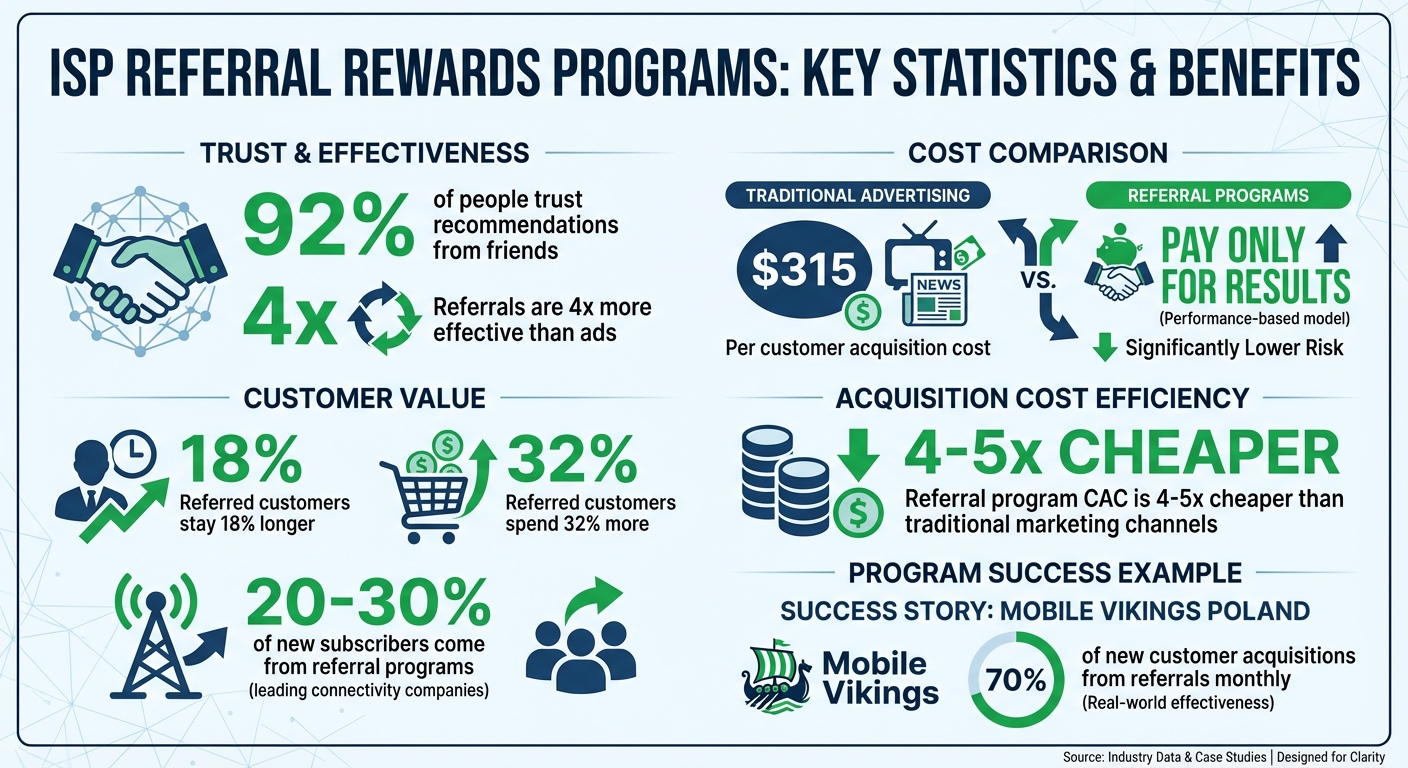
ISP Referral Program Statistics: Trust, Cost Savings, and Customer Value
Benefits of Referral Rewards for ISPs
Lower Customer Acquisition Costs
Referral programs operate on a pay-for-performance basis, meaning ISPs only spend money when a new subscriber signs up and activates their service[2]. This eliminates the hefty upfront costs tied to traditional advertising, which can climb as high as $315 per new customer[5].
What makes referral incentives stand out is their ability to keep Customer Acquisition Costs (CAC) low while still delivering meaningful results[7]. Sofia Baltasar, Head of Customer Success at Giftbit, highlights this advantage:
"Our customer insights indicate that incentives have one of the lowest Customer Acquisition Costs (CAC) while yielding significant impact."[7]
On top of that, referred customers often have a higher lifetime value. Why? They come in with built-in trust, thanks to a friend’s recommendation[2]. This approach not only saves money but also fosters stronger bonds within the community.
Building Trust and Loyalty in Your Community
In tight-knit rural areas, trust is everything. A neighbor’s recommendation carries far more weight than any flashy billboard or online ad ever could.
The reasoning here is simple: when customers are happy with their service, they’re more likely to spread the word[3]. And those referred customers? They’re 32% more valuable because they tend to spend more over time[4].
Double-sided rewards amplify this effect. When both the referrer and the new customer benefit, it creates a mutually rewarding experience that strengthens community ties[1][6]. For instance, offering both parties one free month of service - equivalent to a $120 investment for a $60/month plan - boosts goodwill while keeping acquisition costs much lower than traditional advertising[1][6]. Beyond saving money, this approach builds trust, which is key to long-term growth.
Increasing Revenue Through Word-of-Mouth
Referrals don’t just save money - they drive revenue. Happy customers naturally fuel organic growth. In fact, leading connectivity companies report that 20–30% of their new subscribers come from referral programs[2]. This shows how referrals can evolve from occasional leads into a dependable revenue stream.
The power of personal endorsements is hard to beat. When someone hears about faster speeds or great customer service from a trusted friend, they’re already primed to sign up. Unlike paid ads that target unfamiliar prospects, referrals leverage existing trust and require minimal marketing spend - just the cost of the referral reward.
"Referred telecom leads aren't just cheaper - they're better-quality customers. They upgrade faster and stay longer because their friend recommended you." - Referral Factory[2]
Referred leads are not only budget-friendly but also more loyal. ISPs can even partner with local figures like property managers or community leaders, tapping into their networks of trust to expand reach[3].
sbb-itb-342b8b2
How to Design Your Referral Reward Program
Choosing Rewards Your Customers Want
The best referral programs offer rewards that appeal to both the referrer and the new customer. As Evan Galvin, CEO of Ping Marketing, puts it:
"Give a month of free service to both the referrer and the new customer. This straightforward incentive reinforces positive behavior." [1]
This two-way reward system removes the awkwardness of asking friends to sign up and creates a sense of excitement for everyone involved.
Bill credits are a popular option because they’re simple, practical, and encourage loyalty. For instance, one provider offers $15/month in bill credits for an entire year to both parties. That’s a potential savings of up to $1,800 annually for the referrer [4]. Cash rewards or gift cards, like a $25 prepaid Mastercard per qualifying service (up to $125 per referral), are also effective. Alternatively, service upgrades - such as faster speeds or free add-ons - can provide high perceived value without adding significant costs.
Making the Referral Process Easy
The simpler the process, the more likely customers are to participate.
"The easier it is to refer, the more likely customers will do it. Personalized links and straightforward sharing options are critical", says Splynx [1].
To make it seamless, integrate a referral widget into your customer portal or mobile app. This allows users to share referral links while managing their accounts.
Use "One Click Access" links in emails and newsletters to automatically enroll users without requiring extra sign-ups or passwords. Include pre-formatted sharing options for email, social media, and direct messaging, paired with unique referral links that are easy to copy. An automated dashboard where customers can track their referrals and earnings in real time builds trust and keeps them motivated. Adding social login options, like Google or Facebook, can further simplify the process and reduce friction.
Once the process is effortless, you can boost engagement even more by introducing tiered rewards.
Creating Tiered Rewards for More Referrals
Tiered rewards encourage ongoing participation by aligning bigger efforts with bigger benefits. For example, one system rewards referrers with a $250 Virtual Mastercard for each of their first three successful referrals, increasing the reward to $325 starting with the sixth referral [4]. This gradual escalation keeps customers motivated and rewards your most dedicated advocates.
Another approach is stackable credits. In one case, customers who referred five friends earned $240 in credits - enough to cover a year of service for a specific plan [5]. For your top referrers, consider creating an elite status, like a "Super Recruiter", where reward amounts increase significantly after hitting a milestone of successful referrals. This not only incentivizes high-volume participation but also recognizes and celebrates your most loyal ambassadors.
Marketing Your Referral Program
Using Digital Channels to Spread the Word
Promote your referral program across multiple digital platforms to maximize its reach. Start with targeted email campaigns - sent monthly or quarterly - that emphasize the program's benefits. Include referral links in every email signature, newsletter, and billing notice. Simplify the process by incorporating "One Click Access" links, making it easier for customers to join and share.
Your customer portal and mobile app are prime spaces for promotion. Use banners on the customer dashboard and consider adding a real-time tracker that shows referrals made and rewards earned. Quarterly SMS reminders with direct referral links can also keep the program top of mind. For a creative touch, combine physical and digital marketing by placing durable QR code stickers on routers or equipment. You could even use QR-coded yard signs at active installation sites with messages like, "Tired of buffering? Scan to see how fast your internet could be" [2].
These efforts can be complemented by engaging directly with your community.
Hosting Community Events to Build Awareness
Community events are a powerful way to build trust and influence purchasing decisions. In fact, 80% of consumers say such experiences impact their buying choices, and 98% are more likely to purchase after trust and rapport are established during an event [6]. By sponsoring or participating in local festivals, charity runs, or school programs, you not only show commitment to the community but also create opportunities to introduce your referral program.
These events allow for direct conversations where you can explain the program and gather feedback. Since 92% of consumers trust recommendations from people they know over other forms of marketing [1], personal connections made at these gatherings can directly drive referrals. Even your installation crews can play a role as brand ambassadors. For instance, during a final walkthrough, they could say, "Before I go, here’s your personal referral link. Share it with neighbors who want faster internet, and you’ll both get a $100 credit" [2].
Partnering with Local Businesses
Teaming up with local businesses that share your customer base is a cost-effective way to expand your referral program. Property management companies for apartment complexes and condominiums are especially valuable partners [3]. As Paul Selibio from Visp.net states:
"Partnering with an organization that complements your ISP helps both businesses" [3].
Set up mutual referral systems with businesses like hardware stores, real estate offices, gyms, or community centers. You might also offer community bundles, where customers get a discount on internet service when they sign up for a local gym membership or another service. These partnerships build trust with potential customers and create a ripple effect, as one referred customer can lead to many more [4].
How to Accelerate Your Referral Growth
Measuring and Improving Your Program
A well-measured referral program is the key to refining its effectiveness and driving ISP growth.
Setting KPIs to Track Performance
Start by keeping an eye on metrics like participation rate (the percentage of customers visiting your referral page) and share rate (the percentage sharing referral links). These metrics provide insight into whether your rewards are motivating action.
Another critical metric is your Customer Acquisition Cost (CAC) for referrals compared to traditional channels. For instance, in 2025, Ally Bank found that acquiring customers through their referral program was 4 to 5 times cheaper than through other marketing efforts. David Hixon, Executive Director of Product and Lifecycle Marketing at Ally Bank, shared:
"Our cost to acquire a traditional customer through traditional marketing channels is probably 4 to 5x what it is through the referral program" [8].
Additionally, tracking Referral Revenue Contribution - how much of your total revenue comes from referred customers - can reveal your program's impact. Successful referral programs often account for 10% to 15% of new customer volume [8].
Using Analytics to Find Patterns
Analytics can uncover where potential referrers or their friends drop off in the process. For example, monitor the Friend Click-through Rate (the ratio of friend visits to shares). If clicks are low compared to shares, consider refining your messaging. Similarly, track the time-to-conversion - the average time it takes for a referred friend to complete sign-up. If this metric is too high, simplifying the onboarding process might help.
Another key area to watch is the number of incomplete versus completed referrals. If many referrals remain unfinished, it may indicate that friends start the process but don't follow through. Automated reminders can nudge both the referrer and their friend to complete the sign-up. As Peter Cunningham, Director of Marketing at Buyapowa, explains:
"If you get enough people in the top [of the funnel]... you want to be able to track where people leak out and how you can fix it. So having a platform that lets you know they're leaking out this stage and lets you go and fix something very quickly... can help you improve that funnel" [8].
Use these insights to tweak your reward strategy and improve the overall referral experience.
Adjusting Rewards Based on Customer Feedback
Customer feedback is invaluable when refining your rewards and processes. Offer incentives like service credits to encourage responses to surveys [6]. Ask specific questions such as: Are the rewards appealing? Is the referral process straightforward? Would bill credits work better than other incentives?
Feedback can guide you in fine-tuning your reward structure. For example, if analytics show a drop-off after one or two successful referrals, consider adjusting tiered rewards to keep participants engaged. Pay attention to which incentives customers redeem most often and adapt your offerings to match those preferences. Keep in mind that referred customers often bring a 32% higher lifetime value compared to customers acquired through traditional methods [4].
Conclusion
Referral rewards give ISPs a powerful way to grow their customer base by turning satisfied users into enthusiastic advocates. With trust levels reaching 92% and referred customers delivering 32% higher value, referrals tap into existing relationships to cut acquisition costs significantly [1][4]. Plus, these programs bring in higher-quality leads at a much lower price point [5].
To get the most out of a referral program, tailor it to fit your audience. Strategies like offering double-sided rewards foster mutual benefits, while streamlined processes eliminate barriers. Tiered incentives can also encourage ongoing participation. For example, Mobile Vikings Poland saw referral programs account for 70% of their new customer acquisitions each month. Their Business Development Manager, Maciej Grzelak, emphasized:
"Getting recommendations from existing customers is easily our most scalable growth engine" [5].
After launching, the key to long-term success lies in constant optimization. Use data to fine-tune your program, keeping it aligned with customer preferences. By monitoring metrics like participation rates, conversions, and feedback, you can adjust rewards and processes to meet subscriber expectations. This ongoing refinement turns referrals into a dependable growth tool rather than a one-off effort.
For ISPs operating in underserved or rural areas, referral programs can be even more impactful. In these markets, visible service upgrades can further fuel referrals. Combined with community-focused efforts like local events or partnerships, these programs build trust and amplify word-of-mouth recommendations - making potential customers four times more likely to choose your service [1].
FAQs
What makes a referral rewards program effective for both current and new ISP customers?
An effective referral rewards program can bring benefits to both existing and new customers, while also being simple to use. Internet service providers (ISPs) can offer rewards that appeal to both sides, such as bill credits, free service upgrades, or cash bonuses for those making referrals. At the same time, new customers might enjoy perks like discounts or even free service. These incentives create a win-win situation, encouraging more people to join in.
To make the program successful, keep the process straightforward. Use personalized links and provide easy ways for customers to share them. Transparent tracking is also key - it helps referrers and new customers feel appreciated and builds trust in the program. By prioritizing ease of use, fairness, and rewards that matter, ISPs can strengthen customer loyalty while encouraging organic growth.
How can ISPs effectively promote referral programs in rural communities?
To effectively promote referral programs in rural areas, it’s essential to focus on trust-building and simplicity. Start by offering mutual rewards - think discounts or free service periods - for both the referrer and the new customer. This approach motivates participation by ensuring everyone benefits. Make the process as straightforward as possible by providing personalized referral links and easy sharing options, like SMS or social media, which are widely accessible.
Connecting with the community is key. Personal recommendations carry a lot of weight in close-knit rural areas, so word-of-mouth marketing can be incredibly effective. Use messaging that reflects your company’s dedication to supporting underserved communities, and keep it genuine and relatable. When you combine these strategies, you’ll create a referral program that feels relevant and trustworthy, encouraging participation and driving growth.
What’s the best way for ISPs to evaluate the success of their referral programs?
To gauge how well their referral programs are performing, ISPs should focus on a few critical metrics. Start with customer acquisition rates, the number of successful referrals, and return on investment (ROI). These metrics reveal whether the program is attracting not just a lot of new customers, but also the right kind of customers.
Beyond that, keeping an eye on customer retention and lifetime value can offer a clearer picture of whether referred customers are sticking around and adding to long-term growth. Regularly analyzing these numbers allows ISPs to adjust their referral strategies, making sure they're not only effective but also cost-efficient.
Current contact path
Need Weird Network WiFi, custom apparel, or scoped help?
Use the contact form; removed product, checkout, research, and newsletter funnels stay offline.