Loading…

Best Print-on-Demand Platforms for Custom Journals
By weirdtoo·April 25, 2026·9 min read
Compare top print-on-demand platforms for custom journals — costs, quality, shipping, integrations, and sustainability to find the best fit.
Best Print-on-Demand Platforms for Custom Journals
Creating and selling custom journals is easier than ever with print-on-demand platforms. These services handle production, packaging, and shipping, so you can focus on design and marketing without worrying about inventory. Whether you're into gratitude journals, fitness trackers, or travel planners, there's room to test ideas with minimal upfront costs. With the global notebook market projected to reach $16.55 billion by 2025 and print-on-demand growing at 12%, it's a promising space for personalized products.
Here are the top platforms:
- Printify: Offers a wide network of 90+ print providers, flexible production options, and various journal formats. Free and $29/month plans available.
- Printful: In-house production ensures consistent quality. Higher costs but includes professional branding and global fulfillment centers.
- Gelato: Focuses on local printing in 100+ countries, reducing emissions and shipping times. Great for eco-conscious sellers.
- CustomCat: U.S.-based for faster shipping domestically, with high-quality printing and Shopify/WooCommerce integration.
- Lulu Direct: Affordable with journals starting at $5.00, plus volume discounts and its own marketplace.
- Blurb: Advanced tools for professional designers, though higher costs and branding removal fees apply.
Quick Tip: Compare costs, shipping times, and integrations with your e-commerce store to find the best fit for your goals. Always order samples to ensure quality before selling.
Best Print-on-Demand Platforms for Custom Journals
Printify: Broad Selection and Flexible Production
Printify connects you with a network of over 90 print providers worldwide, giving you the flexibility to choose where your journals are produced. You can opt for a local provider to ensure faster delivery or go for a more cost-effective option with slower shipping times.
Their journals come in various formats - hardcover, spiral-bound, and softcover - and offer a variety of page styles, including lined, dotted, graph, and blank. If you're just starting, the free plan is a great way to test the waters. For those selling in larger volumes, the $29/month Premium plan offers up to 20% discounts on base costs, which can lead to notable savings over time. Printify integrates seamlessly with platforms like Shopify, Etsy, and Wix, so your orders can process automatically.
Their mockup generator is a handy tool for visualizing your designs on the final product. This is especially helpful if you're exploring niche markets, such as gratitude journals or fitness trackers.
Next, Printful offers a more controlled production experience with its in-house facilities.
Printful: Quality Production and Professional Branding
Unlike platforms that rely on third-party providers, Printful manages its own fulfillment centers, ensuring consistent quality and better control over production. While their pricing is on the higher side - spiral notebooks start at $16.03 and hardcover journals at $11.25 - you get premium features like professional packaging and white-label fulfillment, which help strengthen your brand's identity.
Their Design Maker tool streamlines the creation process, and Printful integrates with Shopify, Etsy, and TikTok Shop. If you prioritize quality over cost, Printful’s model is a dependable choice. Additionally, their global facilities help reduce shipping times, though the per-unit cost may be higher compared to platforms with larger provider networks.
For those focused on sustainability, Gelato offers an eco-conscious alternative.
Gelato: Sustainable and Localized Printing
Gelato caters to businesses looking for environmentally friendly solutions. By partnering with local printers in over 100 countries, Gelato reduces carbon emissions and speeds up delivery times by producing journals closer to the end customer. This also helps lower shipping costs for international buyers who value sustainability.
Their journals are available in hardcover and softcover formats with various binding options. The platform’s design tools are beginner-friendly, and Gelato integrates with major e-commerce platforms. You can also add custom branding to your packaging, ensuring a polished and professional presentation.
CustomCat: Quick Fulfillment for U.S.-Based Customers
CustomCat operates entirely within the United States, making it an excellent option for businesses targeting domestic customers. They offer fast shipping and high-quality printing with vibrant colors and sharp details on journal covers. If avoiding long international shipping delays is a priority, CustomCat is a practical choice.
Their journals are available in hardcover and spiral-bound formats with standard interior page options. CustomCat also integrates with Shopify and WooCommerce, making it easy to manage orders and ensure quick turnarounds.
Other Platforms to Consider
Several additional providers cater to varying budgets and design needs:
- Lulu Direct: Known for affordability, Lulu Direct offers journals starting as low as $5.00. They provide a wide range of binding options, including linen wrap and saddle stitch, along with volume discounts for orders over 100 units. Lulu Direct also features its own bookstore marketplace, allowing you to sell directly through their platform.
- Blurb: Ideal for professionals, Blurb integrates with Adobe InDesign and Lightroom, making it a great choice for advanced design work. However, journals start at $14.67, and there’s a 25% fee to remove Blurb branding from your products, which could increase costs if you prefer fully white-labeled items.
For businesses looking to experiment with unconventional or humorous designs, custom item services can complement traditional journal offerings. These platforms let you test bold ideas without committing to inventory, appealing to customers who enjoy a mix of classic stationery with a playful edge.
sbb-itb-342b8b2
How to Choose the Right Platform for Your Business
Calculate Your Budget and Profit Margins
Start by breaking down the costs of each platform. For example, Lulu Direct charges $2.55 for A5 paperbacks and $6.55 for coil-bound journals, while Art of Where starts at $10.00 per journal. If you're considering subscription plans, Printify Premium costs $29 per month but can reduce expenses by up to 20% [1].
Watch out for hidden fees - they can eat into your profits. For instance, Blurb applies a 25% fee to remove white-label elements, and royalty-based marketplaces only pay out 10–30% of the purchase price [1]. To get a clear picture of your expenses, use pricing calculators offered by platforms like Lulu, Printify, and Blurb. These tools can help you factor in all costs, including shipping, before you finalize your product designs [1][5]. Ordering samples is also a smart move to ensure your designs look just as good in person as they do on-screen.
Lastly, make sure the platform you choose integrates well with your online store to streamline operations.
Check Integration with Your Sales Channels
Your chosen platform should connect seamlessly with your storefront, whether you use Wix, Etsy, Shopify, WooCommerce, or BigCommerce [1][4]. If you also rely on design software, check for compatibility.
Keep in mind the difference between marketplace platforms and fulfillment partners. Marketplace platforms provide built-in traffic but take royalties, while fulfillment partners let you set your own prices, requiring you to handle customer acquisition yourself [1][2].
Features like automated order fulfillment and tracking updates are crucial, especially if you need white-label packaging to maintain your branding [2][3].
Once you've ensured smooth integration, shift your focus to scalability and support.
Look at Growth Potential and Customer Support
If you plan to expand globally, choose a provider with a strong international network. Printify, for instance, has over 90 facilities worldwide, making it easier to serve customers across different regions. Many platforms also offer bulk discounts - ranging from 5–15% or more - which can help you save as your order volume grows [2][5].
Reliable customer support and efficient production processes are equally important. Some providers can begin processing orders within 24 hours, while others may take 3–6 business days. Look for platforms that offer resources like publishing guides or design assistance to help you maintain quality as your business scales [2][6].
3 HIGH QUALITY Vendors for Custom Books | Print on Demand Stationery Printing (Unboxing)
Platform Feature Comparison
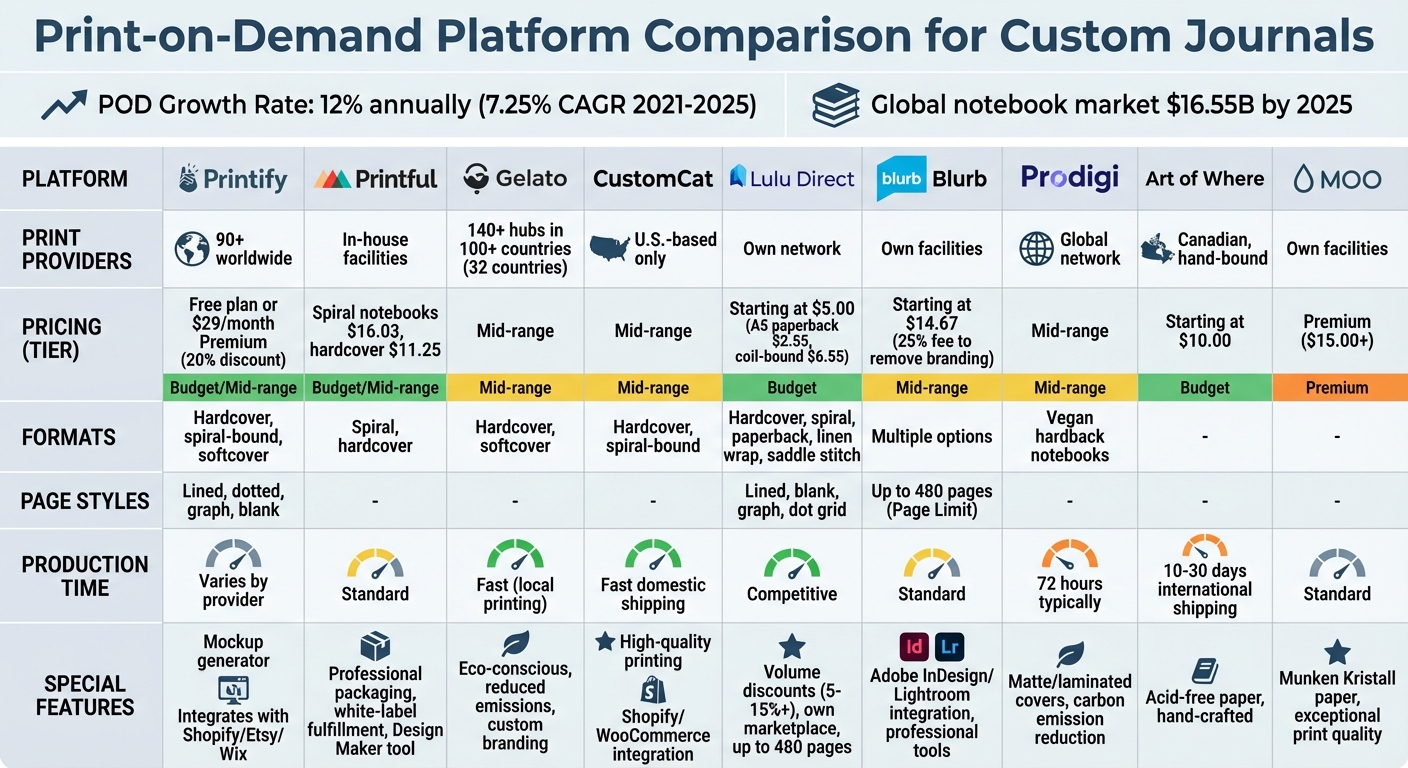
Print-on-Demand Platform Comparison for Custom Journals
Here’s a breakdown of custom journal printing features, focusing on binding styles, page limits, and production timelines. This complements earlier discussions on features and affordability.
Lulu xPress caters to book publishing needs with formats like A5 and US Letter. They offer binding options such as hardcover, spiral, and paperback, along with paper styles like lined, blank, graph, and dot grid [3][4]. Blurb, on the other hand, supports up to 480 pages and integrates seamlessly with Adobe InDesign and Lightroom, making it a go-to for designers using professional tools [3][4]. For those prioritizing environmental considerations, Prodigi provides vegan hardback notebooks with matte or laminated covers while focusing on reducing carbon emissions during production [2][4].
When it comes to production speed, options vary. Contrado boasts a quick turnaround of 1–2 days and offers express delivery [7]. Lulu Direct keeps pace with competitive production schedules [1][2], while Prodigi typically completes orders within 72 hours, leveraging its global network [7]. For Canadian customers, Art of Where offers hand-bound journals made with acid-free paper starting at $10.00. However, international shipping with them can take anywhere from 10–30 days [1][4].
For premium quality, Moo stands out with its Munken Kristall paper, known for exceptional print results [2][4]. Expect higher costs, though, with professional-grade journals priced above $15.00. In contrast, Camaloon provides more budget-friendly options, ranging between $3.50 and $7.00 [1][4].
Finally, consider whether Gelato's extensive network of 140+ production hubs across 32 countries aligns with your need for faster, eco-conscious shipping, or if Art of Where's hand-crafted approach better matches your vision [4][8][9]. These distinctions help pinpoint the platform that fits your production goals.
Conclusion
Select a platform that aligns with your business goals and priorities. The print-on-demand industry is growing steadily, with a projected compound annual growth rate of 7.25% between 2021 and 2025 [6]. This creates plenty of room for sellers who carefully match their platform choice with factors like budget, quality expectations, and fulfillment needs.
Before making a commitment, order product samples to evaluate quality firsthand. Factor in all costs - production, shipping, and platform fees - to set competitive prices that still leave room for healthy profit margins [1][6].
Technical integration is another key consideration. Platforms offering native plugins can simplify order management and streamline processes [1].
Your product's features should also reflect your brand identity. For example, if eco-friendly materials or unique designs are part of your brand, choose a platform that excels in those areas [2][6]. Some platforms specialize in premium offerings, like high-end paper stock, while others focus on affordability, with base costs starting as low as $2.18 per unit [6]. Let your target audience and pricing strategy guide your decision.
Finally, don’t overlook customer support. Since print-on-demand providers handle production and shipping, responsive support is crucial for resolving issues like reprints, refunds, or quality concerns [2]. Look for platforms with a proven history of reliable and attentive service to ensure a smooth experience for both you and your customers.
FAQs
How do I choose the best journal size and binding for my niche?
When choosing a journal, think about its purpose and who will be using it. Smaller sizes are great for on-the-go use, while larger options provide extra room for those who like to write more. For bindings, spiral-bound journals are practical and easy to use, making them a favorite among creatives. On the other hand, hardcovers give a polished, professional touch, which works well for formal or gift-worthy options. Match the size and binding to the specific needs of your audience - whether it's for daily notes, personal journaling, or special occasions - to deliver a product they'll love.
What hidden fees should I watch for before setting my price?
Hidden fees can be a sneaky addition to traditional solutions. Extra costs like setup fees, shipping charges, or add-ons for premium features often aren't included in the initial price. To steer clear of unexpected expenses, take the time to review all potential charges upfront. This way, you’ll have a clearer picture of the total cost and can plan your budget more effectively.
How can I reduce shipping time and costs for U.S. customers?
To cut down on shipping time and expenses for U.S. customers, consider working with print-on-demand providers that offer quick fulfillment options and discounts on bulk orders. Selecting domestic or nearby print providers can also reduce shipping distances, leading to faster delivery and lower costs.
Current contact path
Need Weird Network WiFi, custom apparel, or scoped help?
Use the contact form; removed product, checkout, research, and newsletter funnels stay offline.