Loading…

Best Practices for ISP Subscription Management
By weirdtoo·April 29, 2026·12 min read
Practical strategies for ISP billing, retention, and automation: structured plans, prepaid/postpaid options, self-service portals, and churn metrics.
Best Practices for ISP Subscription Management
Managing ISP subscriptions is critical for ensuring smooth operations and steady revenue. This article breaks down actionable steps ISPs can take to improve billing, retain customers, and streamline processes. Key takeaways include:
- Automate billing: Avoid manual errors and save time with tools that handle invoicing, payments, and service adjustments.
- Offer flexible plans: Use tiered pricing, prepaid/postpaid options, and pro-rata billing to meet customer needs.
- Focus on retention: Reduce churn with clear communication, proactive support, and customer-centric plans.
- Leverage self-service portals: Empower users to manage accounts, reducing support tickets.
- Track key metrics: Monitor churn, revenue, and customer engagement to identify and address issues early.
For smaller ISPs, especially in rural areas, these strategies help overcome challenges like limited resources and manual processes. By focusing on efficient subscription management and customer satisfaction, providers can build trust and grow sustainably.
Splynx ISP Billing Software Overview | Presentation for WISPAU
Core Principles of Subscription Management
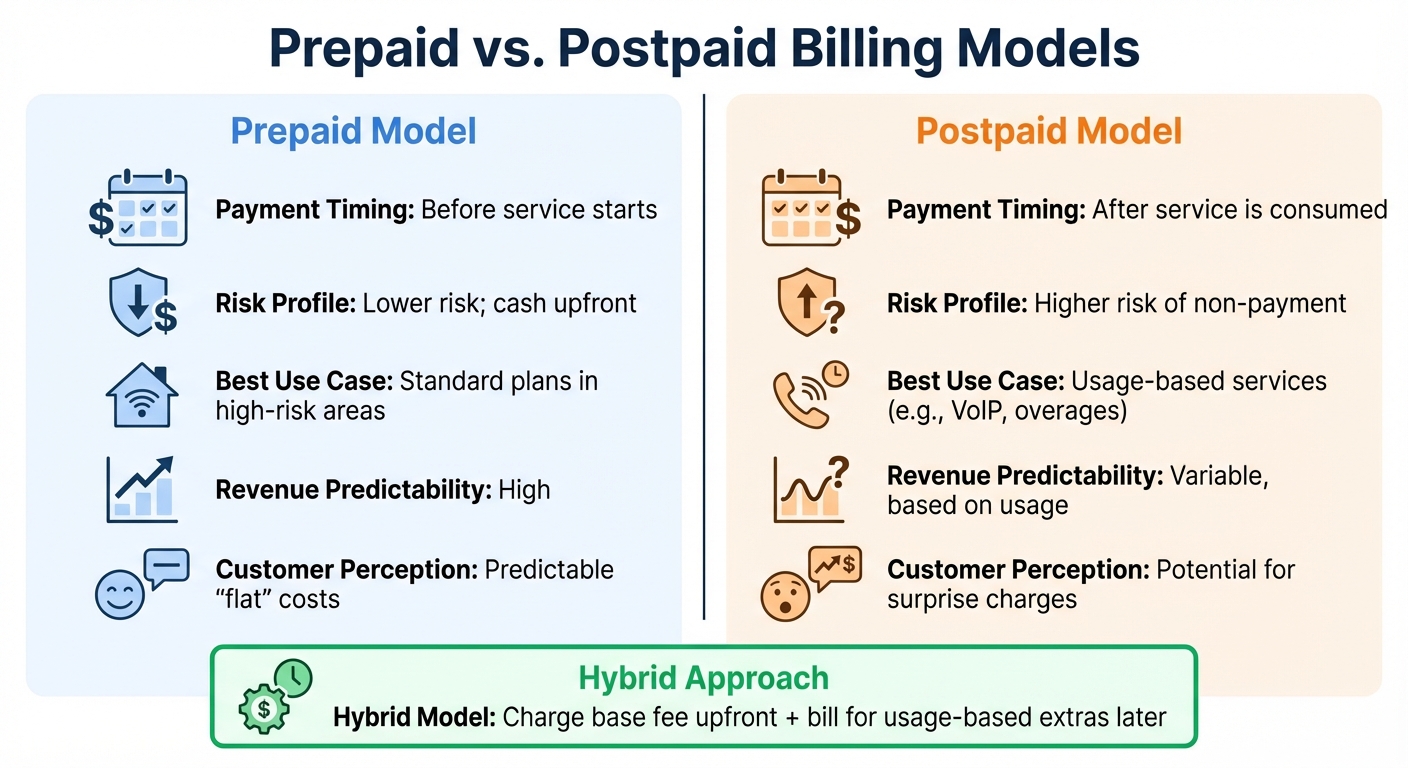
Prepaid vs Postpaid Billing Models for ISPs: Key Differences and Use Cases
To effectively manage subscriptions, start with a well-organized plan catalog, choose the right billing model, and leverage automation to reduce revenue loss and save time.
Building a Structured Plan Catalog
Your service plans should strike a balance between what your network can deliver and what your customers can afford. Begin by creating tiered base plans - offering essential, mid-tier, and premium options that align with both network capabilities and customer preferences. In rural areas, where pricing sensitivity is often a factor, this balance becomes even more critical.
The technology you use also plays a big role in shaping your plan catalog. Whether you're relying on fixed wireless, satellite (LEO vs. GEO), fiber-optic, or DSL, each method has unique capacity limits and cost structures. For instance, fixed wireless usage in the U.S. is expected to grow from 6.9 million users in 2021 to 12.7 million by the end of 2025 [2]. To boost revenue, consider adding value-added options like VoIP services, router leasing, or static IPs.
In areas with limited network capacity - common with satellite or fixed wireless - usage-based components such as data caps or overage charges can help maintain service quality. This approach ensures that heavy users don’t negatively impact others. Additionally, business customers often appreciate customized packages that include perks like dedicated support, higher bandwidth, and advanced security features, which can justify higher monthly fees.
Once your catalog is clear, the next step is to select a billing model that aligns with customer behavior and risk.
Prepaid vs. Postpaid Billing Models
The choice between prepaid and postpaid billing hinges on your customers’ needs and your tolerance for financial risk. Prepaid billing requires customers to pay before their service period begins - for example, paying on the 1st for service through the 31st. This model reduces the risk of unpaid bills and ensures steady cash flow, making it ideal for customers with limited credit or in higher-risk areas.
Postpaid billing, on the other hand, charges customers after they’ve used the service. This model works well for usage-based services like VoIP or data overages but comes with a higher risk of non-payment.
| Feature | Prepaid Model | Postpaid Model |
|---|---|---|
| Payment Timing | Before service starts | After service is consumed |
| Risk Profile | Lower risk; cash upfront | Higher risk of non-payment |
| Best Use Case | Standard plans in high-risk areas | Usage-based services (e.g., VoIP, overages) |
| Revenue Predictability | High | Variable, based on usage |
| Customer Perception | Predictable "flat" costs | Potential for surprise charges |
A hybrid model can offer the best of both worlds. For example, charge a base fee upfront and bill for usage-based extras later. Additionally, anniversary billing - where billing cycles are tied to each customer's signup date instead of a fixed monthly date - can help distribute administrative tasks evenly and smooth out cash flow.
Automating Billing and Lifecycle Operations
Manually managing billing through spreadsheets is prone to errors and inefficiencies. Automation simplifies the process by handling recurring tasks like generating invoices, collecting payments, and suspending services without human intervention. For example, in April 2025, AU Wireless, a small ISP in Colorado, reported cutting software costs by 50% after adopting automated billing and customer management systems. This allowed their team to focus on improving service rather than administrative tasks.
Integrating billing with network access control systems (like RADIUS/AAA) can further streamline operations. AfriQ Network Solutions Ltd, for instance, eliminated manual reconciliation and late-night reconnection calls by automating payment and service workflows. Founder Erick Kiboi shared:
"The billing automation was a game changer – payment integration, disconnection, and reconnection – all handled seamlessly. No more losses from unpaid clients or 2 AM 'I've paid, reconnect me' calls."
Pro-rata billing is another tool to consider. It automatically calculates charges for mid-cycle signups or plan changes, preventing revenue loss and reducing disputes over partial-month fees. Self-service portals also play a crucial role, giving customers the ability to manage their accounts online. This not only reduces support tickets but also empowers customers to handle their accounts on their own time.
Next, dive into ways to improve customer retention and deliver better experiences.
Improving Customer Retention and Experience
Keeping existing subscribers is far more cost-effective than constantly seeking new ones [6]. The secret lies in crafting plans that genuinely address customer needs, spotting potential issues early, and maintaining clear communication throughout the customer journey. This approach not only saves money but also strengthens the bond between providers and their customers.
Designing Plans That Put Customers First
Generic, one-size-fits-all plans often fall short, especially in underserved areas where budgets and usage habits can vary widely. Instead, use behavioral data to create plans that cater to different groups - like remote workers, gamers, or families. Flexibility is key. Offer both prepaid and postpaid options, and use pro-rata billing to ensure customers only pay for what they use, whether they join mid-cycle or switch plans. Additionally, providing local payment methods alongside standard credit card options makes services more accessible. Month-to-month contracts can also ease concerns about long-term commitments, making it easier for customers to choose and stick with your service [3].
For ISPs operating in rural areas, customizing plans not only meets diverse needs but also builds trust - a critical factor for smaller, community-focused providers.
Proven Retention Strategies
From 2023 to 2025, techCONNECT, a South African ISP, slashed its churn rate from 7% to 3% while boosting monthly recurring revenue by 30% year-over-year [2]. Nico Joubert, their Business Development Director, shared their proactive approach:
"We actually try to be proactive and phone the clients and say, look, there's an issue. We actually record and send them a little 2-minute video" [2].
This kind of outreach tackles problems before they spiral out of control. Keep an eye on warning signs like fewer portal logins, plan downgrades, or late payments - these can signal "silent churn", where customers disengage without formally canceling. For customers facing temporary challenges, offering a subscription pause instead of outright cancellation can keep them on board. Automated dunning campaigns, which send SMS or email reminders before suspending service for missed payments, have also been shown to recover up to 9% of revenue [1].
Building Trust Through Clear Communication
Clear and honest communication is the foundation of trust. Unfortunately, half of telecom customer inquiries currently require multiple calls to resolve, which frustrates users and pushes them toward competitors [3]. Lisa Schwarz, Senior Director of Global Product Marketing at NetSuite, emphasizes:
"Confusing invoices and surprise charges can erode trust, even if the service itself meets expectations. But clear telecom contract terms, transparent billing, and upfront pricing help customers feel respected" [3].
Streamlining communication strengthens retention. For example, combining multiple services - like internet, VoIP, and equipment rentals - into a single, easy-to-understand invoice helps customers see exactly what they’re paying for. When service outages occur, quickly providing detailed updates about the issue and expected resolution times can reassure customers. Self-service portals also play a big role, allowing users to check real-time usage, adjust plans, and manage billing without hassle. These tools not only reduce friction but also align with the proactive strategies mentioned earlier, showing customers that their needs are a priority.
For ISPs in rural areas, including small towns and trailer parks, these personalized and transparent practices can be game-changers. Unlike large corporate providers that often treat customers as account numbers, smaller ISPs have the chance to build real relationships through consistent, honest communication about what they can - and can’t - deliver.
sbb-itb-342b8b2
Tools and Best Practices for Subscription Management
Selecting the Right Subscription Management Platform
Choosing the right subscription management platform can make or break your operational efficiency. Look for a system that integrates billing and network control through RADIUS/AAA protocols to automate service activation, adjustments, and suspensions seamlessly [2]. It should also accommodate various billing models, including recurring charges, one-time setup fees, usage-based overages, and prorated charges for mid-cycle changes or sign-ups [2][1].
Make sure the platform supports major payment gateways like Stripe and PayPal, as well as local processors, especially if you're catering to rural areas [2]. Features like automated payment retries, powered by machine learning, optimize the timing for retrying failed payments. Similarly, card updater services ensure expired card details are updated automatically, reducing payment disruptions [1][5]. A customer self-service portal is also indispensable - it allows users to manage invoices, change plans, and track support tickets independently, minimizing manual intervention [2][4].
In April 2025, Arno Joubert, CEO of techCONNECT, highlighted the transformative power of automation:
"Monthly invoice run would take 20 hours plus. Now it takes half an hour thanks to Splynx integration with Xero, and most of things are automated in any case" [2].
For small ISPs serving areas like Wyoming's trailer parks and rural communities, integrated platforms that combine billing, network management, and helpdesk functions reduce vendor reliance and streamline operations [2]. Providers such as WEIRDTOO LLC (https://weirdtoocompany.com) are excellent examples of platforms tailored to meet the challenges of rural markets. Always verify that your chosen vendor can handle your projected user volume effectively [2].
These tools work hand-in-hand with governance measures to ensure secure and compliant service delivery.
Operational Governance and Compliance
Strong operational policies protect both your business and your customers. An Acceptable Use Policy (AUP) is a key document that sets clear boundaries for network usage - prohibiting activities like illegal downloads or excessive bandwidth consumption - and provides a legal framework to enforce these rules. Comprehensive platforms also include tools for managing inventory, scheduling field technicians, and resolving complaints through ticketing systems [2][7].
Data privacy is non-negotiable. Ensuring PCI-DSS compliance is essential for safeguarding cardholder information, and depending on your customer base, you may need to adhere to additional regulations like GDPR or CCPA [2]. Many modern ISP platforms simplify compliance by automating tax calculations based on customer locations and generating mandatory reports, such as FCC Broadband Data Collection filings in the U.S., which helps you avoid legal pitfalls and reduces administrative workloads [2][7].
Adhering to these standards supports continuous performance monitoring and operational stability.
Performance Metrics for Continuous Improvement
Tracking performance metrics is crucial for refining your processes and improving customer retention. Start with the churn rate, which measures the percentage of customers who leave during a specific period. The formula is simple: (Lost Customers / Total Customers at Start) × 100 [5][6]. Break this down further into voluntary churn (customers actively canceling), involuntary churn (due to failed payments), and passive churn (customers disengaging without notice) to identify where the issues lie [5].
Revenue metrics are equally important. Keep an eye on Average Revenue Per User (ARPU) (Total Revenue / Total Users), Monthly Recurring Revenue (MRR), and Customer Lifetime Value (CLV). Compare these against Customer Acquisition Cost (CAC), which is calculated by dividing total marketing and sales expenses by the number of new customers acquired [3][6].
Early warning signs like reduced login activity, negative feedback in support tickets, or plan downgrades can signal potential churn [1][5]. If you rely on email for billing alerts, monitor bounce and complaint rates - aim to keep complaints below 0.1%, as approximately 21% of opt-in emails fail to reach inboxes [8]. Segmenting churn by signup month can also reveal trends related to onboarding experiences or seasonal behaviors [5].
Erick Kiboi, founder of AfriQ Network Solutions, shared how automation revolutionized his operations:
"The billing automation was a game changer – payment integration, disconnection, and reconnection – all handled seamlessly. No more losses from unpaid clients or 2 AM 'I've paid, reconnect me' calls" [2].
Conclusion: Key Takeaways for ISP Subscription Management
Managing ISP subscriptions effectively begins with well-organized plan catalogs and automation. These tools not only help establish steady recurring revenue but also tackle operational inefficiencies head-on. Consider this: subscription businesses can lose up to 9% of their revenue due to failed payments[1], while acquiring a new customer is six to seven times more expensive than retaining an existing one[6]. Features like automated billing, smart payment retries, and self-service portals can significantly reduce involuntary churn - from around 6% to as low as 1%[1]. As experts emphasize, sustainable growth relies more on a strong administrative foundation than just expanding service areas.
Customer retention thrives on clear communication and proactive support. For providers in rural areas, being upfront about pricing, outages, and service changes fosters trust and reduces the likelihood of customers switching to competitors. Companies like WEIRDTOO LLC (https://weirdtoocompany.com) show that finding the right balance between affordability and operational sustainability can effectively address the needs of underserved communities.
With plan structure, automation, and customer support in place, the next step is measurement. Key metrics such as churn rate, ARPU, MRR, and CLV compared to CAC are essential for identifying areas that need improvement. These figures can also highlight early warning signs - like reduced login activity or plan downgrades - before customers decide to leave. By pairing a robust subscription management platform with strong operational practices and ongoing monitoring, billing evolves from a routine task into a strategic advantage.
FAQs
What’s the best way for ISPs to manage both prepaid and postpaid billing models?
Effectively managing both prepaid and postpaid billing models enables ISPs to reach a broader customer base. Prepaid plans are perfect for users who prefer to keep tight control over their spending, while postpaid plans provide the ease of consistent service and predictable monthly revenue. Offering both options allows ISPs to meet a variety of payment preferences, particularly in regions where customer habits differ significantly.
To successfully balance these models, ISPs can rely on flexible, automated billing systems that handle tasks like renewals, plan adjustments, and payment recovery efficiently. Some effective strategies include:
- Usage-based plans: These allow customers to start with prepaid options and transition smoothly to postpaid as their usage or needs increase.
- Automated invoicing and top-ups: Postpaid customers benefit from automated billing, while prepaid users enjoy simple top-up options for a hassle-free experience.
- Self-service portals: These portals empower customers to switch between prepaid and postpaid plans on their own, eliminating the need for support calls.
A great example of this balance is WEIRDTOO, which provides free-tier Wi-Fi with prepaid add-ons alongside monthly postpaid plans. This setup offers customers flexibility while ensuring the company operates efficiently.
What are the benefits of automating ISP billing and subscription management?
Automating ISP billing and subscription management brings a host of benefits that simplify operations and enhance customer experience. By doing away with manual invoicing, automation minimizes errors, ensures timely renewals, and keeps plan adjustments accurate. This consistency helps maintain steady revenue and reduces churn caused by missed or failed payments, keeping everything running smoothly.
Automated systems also quickly handle payment recovery and declined transactions, turning potential losses into retained income. This efficiency allows staff to focus on more strategic tasks. Plus, a unified platform offers real-time insights into billing, usage, and service health. These insights support smarter pricing strategies, speed up customer onboarding, and make compliance reporting a breeze. Overall, automation cuts administrative costs, scales easily with growth, and delivers a dependable experience - especially critical for rural communities where reliable internet is a lifeline.
What can rural ISPs do to build customer loyalty and trust?
Rural ISPs can strengthen loyalty and build trust by prioritizing personalized service and clear communication. Instead of treating customers as one-off transactions, viewing them as long-term partners makes a big difference. This means resolving technical issues quickly, keeping customers informed about outages or upgrades, and offering a billing process that's straightforward - think automated renewals and easy payment options. When customers feel supported and experience consistent service, they’re far more likely to stick around.
Automated tools for billing and ticketing can add another layer of reliability by minimizing errors and streamlining tasks like recurring payments and renewal reminders. Combine this with 24/7 customer support - especially from a team that understands the unique challenges of rural areas - and you create an environment where customers feel truly valued. Offering flexible plans tailored to local needs, such as shared community Wi-Fi hotspots or adjustable data caps, further shows a commitment to the community's well-being.
A great example of this is WEIRD TOO, which serves underserved areas like trailer parks with internet plans that are both affordable and customizable. Their emphasis on transparent pricing, fast issue resolution, and community-focused solutions has helped them build strong, lasting relationships with their customers.
Current contact path
Need Weird Network WiFi, custom apparel, or scoped help?
Use the contact form; removed product, checkout, research, and newsletter funnels stay offline.