Loading…

How Backhaul Sharing Cuts Costs for Rural ISPs
By weirdtoo·July 17, 2026·9 min read
Cut rural ISP backhaul costs with joint builds, neutral-hosts, or open-access fiber—plus capacity planning, SLAs, and funding tips.
How Backhaul Sharing Cuts Costs for Rural ISPs
Shared backhaul can cut one of the biggest rural ISP costs by spreading one route across multiple providers. If I were sizing this up today, I’d focus on four things right away: the sharing model, the cost split, the capacity plan, and the written rules for outages, upgrades, and exits.
Here’s the short version:
- Backhaul is often a major rural cost because long routes, repair trips, tower access, and power are spread across fewer subscribers.
- Sharing works by splitting fixed costs across more than one ISP, which can lower both monthly spend and per-subscriber cost.
- The main models are joint builds, neutral-host setups, and open-access fiber.
- The main design choices are fiber, microwave, or hybrid links, plus traffic separation and failover planning.
- The main business risks are vague SLAs, unclear repair duties, weak upgrade triggers, and fuzzy funding terms.
A simple benchmark I’d use: if a route serves 2 to 4 providers instead of 1, each provider may only carry a fraction of the fixed route cost, though the exact split depends on traffic, ownership, and contract terms.
Quick Comparison
| Model | Who owns it | Best fit | Main tradeoff |
|---|---|---|---|
| Joint build | Two or more ISPs | Same corridor, small partner group | More coordination between owners |
| Neutral host | One owner, many users | ISPs want access without ownership | Less control for tenants |
| Open-access fiber | Shared access framework | Many users on one route | More rules around access and upgrades |
If you want the plain answer: shared backhaul lowers costs when the route is expensive, the partner set is stable, and the agreement is specific enough to stop disputes before they start.
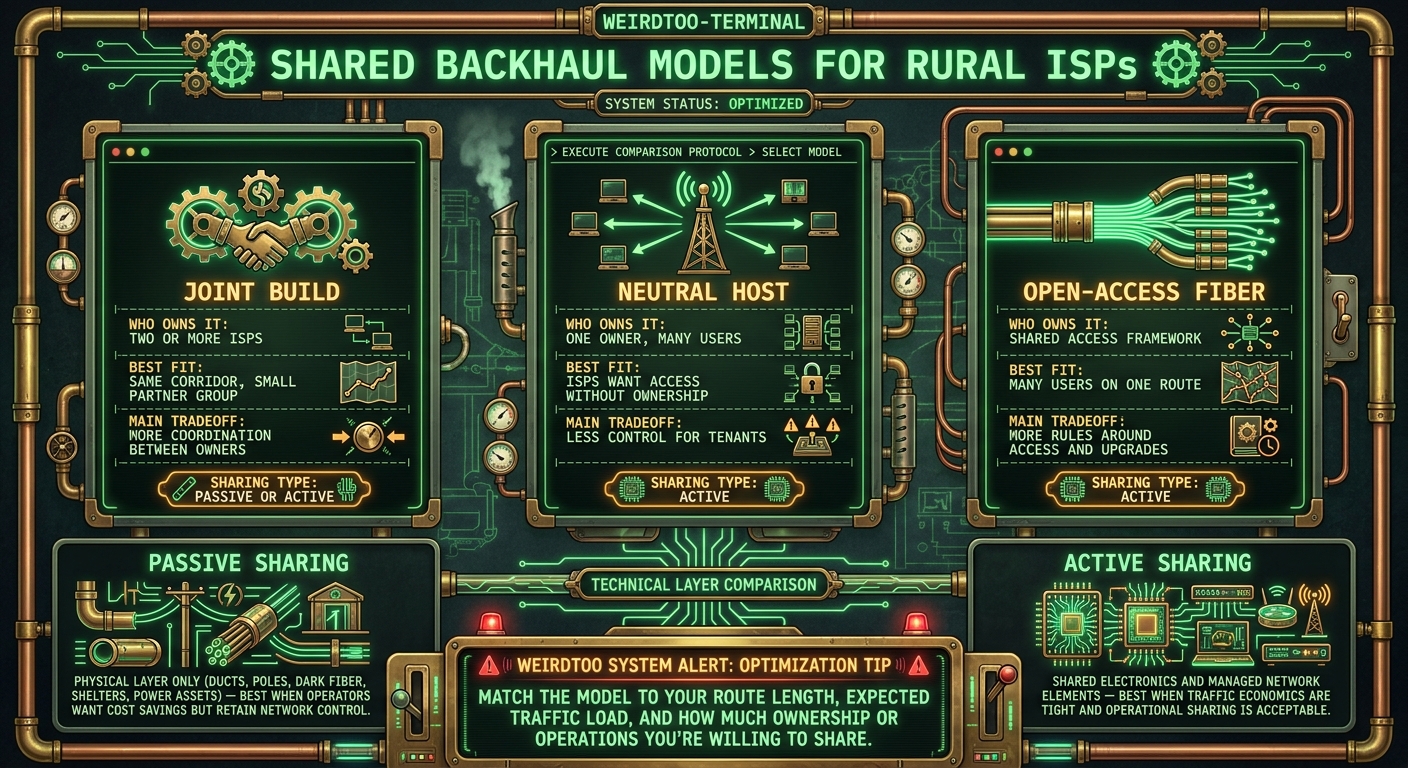
Shared Backhaul Models for Rural ISPs: A Side-by-Side Comparison
1. Compare shared backhaul models before you build
Now that the cost case is clear, the next step is picking a sharing model that fits your market. That choice usually comes down to three things: geography, demand, and control.
Some routes are long and expensive to build. Others have dense traffic and more than one operator ready to use the same path. In some markets, providers want to keep tight control over the network. In others, they’re fine sharing assets or day-to-day operations if it cuts costs.
The main models to compare are joint builds, neutral hosts, and open-access fiber. Each one works best under different conditions, so match the model to your route length, expected traffic load, and how much ownership or operations you’re willing to share.
A simple way to think about it: start with joint builds, then stack that option against neutral-host and open-access setups.
Joint builds, neutral hosts, and open-access fiber
A joint build is usually the most direct option. Two or more parties share the cost of building the backhaul route, and each gets a stake in the asset. This model often works well when a small group of operators needs the same corridor and is willing to coordinate on funding, construction, and governance.
A neutral-host model shifts that setup. Instead of several operators building together, one party builds and runs the infrastructure, then sells access to multiple users. That can reduce coordination headaches. It can also work well in markets where operators want capacity but don’t want to own the route themselves.
Open-access fiber goes a step further. The network is built so multiple providers can use it under a shared access framework. That can make sense where there’s demand from many tenants, public-sector interest, or a push for broad market access along the route.
When passive sharing and active sharing make sense
Passive sharing usually means sharing the physical layer, like ducts, poles, dark fiber, shelters, or power-related site assets. This tends to make sense when operators want cost savings but still want to run their own equipment and manage service quality more directly.
Active sharing involves shared electronics or managed network elements on top of the physical plant. That can lower costs even more, but it also means giving up more control. For some operators, that trade-off is fine. For others, it’s a nonstarter.
A good rule of thumb:
- Use passive sharing when parties want lower build costs without giving up too much network control.
- Use active sharing when traffic economics are tight, operational sharing is acceptable, and the market can support closer coordination.
How to pick the right model for your market
The best model depends on the shape of your market, not just the headline savings.
If your route is long, capital-heavy, and needed by a few committed operators, a joint build may be the cleanest fit. If demand is there but ownership alignment is messy, a neutral-host setup can be easier to execute. If the goal is to serve many providers across the same fiber base, open-access fiber may fit better.
It helps to pressure-test each model against a few practical questions. Who will use the route? How much traffic is likely in the first few years? Who wants control over upgrades, maintenance, and service terms? And where will disagreements show up once the network is live?
That’s the part people sometimes skip. On paper, several models can work. In practice, the right one is the one your market can actually support without turning every operating decision into a tug-of-war.
sbb-itb-342b8b2
2. Calculate cost savings and capacity needs
Once you’ve picked the model, the next step is simple: show the math. Run the cost model against your current backhaul spend, then compare that with what the shared setup would cost.
Map your current cost baseline
Start with your full backhaul cost picture. That means lease fees, pole or tower access, power, maintenance, repair trips, and outage costs. Don’t stop at bandwidth charges.
Rural backhaul often comes with extra travel time, longer repair trips, and hard-to-reach sites. Those costs add up fast, and they’re easy to miss if you only look at bandwidth pricing. This baseline gives you the reference point for every sharing option.
Estimate shared cost per ISP and per subscriber
Next, divide costs using the agreed method. That could be committed capacity, equal shares, or another written formula. Then turn that into cost per ISP and cost per subscriber.
Use the same rule for every partner. If the agreement says costs are split one way, stick to that. Don’t rely on a casual or unwritten split, even if it feels easier in the moment.
Set upgrade points before congestion starts
Put upgrade triggers into the agreement before traffic grows. Good triggers can include sustained congestion, a new tenant joining the network, or missed performance targets.
The point is to act before users feel the pain. Set the trigger before latency climbs and packet loss starts to show up.
Once the cost target is clear, the next move is performance planning. Use those numbers to size the link and set redundancy in the technical design.
3. Build a technical design that protects performance
Once you've nailed down cost and capacity, the next move is the network design. This is where you make sure the shared link stays steady when traffic climbs. Use your capacity target to pick the transport, separate tenants, and lock in failover rules before demand starts pushing the network around.
Choose the transport medium for your geography
Choose fiber, microwave, or a hybrid route based on the land and the distance. Fiber tends to work better on shorter, easier-to-reach corridors where build costs stay in check. Fixed microwave makes more sense on longer routes or in places where trenching gets expensive fast. If fiber construction would wipe out the savings, microwave can be the smarter call.
In many rural markets, a hybrid setup works best. You use fiber on the parts of the route that are easier to build, then switch to microwave where the terrain makes trenching a bad bet. The key idea is simple: match the medium to the route, not to habit or preference.
Separate traffic with clear tenant controls
Each tenant should have isolated traffic from day one. Use VLANs, MPLS, or logical partitioning so one operator's traffic doesn't spill into another's. That's not just a nice network feature. It's how you keep shared infrastructure from turning into shared pain.
Bandwidth limits also need to be spelled out per tenant in the agreement and enforced at the network layer. Paper terms alone won't save performance. If one partner has a traffic spike, the others shouldn't see their service drop because of it. Put those controls in place before launch, not after the first angry phone call.
Plan redundancy, monitoring, and repair responsibility
Set backup paths and failover rules before the main link goes down. That means mapping alternate routes, setting automatic switchover thresholds, and testing failover under load. If you wait until an outage hits, you're making hard calls in the worst possible moment.
Monitoring needs a named owner. The group should agree on alert thresholds, response times, and escalation steps ahead of time. Repair duties should be written the same way: who responds first, who pays for what, and how long remote fixes versus on-site work should take.
These details can feel tedious when everything is working. But during an outage, they stop finger-pointing and wasted time.
Once the design is set, put the operating rules, SLAs, and repair duties in writing.
4. Put agreements, funding, and operations in writing
Once the network design is set, get the business terms on paper. A shared network can save money, but only if the contract is just as solid as the build plan. Shared backhaul keeps costs down when everyone knows the rules and agrees to them up front.
Write SLAs and cost-sharing rules that remove ambiguity
Put the key terms in writing before launch. That includes pricing, service levels, repair response times, escalation steps, and exit terms.
If those details stay vague, small issues can turn into big fights. Who pays for what? How fast does a repair team need to respond? What happens if one party wants out? A clear SLA and cost-sharing agreement answers those questions before they become a problem.
Use grants and anchor institutions to close the funding gap
Outside funding can make a shared build pencil out. Use grants, loans, and anchor-institution support to lower the shared build cost, but don't let that muddy ownership.
Track matching requirements and ownership expectations from the start. Document matching funds, ownership, and repayment terms from day one. That lowers the per-ISP cost and cuts down on disputes over funding terms later.
Keep the signed agreement, SLA, funding terms, and change log in one shared repository.
Conclusion: A practical path to lower backhaul costs
Backhaul is one of the biggest cost hurdles for rural ISPs. Sharing it can lower both build costs and monthly operating costs.
Put it all together, and sharing starts to look less like a nice idea and more like a plan you can use. The details matter: choose the right sharing model, size capacity based on actual upgrade triggers, design for tenant performance, and spell out every duty before you spend a single dollar. That planning is what turns cost-cutting on paper into cost-cutting in practice.
Before you build, make three moves:
- Calculate today’s costs
- Identify likely partners
- Draft a simple sharing framework for cost, capacity, and responsibility
That’s the moment shared backhaul stops being theory and starts becoming a real operating plan.
Done well, shared backhaul cuts costs without giving up performance.
FAQs
How do we choose the right sharing model?
Choose the sharing model that fits your network needs, budget, and operating setup. The right choice can cut costs while still supporting steady, dependable service for rural customers.
Keep it practical. Your model should match your goals for coverage, capacity, and day-to-day management.
How should partners split backhaul costs fairly?
The original answer does not address backhaul cost sharing. Instead, it talks about an unrelated AI language model, including its size, context window, compatibility, pricing, and planned release timeline.
To keep the meaning unchanged, there isn't a valid FAQ answer to pull from that text.
What should be in the sharing agreement?
The agreement should clearly lay out how the shared backhaul arrangement will work, including each party’s roles, responsibilities, and expectations.
It should also define the key terms in plain language to cut down on confusion and make day-to-day coordination smoother over time.
Current contact path
Need custom apparel or scoped help?
Use the contact form; removed product, checkout, research, and newsletter funnels stay offline.