Loading…
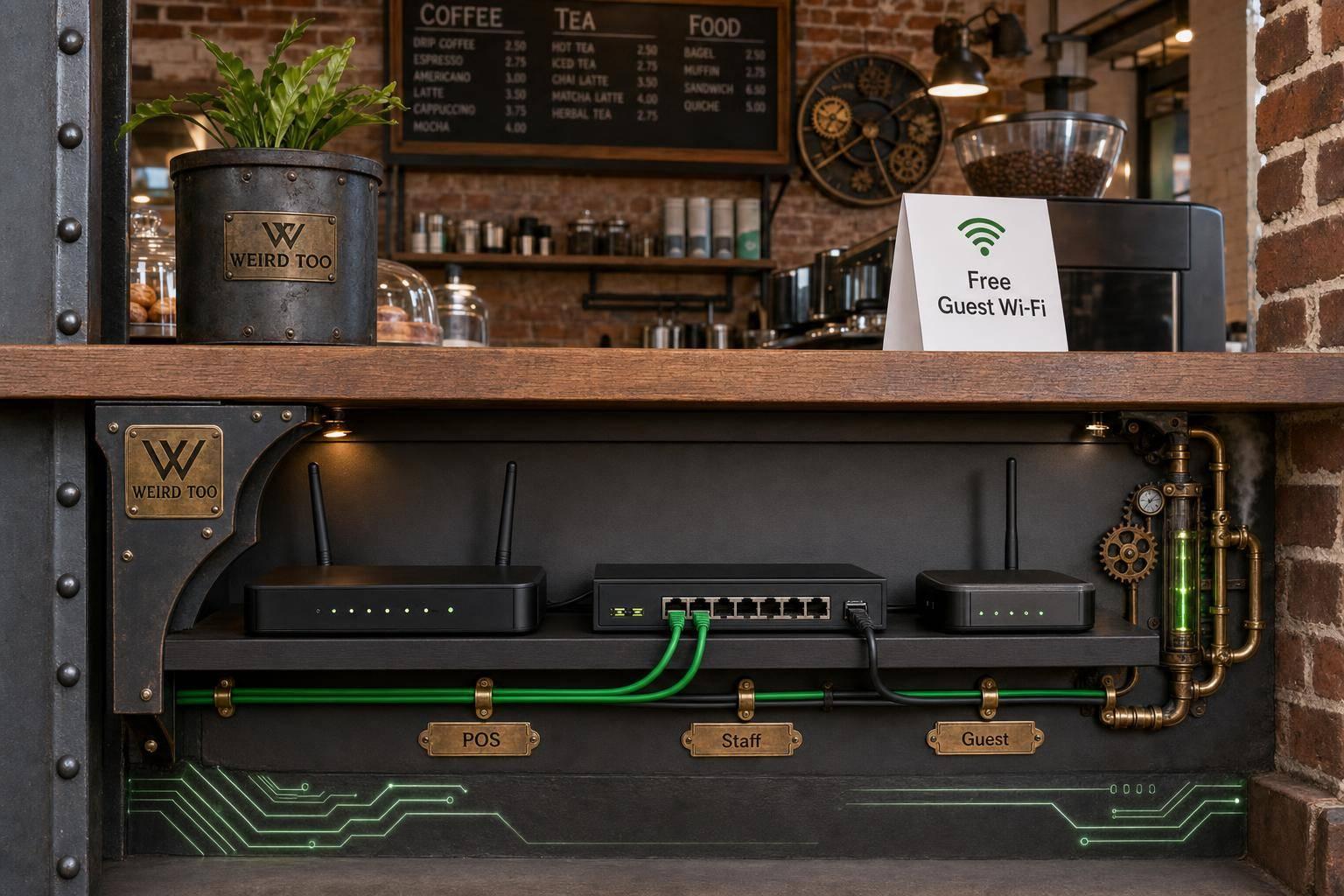
Affordable Network Equipment for Local Cafés Owners in Rust Belt Areas
By weirdtoo·July 13, 2026·5 min read
Guide to budget-friendly routers, switches and Wi‑Fi with LTE failover and VLAN tips to keep Rust Belt cafés' POS and guest networks reliable.
Affordable Network Equipment for Local Cafés Owners in Rust Belt Areas
Affordable Network Equipment for Local Cafés Owners in Rust Belt Areas
An in-depth article and buying guide tailored for local café owners in underserved Rust Belt regions. The article addresses the unique connectivity challenges of aging broadband infrastructure in these areas and recommends cost-effective, reliable network equipment solutions (such as routers, switches, and APs) to keep point-of-sale (POS) systems, guest Wi-Fi, and employee networks running smoothly and securely without breaking the bank.
Business Type
Local Café / Coffee Shop
Region
Rust Belt (including Ohio, Pennsylvania, Michigan, and Indiana)
Region-Specific Connectivity Challenges
Rust Belt communities often face acute connectivity gaps due to decades of deindustrialization, underinvestment in broadband, and difficult topography that raises expansion costs. Rural businesses frequently experience highly unstable broadband speeds or total outages. Furthermore, aging electrical infrastructure can lead to power fluctuations, while local carrier competition is often limited, resulting in notable cellular coverage gaps. In these conditions, local cafés require equipment that supports dual-WAN load balancing, cellular (4G/LTE) backup, and isolated VLANs to ensure POS payment terminals can process transactions securely even when the main guest Wi-Fi is heavily loaded or the primary landline broadband drops out.
Types of Network Equipment Covered
- Router
- Switch
- Access Point
- Security Gateway
Recommended Products
- ASUS ExpertWiFi EBR63
- TP-Link ER605
- TP-Link ER706W
- TP-Link ER706W-4G
- TP-Link ER706WP-4G
- TP-Link Festa FR307-M2
- TP-Link SG2008P
- TP-Link EAP613
Key Features
- Wi-Fi 6
- Dual-Band
- Mesh Support
- Guest Network / Captive Portal
- VLAN Support
- PoE Support
- VPN Support
- Failover / Cellular Backup
- Load Balancing
- Cloud Management
Product Recommendations & Rationale
The article outlines a clear set of product recommendations designed for varying levels of café size and infrastructure needs. For a small café, an all-in-one device like the ASUS ExpertWiFi EBR63 is the simplest starting point, combining router, switch, and security gateway functions without subscription fees. For cafés needing dedicated gateway management or cellular backup, the TP-Link ER605 acts as a highly affordable security gateway with central cloud management. If Wi-Fi 6 and LTE resilience are required due to fragile rural broadband, the TP-Link ER706W or TP-Link ER706W-4G (with built-in 4G/LTE failover) is recommended. Larger café spaces can scale up by pairing these gateways with a TP-Link SG2008P PoE+ switch and Omada ceiling-mounted access points to handle dense concurrent guest connections and separate POS systems on isolated VLANs.
Performance Metrics
The recommended products offer modern performance metrics suited for small-business cafe operations. The ASUS ExpertWiFi EBR63 supports Wi-Fi 6 AX3000 speeds (up to 3.0 Gbps total throughput), covers up to 1,500 square feet, handles up to 5 SSIDs/VLANs, and connects up to 100+ concurrent devices. The TP-Link ER706W-4G is a Wi-Fi 6 AX3000 dual-band router featuring 4G/LTE Cat6 cellular backup (speeds up to 300 Mbps), support for multi-WAN load balancing, and integrated Omada mesh support. The TP-Link ER605 is a wired Gigabit VPN router supporting up to 4 WAN connections for multi-line internet reliability and an SPI firewall with DoS protection.
Setup Difficulty
Easy to Moderate
Step-by-Step Setup Instructions
- Unbox the main business router or security gateway and place it near the center of your café, ensuring it is away from large metal objects. Keep the ISP-provided modem or ONT nearby.
- Connect an Ethernet cable from the yellow/WAN port of your ISP modem to the WAN port on your new router (e.g., ASUS EBR63 or TP-Link ER605).
- If using separate access points, cameras, or POS printers, connect an Ethernet cable from one of the router's LAN ports to a PoE+ switch, and plug those wired devices into the switch.
- Power on all the devices and wait 2 to 3 minutes for the lights to stabilize.
- Download the companion app (such as the ASUS ExpertWiFi app or TP-Link Omada app) on your smartphone. Connect to the default Wi-Fi network listed on the bottom sticker of your router.
- Follow the on-screen configuration wizard to set up separate Wi-Fi networks (SSIDs) with VLAN isolation: one secure network for staff/POS terminals, one isolated network for guests with a customizable captive/splash portal, and one for IoT/smart-building devices.
- Set up your backup line: If using a cellular LTE-enabled gateway or USB dongle, insert your active SIM card and enable automatic WAN Failover in the router's internet settings to keep credit card transactions processing during main service outages.
- Save a simple diagram of which physical port connects to each device to simplify future troubleshooting.
Troubleshooting Tips
If your POS terminal loses connection, verify that it is connected to the dedicated Staff network rather than the isolated Guest portal, as guest networks often block local device-to-device communication. If the internet goes down completely, check the router's status LEDs: a solid red or amber WAN light indicates an issue with your ISP connection, which should automatically prompt your cellular/dual-WAN backup to engage if configured. For areas with weak Wi-Fi coverage or physical interference (like brick walls or metal kitchen gear), try relocating the router or adding an Omada mesh access point with wired backhaul rather than relying on weak wireless repeater links. Always keep your router's firmware updated through the mobile app to secure payment portals against vulnerabilities.
Price Range
Budget to Mid-range ($100 to $350)
Total Cost of Ownership (Estimated 3 Years)
$350
Cost Comparison
For a local café, an all-in-one gateway router like the ASUS ExpertWiFi EBR63 (~$150) offers excellent value for money by eliminating the need to buy a separate router, switch, access point, and security controller. Traditional SMB modular setups, such as TP-Link Omada (consisting of the ER605 gateway at ~$50, a PoE switch like the SG2008P at ~$90, and an EAP613 Access Point at ~$70), are more expensive upfront (around $210 total) and require more assembly. However, they provide much greater flexibility, better coverage, and lower replacement costs if only a single component fails. Compared to high-end enterprise systems like Cisco Meraki, both the ASUS and TP-Link Omada solutions are highly budget-friendly and do not require ongoing subscription fees.
Scalability Advice
Cafes can start with a compact, cost-effective all-in-one unit like the ASUS ExpertWiFi EBR63 or TP-Link ER706W. As the business grows (e.g., adding a larger patio, a back-room office, or smart smart cameras), the network can scale by connecting a PoE (Power over Ethernet) switch to power additional hardwired devices. In larger setups, café owners can shift to a centralized SDN (Software-Defined Networking) environment like TP-Link Omada, where separate ceiling-mounted access points can be managed under a single, free cloud-based dashboard to support seamless roaming across multiple rooms. Additionally, deploying secondary WAN lines or LTE failover dongles early protects growth from internet instability.
Support and Warranty
Most business-class networking devices from ASUS and TP-Link come with a 2-year or 3-year limited manufacturer warranty. Technical support is available via 24/7 phone hotlines, online live chat, and comprehensive active community forums, ensuring business owners can get assistance without needing an on-site IT team.
Where to Buy
Related Weird Too links
Keep following this lane
Current contact path
Need Weird Network WiFi, custom apparel, or scoped help?
Use the contact form; removed product, checkout, research, and newsletter funnels stay offline.