Loading…
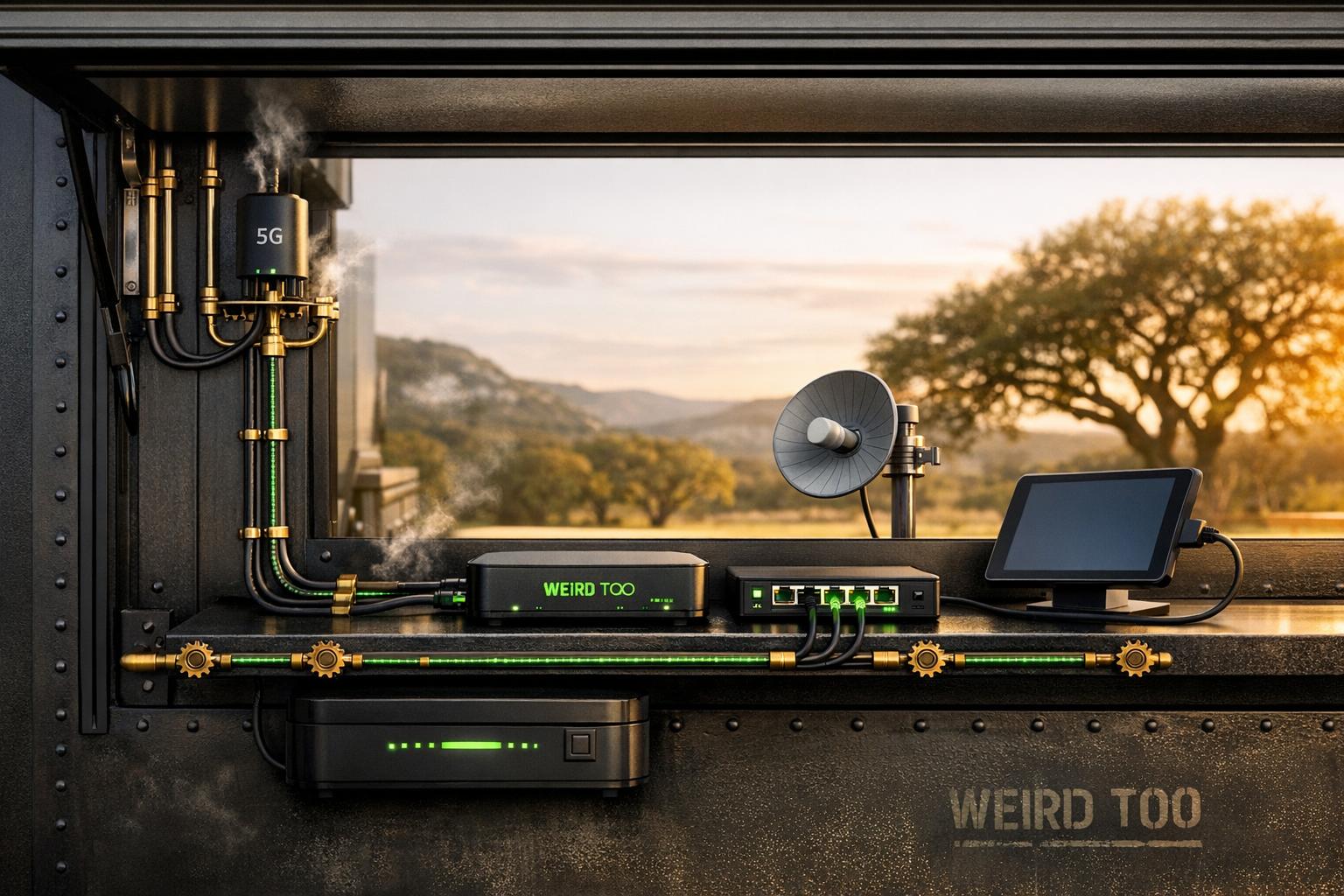
Affordable Network Equipment for Food Trucks Owners in Texas Hill Country
By weirdtoo·June 8, 2026·5 min read
Low-cost mobile and fixed wireless networking for Texas Hill Country food trucks — dual-WAN failover, VLAN POS isolation, UPS tips.
Affordable Network Equipment for Food Trucks Owners in Texas Hill Country
Affordable Network Equipment for Food Trucks Owners in Texas Hill Country
A buying-and-setup guide for food truck owners operating in Texas Hill Country conditions (limited wireline options, hilly/treed terrain, and frequent connectivity disruptions). It emphasizes low-cost “mobile + fixed wireless” style connectivity, business-grade routing/firewall for POS and guest Wi‑Fi separation, and practical deployment steps (mount points with clear sky view, UPS for continuity, and failover planning).
Business Type
Food Truck
Region
Texas Hill Country
Region-Specific Connectivity Challenges
Texas Hill Country often has limited or no fiber/cable/DSL infrastructure in some areas, and terrain (limestone hills/ravines and heavy tree cover) plus provider coverage gaps can make traditional wireline deployment or consistent wireless performance difficult. Because of this, food truck connectivity plans frequently need fixed wireless or cellular as a primary path plus an automatic backup (dual‑WAN) to reduce downtime, and mounting/placement that maintains clear signal paths.
Types of Network Equipment Covered
- Cellular modem / 4G-5G mobile router
- Dual-WAN router
- Router / Firewall (VLAN support)
- Managed switch (PoE if needed)
- Wi‑Fi Access Point
- UPS / battery backup
Recommended Products
- 4G/5G LTE (cellular) mobile router with SIM support (MiFi-style)
- 5G home internet / fixed wireless modem-router (ISP-provided)
- Dual-WAN router for automatic failover
- Business-grade router/firewall with VLAN support
- Managed switch (PoE if powering access points)
- Wi‑Fi 6/7 access points (APs) for coverage where needed
- UPS (battery backup) for modem/router/ON T/network closet
Key Features
- Cellular connectivity via 4G/5G with SIM
- Fixed wireless “tower to property” style service where fiber/cable is unavailable
- Dual‑WAN or cellular failover for uptime
- VLANs/segmentation to isolate POS vs guest networks
- Firewall rules / guest isolation
- PoE support for simplifying AP power
- UPS/battery backup to keep network running during outages
- Mounting points with clear sky view (for fixed wireless/satellite/cellular antennas)
Product Recommendations & Rationale
- Primary connectivity: use a 4G/5G mobile router (MiFi-style) with SIM support for a truck that moves between locations; this is positioned as an affordable way to keep POS and customer Wi‑Fi working even when wired options aren’t available. 2) Backup / resilience: add a dual‑WAN router that can automatically switch between two internet sources (for example, fixed wireless plus cellular) so payments continue during outages. 3) Network security & segmentation: choose a business-grade router/firewall that supports VLANs and guest isolation so POS/payment devices run on an isolated VLAN while customer/guest SSIDs are blocked from reaching internal systems. 4) Coverage/throughput where you have a “setup spot”: if you need a stronger local Wi‑Fi footprint (staff + POS + customer devices), use access points powered via a PoE-capable managed switch. 5) Cost-of-ownership guardrails: power the modem/router and critical networking equipment with a UPS, and plan antenna/mount locations ahead of time with clear sky/signal paths—especially important for rural/treed Hill Country areas.
Performance Metrics
Designed for event-grade reliability: cellular routers are positioned as a “more reliable and plugged-in” option vs basic hotspots; performance depends on cellular signal strength and a data plan capable of supporting payments/menu updates.
Setup Difficulty
Moderate
Step-by-Step Setup Instructions
- Choose your connectivity approach: a 4G/5G cellular router (recommended for reliable, power-stable internet on the road) or a portable hotspot if you’ll be near strong cellular coverage.
- Install the cellular router in the truck so it has good ventilation and cable management (keep it powered continuously).
- If you use a cellular router, pair it with a data plan sized for your needs (payments/POS, menu updates, and customer Wi‑Fi usage).
- Connect your in-truck devices: - Plug POS/tablet devices into your local Wi‑Fi network. - If you have a POS that benefits from stability, ensure it stays on the same SSID and password.
- If you operate near occasional fixed Wi‑Fi (commissary or event venue) and want to extend that coverage inside/around the truck, add a Wi‑Fi extender only when the original signal is strong enough to “re-broadcast.”
- Create separate networks if needed: - A staff/operations network for POS and admin devices. - A guest network for customer devices (optional).
- Test before each event: confirm you can process payments, load ordering/menu pages, and upload any updates without frequent reconnects.
Troubleshooting Tips
- If your internet is slow or drops out, prioritize improving cellular signal (router placement, higher mounting point, and ensuring the router stays powered rather than relying on a battery hotspot).
- For unreliable events coverage, switch from a basic hotspot to a 4G router that is powered (plugged in) for more consistent uptime.
- If using a Wi‑Fi extender, remember it only performs well when the source signal is already strong—relocate the extender or consider a cellular router instead.
- Watch out for extra costs from overages if your data plan is undersized; upgrade the data plan or reduce high-bandwidth usage during service.
Price Range
Budget to Mid-range (cellular router + data plan; satellite is typically higher cost in very remote areas)
Total Cost of Ownership (Estimated 3 Years)
$900
Cost Comparison
Mobile hotspots and 4G/5G routers are generally more budget-friendly upfront than satellite; satellite internet tends to cost more in both equipment and monthly fees, but may be a fallback for very remote locations. Wi‑Fi extenders can be inexpensive, but they may underperform if the original venue signal is weak.
Scalability Advice
As your routes grow across the Hill Country, standardize on the same core setup (cellular router + consistent Wi‑Fi SSID/password plan). Then scale by:
- Increasing data-plan capacity as you add more devices/automation.
- Adding a secondary router or failover approach for higher uptime when you expect weaker signal areas.
- Adding guest Wi‑Fi capabilities separately from POS/staff networks to keep operations stable during peak customer load.
Support and Warranty
Use the manufacturer’s warranty for the router plus your cellular provider’s support for coverage and data-plan issues. (Specific warranty terms weren’t available in the provided sources.)
Where to Buy
Related Weird Too links
Keep following this lane
Current contact path
Need Weird Network WiFi, custom apparel, or scoped help?
Use the contact form; removed product, checkout, research, and newsletter funnels stay offline.