Loading…
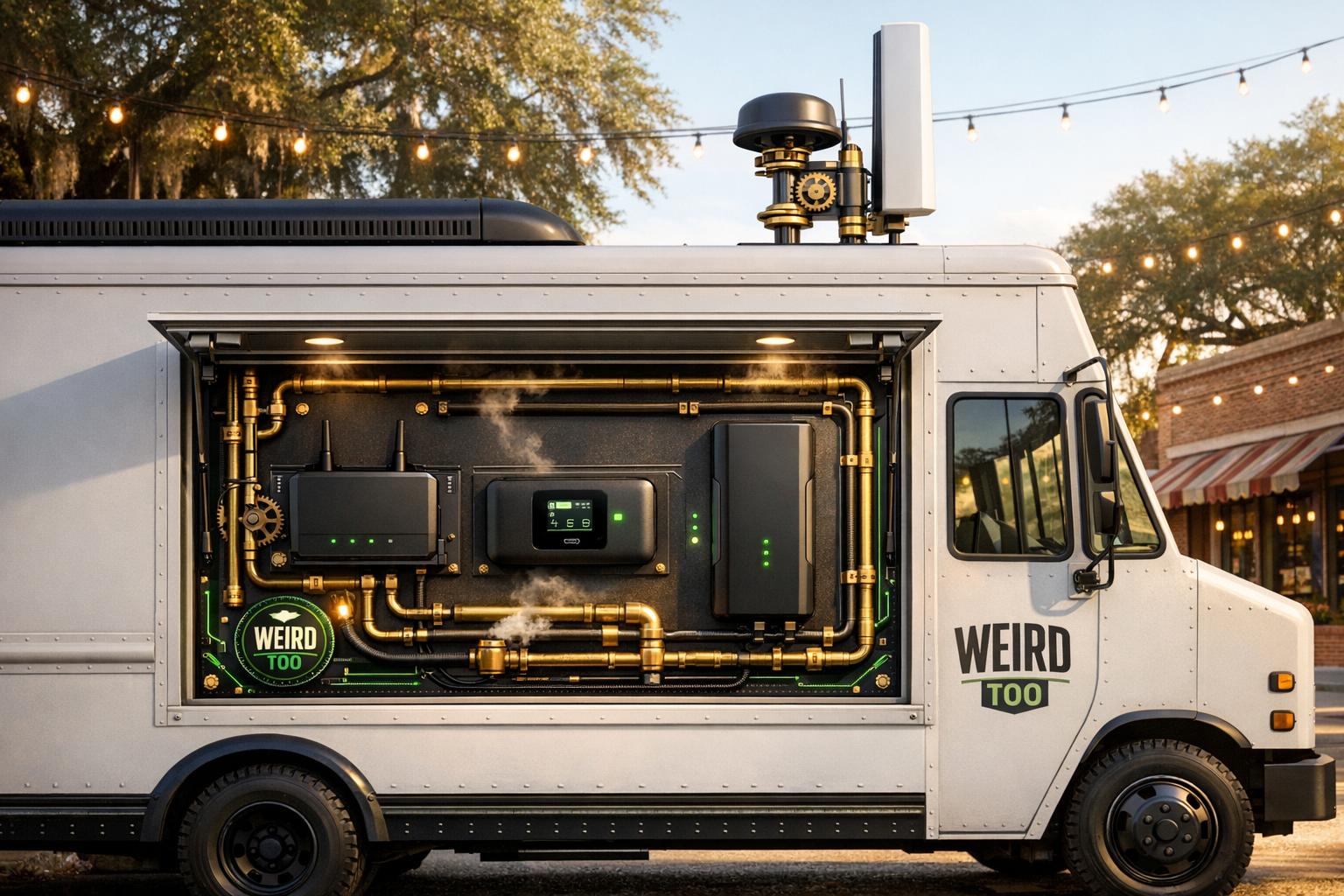
Affordable Network Equipment for Food Trucks Owners in Southern Communities
By weirdtoo·April 27, 2026·10 min read
Guide for southern food truck owners on affordable 4G/5G routers, hotspots, boosters, setup and troubleshooting.
Affordable Network Equipment for Food Trucks Owners in Southern Communities
Affordable Network Equipment for Food Trucks Owners in Southern Communities
This article provides an in-depth guide tailored for food truck owners in southern communities seeking affordable and reliable network equipment solutions. It highlights the advantages of using 4G and 5G technology, including cellular modems, routers, antennas, and signal boosters that enhance internet and cellular coverage, ensuring stable connectivity for mobile ordering, payment processing, and customer engagement. The guide emphasizes the importance of connectivity for customer satisfaction, recommending customizable device packages that fit various budgets and operational needs, from basic connections to full network setups.
It outlines popular internet connection methods such as personal mobile hotspots, dedicated MiFi devices, and standalone 4G connections, explaining their benefits and limitations for food truck operations. Additionally, it covers practical setup instructions and troubleshooting tips for non-technical users, including offline payment options to mitigate connectivity disruptions.
The article also addresses unique connectivity challenges faced by food trucks in southern and underserved rural areas, offering region-specific advice to overcome dead zones and weak signals. It provides cost comparisons and total cost of ownership insights to help small business owners make informed decisions. Finally, it offers guidance on scaling network solutions as food trucks grow, ensuring continued reliable connectivity and enhanced customer experience.
Overall, this resource equips food truck owners in southern communities with actionable knowledge to select the best affordable network equipment, maintain seamless operations, and deliver superior service to their customers.
Business Type
Food Truck
Region
Southern rural and underserved communities in the United States
Region-Specific Connectivity Challenges
Food truck owners in southern rural communities face unique connectivity challenges primarily due to significant infrastructure gaps. These areas often lack essential components such as fiber optic cables and cell towers needed for reliable high-speed internet access. The low population density and dispersed locations make it economically unappealing for internet service providers to invest in building and maintaining the necessary infrastructure. Additionally, challenging terrain and greater distances between service points further increase deployment costs. These factors contribute to unreliable or slow internet connections, which can hinder food trucks' ability to process payments, engage customers through digital platforms, and manage operations efficiently. Public-private partnerships and government initiatives like the FCC’s Rural Digital Opportunity Fund are critical to bridging this digital divide by funding broadband expansion projects. Innovative solutions such as satellite internet and fixed wireless technology are also being explored to provide more cost-effective connectivity in these underserved southern rural regions. Overall, these connectivity challenges require tailored network equipment solutions that can operate reliably in low-infrastructure environments and support the scaling needs of growing food truck businesses in these communities.
Types of Network Equipment Covered
- Router
- Switch
- Wi-Fi Extender
- Cellular Modem
- Antenna
- Signal Booster
- Wi-Fi Hotspot Device
- Security Device
Recommended Products
- MiFi devices (portable wireless routers)
- Personal mobile hotspot (phone hotspot)
- Dedicated 4G connection device with cellular data plan
- POS systems with offline payment mode
- Sierra Wireless RV55
- Peplink MAX Transit Mini
- Cradlepoint IBR900
Key Features
- Dual-band support (2.4GHz and 5GHz) for reliable connectivity
- Wi-Fi 6 compatibility for faster speeds and better performance
- Mesh network support (e.g., OneMesh) for seamless coverage expansion
- Easy installation and management for non-technical users
- Supports multiple device connections (up to 15 or more)
- Long battery life for all-day use in mobile environments
- Tethering capabilities for mobile internet access
- Cost-effective options suitable for small business budgets
- Stable and reliable internet connection to support POS and online orders
- Compact and portable design suitable for food truck setups
Product Recommendations & Rationale
For food truck owners in southern communities seeking affordable and reliable network equipment, the Peplink Max Transit Mini stands out as a top recommendation. This device is designed specifically for mobile environments, offering robust cellular connectivity with support for major US carriers such as Verizon, AT&T, T-Mobile, and U.S Cellular. Its features include multi-WAN bonding (SD-WAN) technology, which enhances speed, reliability, and security—critical for maintaining seamless point-of-sale (POS) operations, real-time menu updates, and customer engagement through Wi-Fi portals.
Peplink's product line also includes other models like the MAX BR2 PRO, MAX BR1 Mini HW3, and Max Transit Duo Pro, which provide scalable options depending on the size and connectivity needs of the food truck business. These devices are industrial-grade, ensuring durability and consistent performance in rural or underserved southern areas where connectivity can be challenging.
In addition to routers, cellular signal boosters are highly recommended to amplify weak signals in rural or remote locations, improving overall network stability and customer experience. Choosing equipment compatible with major cellular networks ensures broader coverage and better service quality.
For non-technical users, dedicated Wi-Fi devices like the Peplink Max Transit Mini offer easier setup and longer battery life compared to relying solely on smartphone hotspots, which can drain battery quickly and provide less stable connections. Step-by-step setup guides typically include placing the router in a central location within the truck, connecting to a reliable cellular data plan, and using included antennas or boosters to maximize signal strength.
Overall, investing in Peplink's mobile routers combined with cellular signal boosters provides an affordable, scalable, and user-friendly network solution tailored to the unique connectivity challenges faced by food trucks in southern communities, ensuring reliable internet access for business operations and customer satisfaction.
Performance Metrics
The recommended affordable network equipment for food truck owners in southern communities includes several Wi-Fi extenders with strong performance metrics suitable for mobile and small business use. The TP-Link RE715X Wi-Fi 6 range extender offers fast throughput on 2.4GHz and 5GHz bands, easy installation, and supports advanced Wi-Fi 6 features including 160MHz channels, making it excellent for extending coverage in challenging environments. The TP-Link RE600X is a budget-friendly option with good throughput and easy setup but lacks some advanced Wi-Fi 6 features. The Netgear EAX15 is a mesh-ready Wi-Fi 6 extender providing reliable coverage expansion. The Linksys RE7310 stands out with high Wi-Fi 6 speeds, delivering average download speeds of 132 Mbps and upload speeds of 124 Mbps in real-world tests, making it ideal for video calls and consistent connectivity in mobile setups. The TP-Link RE605X offers excellent upload and download speeds but at a higher price point. For very budget-conscious buyers, the TP-Link RE220 provides basic Wi-Fi extension capabilities. These devices collectively offer a balance of speed, range, ease of use, and affordability, ensuring reliable and scalable network connectivity for food trucks operating in southern and potentially rural or underserved areas.
Setup Difficulty
Low to moderate. Setting up affordable network equipment such as personal mobile hotspots, MiFi devices, or dedicated 4G routers for food trucks in southern communities is generally straightforward and manageable for non-technical users. Personal hotspots require minimal setup, MiFi devices offer stable connections with simple configuration, and dedicated 4G connections may involve slightly more steps but remain accessible with basic instructions. Overall, these solutions are designed to be user-friendly, providing reliable connectivity without requiring advanced technical skills.
Step-by-Step Setup Instructions
Step-by-Step Setup Instructions for Affordable Network Equipment for Food Trucks in Southern Communities
1. Using a Personal Mobile Hotspot
- Ensure your smartphone has a mobile data plan with hotspot capability.
- On your phone, go to Settings > Mobile Hotspot or Personal Hotspot.
- Turn on the hotspot feature.
- Set a secure Wi-Fi password.
- On your POS device or other equipment, search for available Wi-Fi networks.
- Connect to your phone's hotspot using the password you set.
- Limit connected devices to 2 or fewer for better stability.
- When not on the truck, turn off the hotspot to save battery and data.
sbb-itb-342b8b2
2. Setting Up a MiFi Device
- Purchase a MiFi device compatible with your cellular carrier.
- Insert a SIM card with an active data plan into the MiFi device.
- Power on the MiFi device.
- Use a computer or smartphone to connect to the MiFi device's Wi-Fi network (network name and password are usually on the device or in the manual).
- Access the MiFi device’s web interface via the provided IP address to configure settings if needed.
- Connect your POS system and other devices to the MiFi Wi-Fi network.
- Keep the MiFi device charged or plugged into a power source during operation.
3. Using a Dedicated 4G Connection
- Obtain a dedicated cellular device (phone, tablet, or router) with its own 4G data plan.
- Activate the data plan and ensure the device has good cellular signal.
- Connect your POS system or other network devices to this dedicated device via Wi-Fi or USB tethering.
- Configure the device to automatically connect to the cellular network.
- Keep the device charged and accessible for easy management.
4. Additional Tips
- Consider a POS system with offline payment mode to accept payments when internet is unavailable.
- Regularly monitor data usage to avoid overage charges.
- Test your connection in typical operating locations to ensure reliable coverage.
- Keep backup power sources like portable chargers for your network devices.
By following these steps, food truck owners in southern communities can set up affordable and reliable network connections to process payments and manage orders efficiently.
Troubleshooting Tips
Common troubleshooting advice for food truck network equipment setup in southern communities includes:
- Avoid relying solely on personal mobile phone hotspots as they may be unstable, especially if more than two devices connect or in busy areas.
- Use a MiFi device, a portable wireless router designed for cellular networks, to provide a more stable and reliable connection that is consistent regardless of who manages the truck.
- Consider a dedicated 4G connection with its own cellular data plan for reliable connectivity independent of personal phones.
- Use a POS system with offline mode as a backup to accept credit card payments when the internet is unavailable, but be cautious as some transactions may be declined later and require careful reconciliation.
- Prioritize reliable internet connectivity to avoid revenue losses and ensure smooth operations, especially if multiple employees need access.
These tips help food truck owners maintain connectivity for processing payments and online orders despite challenges like network outages or busy locations. (tableneeds.com, YouTube - Table Needs)
Price Range
Affordable network equipment for food trucks in southern communities generally falls within the $15 to $85 range for basic 4G MiFi routers and portable hotspots. Premium options with advanced features can cost up to $400, but budget-friendly solutions suitable for small food truck operations are typically available under $100.
Total Cost of Ownership (Estimated 3 Years)
$2000
Cost Comparison
The recommended network setup for food trucks in southern communities combines budget-friendly routers and Wi-Fi extenders with flexible internet service options, offering significant savings compared to premium gear without sacrificing reliability or scalability.
• Wi-Fi Extenders: The TP-Link RE600X AX1800 costs about $60, while its higher-performance sibling, the TP-Link RE715X AX3000, runs ~$90. Both deliver excellent 2.4 GHz/5 GHz coverage; the RE600X is a solid value, saving ~$30 compared to similar Wi-6 extenders (e.g., Netgear EAX15 at ~$90). (PCMag)
• Budget Routers: The TP-Link Archer AX21 AX1800 dual-band router is available for ~$53 (retail $100), making it the cheapest tested Wi-Fi 6 option and undercuts competing budget routers (e.g., TP-Link BE230 Wi-Fi 7 at $110) by nearly 50%. Its mesh-ready design and basic parental controls add value for growing food truck operations. (PCMag)
• Internet Service: Verizon prepaid 4G/5G mobile router plans start at ~$30/month for 50 GB data, while T-Mobile prepaid plans with 100 GB run ~$40/month. Starlink Roam (mobile plan) costs $50/month with no long-term contract but requires a $350 Mini dish. The trade-off: Starlink offers unbeatable rural coverage and speeds up to 100 Mbps for a $350 upfront investment, whereas traditional carriers need no hardware purchase but may drop out in low-signal areas. ([User reports], PCMag)
• Security Solutions: Entry-level network security (firewall/UTM) can be self-hosted using open-source software on a $100 mini-PC (e.g., Protectli Vault) versus a commercial Ubiquiti EdgeRouter at ~$140. For physical premises protection, SimpliSafe’s business package starts at $250 equipment + $25/month monitoring, compared with ADT at $269 equipment + $25–$50/month. SimpliSafe is the most cost-effective for basic intrusion detection. (Security.org)
Overall, this setup totals ~$213 upfront (AX21 router + RE600X extender + mini-PC firewall) versus ~$350 for a single premium kit, and monthly connectivity costs of $30–$50 (carrier) or $50 (Starlink Roam), compared with $80–$120 for fixed Starlink residential plans. This delivers reliable coverage, easy scaling, and the best value for money for southern-region food trucks.
Scalability Advice
To scale and upgrade network solutions for food trucks in southern communities, start by assessing your specific connectivity needs including data usage, coverage areas, and number of connected devices. Choose mobile internet solutions like mobile hotspots, MiFi devices, or dedicated 4G connections based on coverage and reliability. As your business grows, consider upgrading to higher bandwidth plans and devices that support multiple simultaneous connections. Implement backup internet options to ensure continuous operations during outages. Use cloud-based services for efficient remote management and keep device software updated for security and performance. Offering customer Wi-Fi and digital loyalty programs can enhance engagement. Prioritize portable, easy-to-use equipment that integrates well with your POS and other systems, ensuring seamless scaling as you expand locations or increase staff. Regularly monitor data usage and adjust plans accordingly to avoid interruptions and manage costs effectively. This approach ensures reliable, scalable, and cost-efficient network connectivity tailored to the unique challenges of mobile food businesses in southern and underserved areas.
Support and Warranty
TP-Link offers a limited warranty covering defects in material or workmanship for their network equipment, including routers, switches, and Wi-Fi extenders. Warranty periods vary by product category: business-class switches with steel chassis have a 3-year warranty, plastic chassis switches have 2 years, Omada Pro switches have a limited lifetime warranty, and most Wi-Fi routers and extenders have 2 years. The warranty applies only to the original purchaser with proof of purchase and excludes damage from misuse, modifications, or unauthorized repairs. Replacement products may be refurbished and warranty periods are not extended with replacements. (https://www.tp-link.com/us/support/replacement-warranty) NETGEAR provides a limited hardware warranty for their network products, including routers, switches, and security devices. Warranty length varies by product and is valid only for the original purchaser with proof of purchase. Products must be purchased from authorized resellers to qualify. The warranty covers defects in materials and workmanship but excludes damage from misuse, unauthorized modifications, or removal of serial numbers. NETGEAR offers a warranty registration process and requires an RMA number for returns. Replacement products may be refurbished. (https://www.netgear.com/about/warranty)
Where to Buy
Related Weird Too links
Keep following this lane
Current contact path
Need Weird Network WiFi, custom apparel, or scoped help?
Use the contact form; removed product, checkout, research, and newsletter funnels stay offline.